1853 G50C BG-421 (Regular Strike)
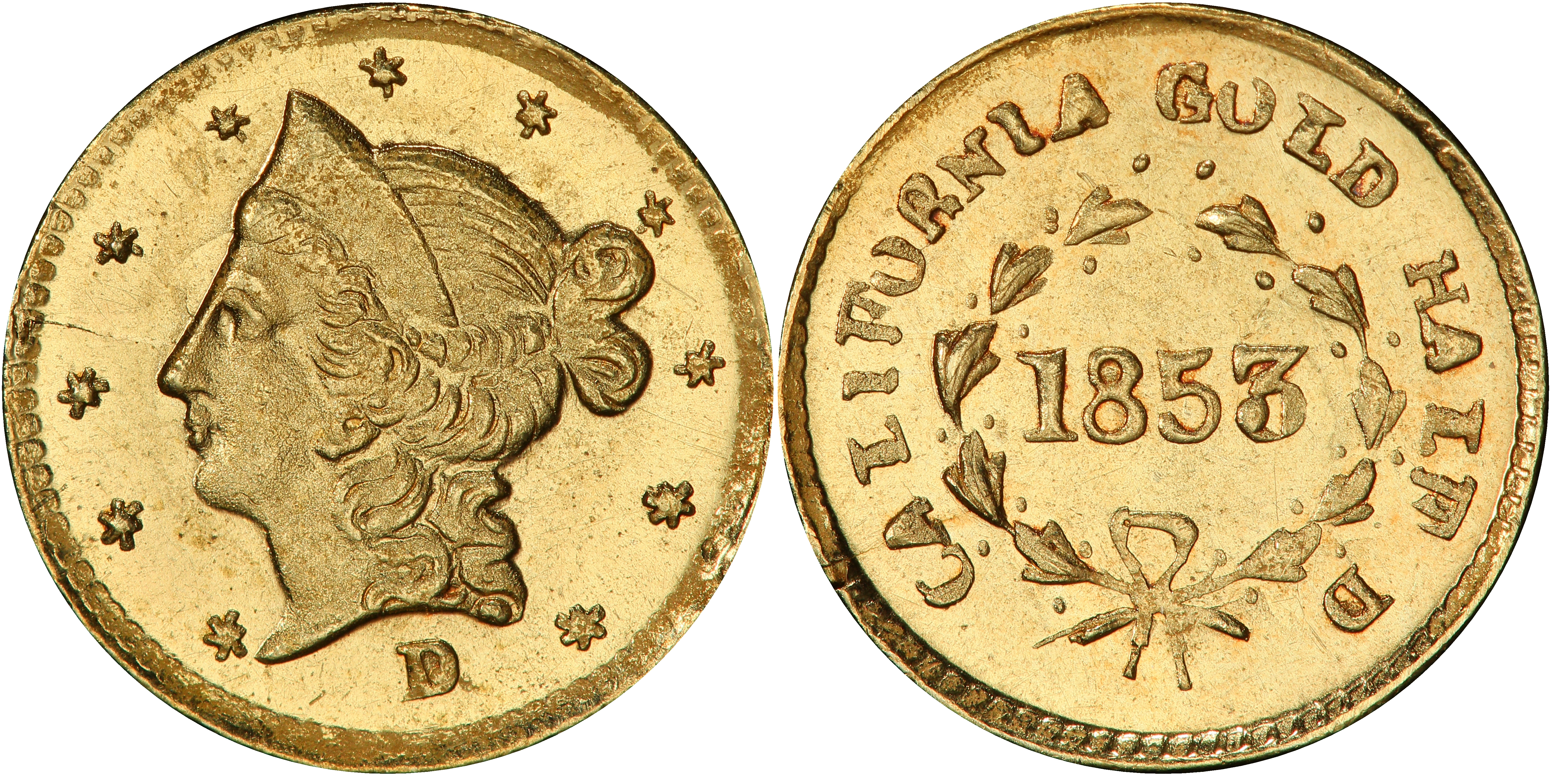
Obverse & Reverse
The 1853 G50C BG-421 Half Dollar is a quintessential artifact from the socio-economic maelstrom of the California Gold Rush. Following the discovery of gold at Sutter's Mill in 1848, a massive influx of over 300,000 people descended upon California, creating a vibrant but chaotic economy. While immense quantities of gold dust and large-denomination private ingots and coins circulated, there was a crippling shortage of small-denomination coinage for everyday transactions. A pinch of gold dust, the default medium of exchange, was an imprecise and unsatisfactory solution for buying a drink or a meal. This monetary vacuum spurred private jewelers and metallurgists in San Francisco to begin striking their own fractional gold coins in 1852. These pieces, now categorized by numismatists as 'Period One' (1852-1857) issues, were initially intended to facilitate commerce. They were not clandestine issues; rather, they were a tolerated necessity in a frontier economy geographically isolated from the main U.S. Mints. The BG-421, like its contemporaries, was produced by hand-striking, with dies placed in a block and struck with a sledgehammer, resulting in variable strike quality. While initially serving a commercial need, the novelty and small size of these gold pieces quickly made them popular as souvenirs that could be easily mailed back East. This shift in purpose meant that intrinsic value became less important than face value, and many Period One issues are consequently underweight for their stated denomination. The United States government officially outlawed private coinage with the Coinage Act of 1864, but by then, the establishment and full production of the San Francisco Mint had already rendered most private issues obsolete. The BG-421 survives today as a tangible link to this unregulated and innovative period of American monetary history, representing the ingenuity of private enterprise in response to a critical economic need.
Associated EventCalifornia Gold Rush
Reason For MintingTo alleviate a severe shortage of small-denomination coinage for daily commercial transactions in Gold Rush-era California.
Minter HistoryThe specific minter for the BG-421 variety remains unidentified, a common characteristic for many Period One California Fractional Gold pieces. Production was not the work of a single, large entity but rather numerous jewelers and metallurgists operating in San Francisco. Prominent known minters of the era include Antoine Louis Nouizillet, M. Deriberpe, Pierre Frontier, and Eugene Deviercy, often working in partnerships. These artisans, many of French origin, used their skills to create dies and strike coins to meet the pressing local demand. Their operations were typically small-scale, using hand-operated presses or simple hammer-striking methods, which accounts for the frequent die breaks, varied strike sharpness, and overall crude charm of many surviving examples.
Historical SignificanceAs a 'Period One' issue, the BG-421 is numismatically significant for representing the initial wave of fractional gold coins genuinely intended to address the coinage shortage. Unlike later 'Period Two' and 'Three' issues which were primarily souvenirs, these early pieces likely saw some circulation, evidenced by the existence of worn examples. They are a testament to the ad-hoc economic solutions developed on the American frontier and are a foundational element of the U.S. territorial and private gold series.
BG-421
Denomination50 Cents
Minting Period1853
Assayer/MinterUnknown
Geographic OriginSan Francisco, California
Obverse DescriptionA fairly large bust of a left-facing Liberty Head, stylistically similar to the contemporary U.S. federal gold coinage. Liberty's hair is tied in a bun. The portrait is surrounded by thirteen six-pointed stars, typically unevenly spaced and oriented.
Obverse InscriptionNo inscription.
Reverse DescriptionThe denomination 'HALF DOL.' is centrally located within a simple wreath composed of two branches tied by a bow at the bottom. Outside the wreath, the legend 'CALIFORNIA GOLD' curves along the upper periphery. The date '1853' is positioned at the bottom, below the wreath.
Reverse InscriptionCALIFORNIA GOLD / HALF DOL. / 1853
CompositionGold
Stated Fineness Actual FinenessTypically struck from native California gold, which often contained a natural alloy of silver, resulting in a fineness of approximately .850 to .885.
Weight0.25 grams
Diameter10.50 mm
EdgePlain
Unknown
Survival Estimate75-125
Rarity ScaleR-5
The BG-421 is highly sought after as an attractive and representative example of a 'Period One' Liberty Head half dollar. Its appeal lies in its direct connection to the California Gold Rush, its classic design, and its relative scarcity. It offers a tangible piece of Old West history at a more accessible price point than the larger territorial gold coins.
Key VarietiesThe BG-421 itself is a specific die marriage (variety). No major sub-varieties, patterns, or official restrikes are known from the original period of issue. The primary variations among surviving examples are in strike quality, planchet thickness, and the presence of die cracks or other imperfections resulting from the crude hand-striking process.
Authentication TipsAuthentic BG-421 pieces should be compared against high-resolution images from major auction archives or grading service population reports. Key diagnostics include the specific positioning of the Liberty bust relative to the stars and the alignment of the reverse lettering and date. Many modern replicas exist; these are often underweight, have a soapy or cast-like appearance, incorrect luster, and may feature a bear on the reverse (a fantasy element not found on genuine denominated fractionals). True Period One pieces were struck, not cast, and should exhibit corresponding sharpness and flow lines under magnification. Professional third-party grading is highly recommended.
Shopping ConsiderationsA premium quality BG-421 for its grade will exhibit a sharp strike, particularly on Liberty's hair details and the numerals of the date. Surfaces should be free of distracting planchet flaws, cleaning, or tooling. Original, unmolested 'skin' with some remaining mint luster is highly desirable and commands a significant premium. Given the hand-production method, some softness of strike in peripheral areas is common and acceptable, but central details should be bold. Avoid examples that have been holed or used in jewelry, as this severely impacts value. Eye appeal is paramount; seek out coins with a pleasing, uniform color and minimal distracting marks.
A coin's grade is its condition, rated on a 1-70 scale. For rare coins, this is the most critical factor in determining value, as a tiny difference in preservation can mean a huge difference in price.
Relevant Grade TypesAll original 1853 BG-421 half dollars were struck as business strikes intended for potential circulation. They are found in Circulated grades (AG-3 to AU-58) and Mint State grades (MS-60 to MS-70). No proofs were struck during the original period of issue, and there are no known later-date proof restrikes of this specific variety.
Mint State CharacteristicsUncirculated examples of BG-421 often display a soft, satiny luster characteristic of early California gold. Strike quality is a key differentiator in Mint State; many are softly struck, especially on the stars and wreath details. A well-struck coin with sharp central details on both obverse and reverse is considered premium. Due to the small size and handling, even uncirculated pieces may show minor planchet imperfections or light contact marks; however, a 'gem' quality piece (MS-65 or higher) would be exceptionally clean with vibrant luster and a sharp strike.
Circulated Wear PatternsWear first appears on the highest points of the design. On the obverse, this includes Liberty's cheek, the hair above the ear, and the eyebrow. On the reverse, the highest points of the wreath's leaves and the numerals in the date will show the first evidence of friction. In lower grades (VG and below), the stars will become faint, and the finer details of the wreath will merge.
Key Factors For ValueThe primary drivers of value for a BG-421 are grade and surface quality. An example with original, uncleaned surfaces will always be worth significantly more than a cleaned or polished coin of the same grade. Strike sharpness is the next critical factor; a coin with a bold strike can command a premium over a weakly struck example in the same numerical grade. Eye appeal, encompassing attractive natural toning and a lack of distracting marks, is also crucial. Certification by a top-tier grading service (PCGS or NGC) is standard for this series, and a CAC sticker indicating premium quality for the grade adds a further price premium.
PCGS Price Guide
| Grade | Price | Population |
|---|---|---|
| 25 | N/A | 1 |
| 40 | $200.00 | 2 |
| 45 | $210.00 | 2 |
| 45+ | $210.00 | N/A |
| 50 | $220.00 | 1 |
| 50+ | $225.00 | N/A |
| 53 | $235.00 | 1 |
| 53+ | $240.00 | N/A |
| 55 | $250.00 | 7 |
| 55+ | $255.00 | N/A |
| 58 | $275.00 | 21 |
| 58+ | $280.00 | N/A |
| 60 | $300.00 | 7 |
| 61 | $400.00 | 8 |
| 62 | $500.00 | 31 |
| 62+ | $550.00 | N/A |
| 63 | $650.00 | 26 |
| 63+ | $725.00 | N/A |
| 64 | $950.00 | 12 |
| 64+ | $1,100.00 | N/A |
| 65 | $1,500.00 | 6 |
| 65+ | $2,100.00 | 1 |
| 66 | $3,750.00 | 1 |