1854 G25C BG-108 (Regular Strike)
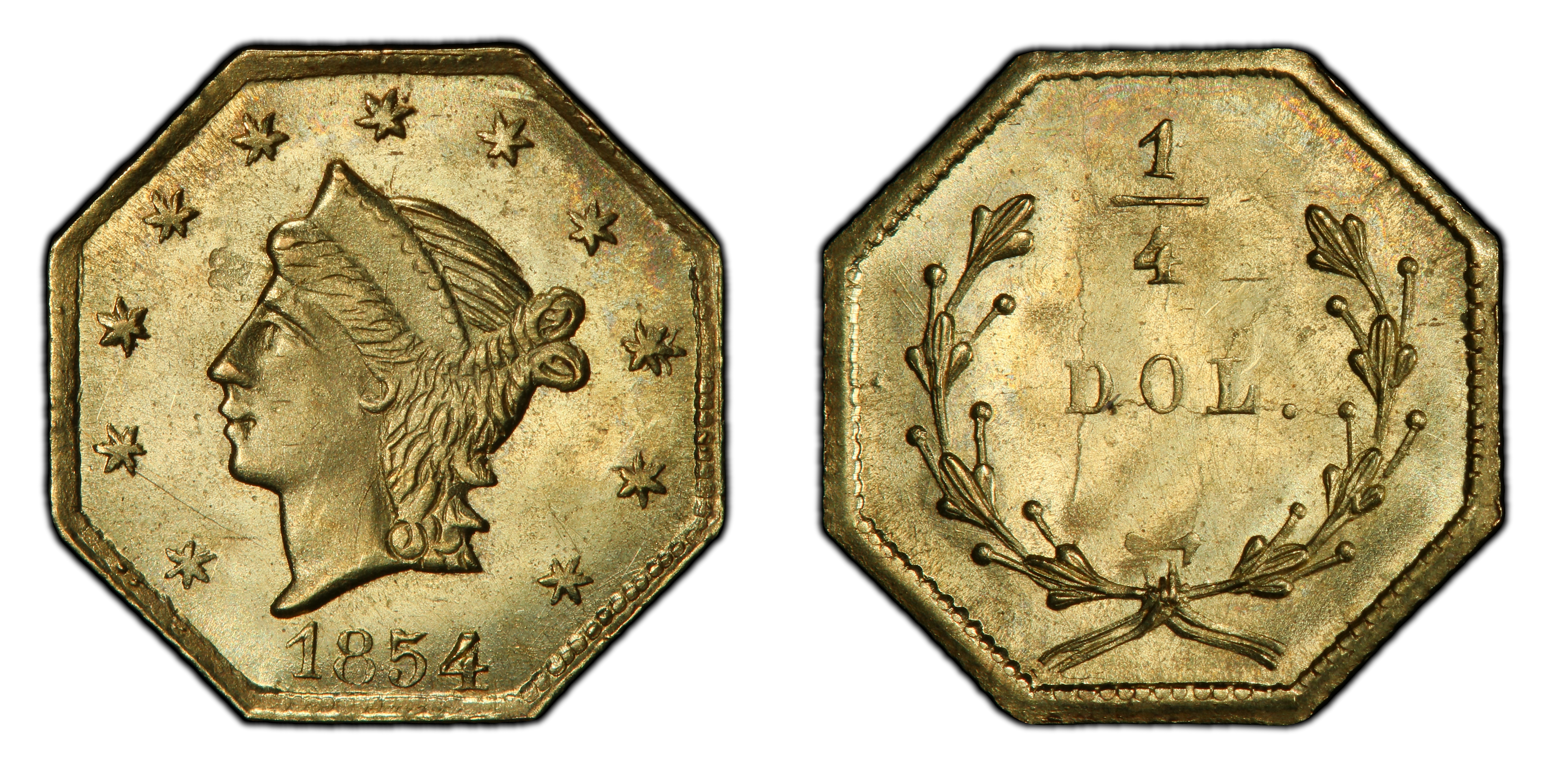
Obverse & Reverse
The 1854 BG-108 Quarter Dollar is a tangible relic from the chaotic and economically volatile peak of the California Gold Rush. Following the discovery of gold in 1848, a massive influx of prospectors and merchants descended upon California, creating a vibrant but fundamentally flawed economy. While vast quantities of gold dust and large-denomination private coinage from assayers like Moffat & Co. circulated, there was a severe and crippling shortage of small-denomination specie for everyday transactions. A pinch of gold dust for a drink or loaf of bread was an imprecise and unsatisfactory system, and the U.S. Mint's new San Francisco branch, which only opened in 1854, initially focused on larger denominations and could not meet the overwhelming local demand for pocket change. Into this monetary vacuum stepped a number of jewelers and artisans, primarily in San Francisco. Between 1852 and 1857 (a period now classified by numismatists as 'Period One'), these private minters began striking their own fractional gold coins in 25-cent, 50-cent, and one-dollar denominations. Unlike the later 'Period Two' issues, which were largely made as souvenirs, these early Period One pieces were created out of genuine commercial necessity and are believed to have seen actual, albeit limited, circulation. The BG-108 is attributed to Antoine Louis Nouizillet, a French jeweler whose work is noted for its superior quality and workmanship compared to many of his contemporaries. Struck in 1854, the same year the federal mint opened its doors, this piece represents a direct private-sector response to a public need the government was not yet equipped to handle. These tiny octagonal coins would have facilitated minor commerce, allowing for more precise payment in a society still wrestling with the transition from a barter-based gold dust economy to a standardized monetary system. Their existence was short-lived; by 1856-1857, the San Francisco Mint was producing enough federal silver and gold coinage to render these private issues obsolete. Most were eventually withdrawn, melted, or lost, contributing to their present-day rarity.
Associated EventCalifornia Gold Rush
Reason For MintingTo alleviate a severe shortage of small-denomination coinage for daily commercial transactions in Gold Rush-era San Francisco.
Minter HistoryAntoine Louis Nouizillet was a French jeweler and watchmaker who operated in San Francisco during the Gold Rush. Along with other craftsmen like Pierre Frontier and Eugene Deviercy, Nouizillet was a key producer of 'Period One' California Fractional Gold. His pieces are often distinguished by their relatively high quality of engraving and striking, suggesting a greater level of skill and better equipment than some other private minters. He was also involved in partnerships, including 'Nouizillet and Routhier' (N.R.), and his work represents some of the finest examples of these necessary and historically significant private issues.
Historical SignificanceThe BG-108 is a prime example of a 'Period One' California Fractional Gold coin, representing a private solution to a government failure in providing adequate coinage for a booming economy. It underscores the desperation for small change during the Gold Rush and the ingenuity of local artisans. As an issue from 1854, it competed directly with the first coins from the new San Francisco Mint, making it a fascinating artifact of America's turbulent monetary transition on the West Coast.
BG-108
Denomination$0.25
Minting Period1854
Assayer/MinterAntoine Louis Nouizillet
Geographic OriginSan Francisco, California
Obverse DescriptionA fairly well-executed Liberty Head facing left, her hair tied in a bun at the back. She is surrounded by seven six-pointed stars, with four to the left and three to the right. The portrait style is finer and more detailed than many earlier fractional issues from other makers.
Obverse Inscription Reverse DescriptionA simple, utilitarian design featuring the fraction '1/4' and the word 'DOLLAR' within a circle of beads or pellets. The date '1854' is placed below the denomination, also within the circle. The overall impression is one of clarity and function.
Reverse Inscription1/4 DOLLAR 1854
CompositionGold
Stated Fineness Actual FinenessTypically around .880 fine, consistent with unrefined native California gold which contained a high percentage of silver.
Weight0.25 grams
Diameter9.50 mm
EdgePlain
Unknown
Survival EstimateFewer than 75 known, based on NGC and PCGS population reports totaling around 50-60 graded examples across all conditions.
Rarity ScaleR-4 (Low Rarity-4)
This coin is highly sought after as a genuine 'Period One' circulating issue, not a later souvenir. Its appeal is enhanced by its octagonal shape, the historic date of 1854 (coinciding with the opening of the SF Mint), and its attribution to the respected minter Antoine Nouizillet. It represents a tangible link to the daily life of a 49er.
Key VarietiesThere are no major varieties of the BG-108 itself, as it is a specific die marriage. No known restrikes or patterns exist. The primary 'variations' for collectors are in die state and strike quality, with early, sharp strikes being the most desirable. It is part of the larger series of octagonal quarter dollars, which includes numerous other BG numbers with different star counts and portrait styles from various makers.
Authentication TipsAuthentic Period One pieces like the BG-108 were struck, not cast, so they should exhibit sharp details and defined edges, not the soft, soapy look of many cast counterfeits. The weight should be very close to 0.25 grams. Crucially, genuine pieces from this era bear a denomination (e.g., 'DOLLAR'). Many later fakes and souvenir tokens omit the word 'DOLLAR' and replace it with 'CALIFORNIA GOLD' or 'CHARM' to evade anti-counterfeiting laws. The specific die markers, star positions, and letter shapes of the BG-108 should be carefully compared to high-resolution images of certified examples.
Shopping ConsiderationsA premium quality BG-108 will have a bold strike, with clear details on Liberty's hair and the stars. Weakness of strike is common, so a fully struck piece commands a significant premium. Look for original, uncleaned surfaces, which often have a slightly reddish or greenish-gold hue from the native alloys. Avoid examples that are bright and shiny from harsh cleaning or polishing. Due to their small size, these coins are very susceptible to damage; check carefully for scratches, rim bumps, or any signs of having been mounted in jewelry. A coin with smooth, problem-free surfaces and strong eye appeal is far more desirable than a slightly higher-grade example that has been cleaned or damaged.
A coin's grade is its condition, rated on a 1-70 scale. For rare coins, this is the most critical factor in determining value, as a tiny difference in preservation can mean a huge difference in price.
Relevant Grade TypesAll original 1854 BG-108 examples are business strikes intended for circulation. They are found in Circulated grades (AG-3 to AU-58) and, more commonly for this issue, in Mint State (MS-60 to MS-70) as many were saved as curiosities. No proofs were struck during the original minting period, and there are no known later-date proof restrikes of this specific variety.
Mint State CharacteristicsUncirculated examples are typically found in the MS-62 to MS-64 range. The quality of the strike is the most important factor; many specimens are softly struck in the center of the obverse and reverse. Luster is typically satiny rather than deeply prooflike. Due to the softness of the gold and the primitive production methods, it is common to see minor planchet flaws or adjustment marks made before striking. These are generally accepted and should not be confused with post-strike damage.
Circulated Wear PatternsWear first appears on the highest points of the coin: Liberty's cheek, hair above the eye, and the top of her ear. On the reverse, the fraction '1/4' and the date will show initial flatness. In grades below VF, the stars will begin to merge with the fields and the legends on the reverse will become soft. Heavily worn examples will have a flattened, indistinct portrait.
Key Factors For ValueFor the BG-108, the primary value drivers are strike and surface quality. A sharply struck coin with minimal distracting marks will always command a strong premium. Eye appeal is crucial; collectors favor pieces with attractive, original color and luster over those that are bright from cleaning. Problem-free surfaces are paramount, as any damage significantly impacts value. Given the prevalence of counterfeits in the fractional gold series, certification by a top-tier service like PCGS or NGC is virtually required for any significant transaction, with a CAC sticker adding a further premium for exceptional quality within the assigned grade.
PCGS Price Guide
| Grade | Price | Population |
|---|---|---|
| 55 | $250.00 | 5 |
| 55+ | $255.00 | N/A |
| 58 | $270.00 | 10 |
| 58+ | $280.00 | N/A |
| 60 | $300.00 | 4 |
| 61 | $375.00 | 10 |
| 62 | $425.00 | 50 |
| 62+ | $450.00 | N/A |
| 63 | $500.00 | 42 |
| 63+ | $575.00 | N/A |
| 64 | $900.00 | 22 |
| 64+ | $1,000.00 | 1 |
| 65 | $1,100.00 | 3 |
| 65+ | $1,350.00 | N/A |
| 66 | $2,200.00 | 1 |