1853 G50C BG-415 (Regular Strike)
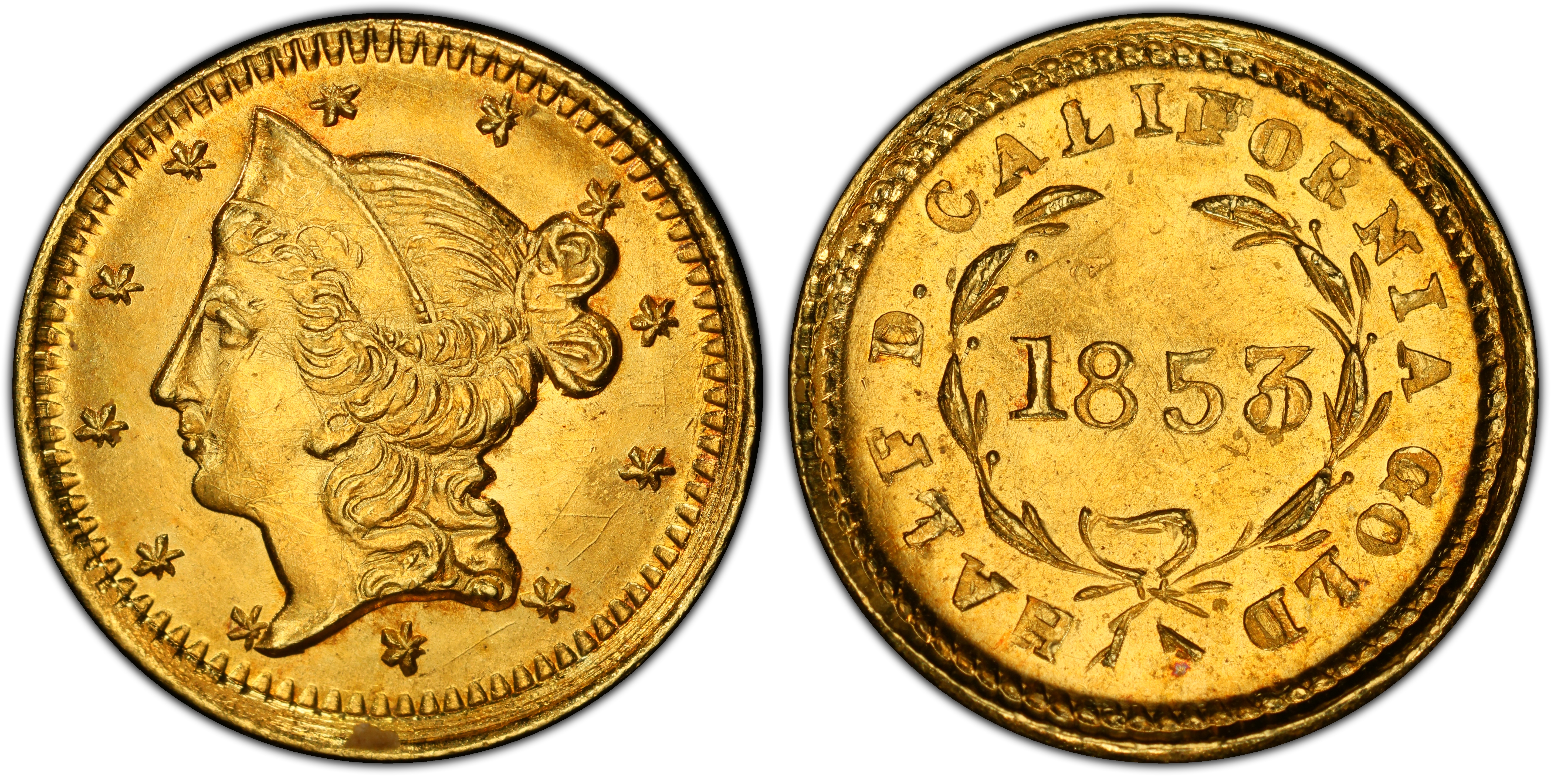
Obverse & Reverse
The 1853 BG-415 fifty-cent piece is a quintessential artifact of the California Gold Rush, born from a severe and persistent shortage of small-denomination coinage. In the early 1850s, San Francisco's economy was supercharged with gold dust and large private ingots, yet daily commerce was crippled by the scarcity of coins for minor transactions. A 'pinch' of gold dust, notoriously inexact, was often used for a drink or a small purchase, leading to constant disputes. While the U.S. Assay Office and private minters like Moffat & Co. produced larger denomination coins, the federal government's response was slow; the San Francisco Mint would not be fully operational until 1854. Into this monetary vacuum stepped a number of entrepreneurial jewelers and metalworkers, many of whom were French immigrants. Between 1852 and 1857 (the era now classified by numismatists as 'Period One'), these craftsmen began striking their own fractional gold coins in 25-cent, 50-cent, and dollar denominations. These pieces were not government-sanctioned but were tolerated out of sheer necessity. The BG-415 is a prime example of these utilitarian issues. Struck anonymously, it was intended to circulate and facilitate trade in the booming metropolis. Its design, a small Liberty head, mimicked federal gold coinage to inspire public confidence. However, like most of its contemporaries, it was intrinsically worth less than its face value, a fact the inflated Gold Rush economy could temporarily absorb. These coins saw genuine, if brief, circulation before the arrival of federal coinage rendered them obsolete. Many were likely lost or melted, but their transition into keepsakes and souvenirs of the Gold Rush ensured the survival of a small number. The BG-415's existence is a direct testament to the chaotic, innovative, and unregulated economic environment of Gold Rush California, where private enterprise filled a crucial void left by the federal government.
Associated EventCalifornia Gold Rush
Reason For MintingTo alleviate a severe shortage of small-denomination coinage for daily commercial transactions in Gold Rush-era San Francisco.
Minter HistoryThe specific minter of the BG-415 variety is unknown. Period One California fractional gold coins were produced by a number of San Francisco jewelers and artisans, many of whom did not sign their work. Prominent known makers of other similar pieces from this period include Antoine Louis Nouizillet, Pierre Frontier & Eugene Deviercy, and M. Deriberpe. These craftsmen used their metallurgical and engraving skills to meet a pressing economic need, operating in a legally gray area out of necessity. The anonymity of the BG-415's maker is characteristic of many issues from this early, chaotic period of private minting.
Historical SignificanceAs a 'Period One' issue, the BG-415 is a genuine artifact of commerce from the peak of the Gold Rush, not a later souvenir piece. It represents a fascinating chapter in American monetary history where private citizens minted their own currency to solve a critical economic problem, highlighting the limitations of federal infrastructure on the remote West Coast.
N/A
Denomination50 Cents
Minting Period1853
Assayer/MinterUnknown Private Minter
Geographic OriginSan Francisco, California
Obverse DescriptionA small, somewhat crudely rendered bust of Liberty faces left, her hair tied in a bun. She is surrounded by ten six-pointed stars. The date, 1853, appears below the bust. The rendering is typical of the simplified designs used by private minters to emulate federal coinage.
Obverse Inscription1853
Reverse DescriptionThe central device is the denomination '1/2' which is enclosed within a delicate wreath of two olive branches. The wreath is open at the top. The legend 'CALIFORNIA GOLD' encircles the wreath along the upper periphery.
Reverse InscriptionCALIFORNIA GOLD 1/2
CompositionGold
Stated Fineness Actual FinenessVariable, typically around .800 to .885 fine, often alloyed with native silver and copper.
Diameter10.50 mm
EdgePlain
Unknown, but very small.
Survival Estimate31-75 (per R-5 rating)
Rarity ScaleR-5 (Low R-5)
The BG-415 is highly sought after as a genuine 'Period One' circulating issue from the Gold Rush. Its appeal lies in its historical importance, rarity, and connection to the romanticized 'Wild West' era of American history. Unlike the more common 'Period Two' souvenir pieces, it was made to be, and was, actually used as money.
Key VarietiesThe primary variety is the regular strike BG-415. A major related variety is the BG-415A, which is of extreme rarity (R-9). The BG-415A is differentiated by die characteristics, including a different date position and star placement. No later-date restrikes or special collector issues of the BG-415 dies are known to exist.
Authentication TipsAuthentic examples exhibit a somewhat crude but sharp strike from hand-engraved dies. Look for die polish lines and a characteristic 'funky' luster often seen on these issues. The ten stars on the obverse should be checked for proper placement and form. Counterfeits are common in this series and are often either cast, showing a soft, porous appearance, or struck from modern dies with incorrect lettering fonts and a lifeless, tool-marked look. Many fakes are gold-plated brass. Genuine pieces will not have a bear on the reverse or say 'CHARM' or 'TOKEN'.
Shopping ConsiderationsFor a premium quality example, seek a specimen with a bold strike, especially on Liberty's hair details and the numerals of the date. Original, uncleaned surfaces are paramount; many examples have been harshly cleaned or polished over the years, which drastically reduces their value. Look for attractive, slightly reddish or orange-gold toning that is indicative of original surfaces. Small planchet flaws or adjustment marks are common and often acceptable for the grade, but avoid pieces with significant scratches, rim bumps, or evidence of having been mounted in jewelry. Central weakness is common, but a coin with strong central details commands a significant premium.
A coin's grade is its condition, rated on a 1-70 scale. For rare coins, this is the most critical factor in determining value, as a tiny difference in preservation can mean a huge difference in price.
Relevant Grade TypesAll original 1853 BG-415 coins were struck as business strikes intended for circulation. They are found in Circulated grades (AG-3 to AU-58) and, more rarely, in Mint State grades (MS-60 to MS-70). No proofs were struck during the original minting period, and there are no known later-date Proof restrikes from these dies.
Mint State CharacteristicsAn uncirculated BG-415 will exhibit full mint luster, which is typically soft and satiny rather than bright and flashy. Strike quality varies; many show some weakness in the center of the obverse (Liberty's cheek) and reverse (the fraction). High-end examples are prized for having a sharp strike across all elements. Due to the primitive minting process and soft gold, even Mint State examples will often display minor planchet imperfections or small, scattered contact marks that do not impede the overall eye appeal.
Circulated Wear PatternsWear first appears on the highest points: Liberty's hair above the eye and on her cheekbone. On the reverse, the fine details of the wreath's leaves will show flatness first, followed by the numerals in the fraction. On lower-grade examples (Fine and below), the date and stars will begin to merge with the fields, and the legend on the reverse will become faint.
Key Factors For ValueThe primary driver of value is grade, followed closely by surface quality. An example with original, undisturbed luster and pleasing eye appeal will always be worth significantly more than a cleaned or polished coin of the same technical grade. Sharpness of the strike is a key differentiator; a well-struck coin is much more desirable. Finally, because of the prevalence of counterfeits and quality issues, certification by a top-tier grading service (PCGS or NGC) is nearly essential for market acceptance. A CAC sticker on a certified coin indicates premium quality for the grade and often results in a substantial price premium.
PCGS Price Guide
| Grade | Price | Population |
|---|---|---|
| 50 | $250.00 | 1 |
| 53 | $260.00 | N/A |
| 55 | $275.00 | 2 |
| 55+ | $280.00 | N/A |
| 58 | $300.00 | 5 |
| 58+ | $350.00 | N/A |
| 60 | $450.00 | 2 |
| 61 | $525.00 | 2 |
| 62 | $650.00 | 12 |
| 62+ | $750.00 | N/A |
| 63 | $1,400.00 | 12 |
| 63+ | $1,500.00 | N/A |
| 64 | $1,750.00 | 11 |
| 64+ | $2,500.00 | N/A |
| 65 | $3,000.00 | 3 |
| 65+ | $3,500.00 | N/A |
| 66 | $4,250.00 | 1 |