1876 G50C BG-1060, PL (Regular Strike)
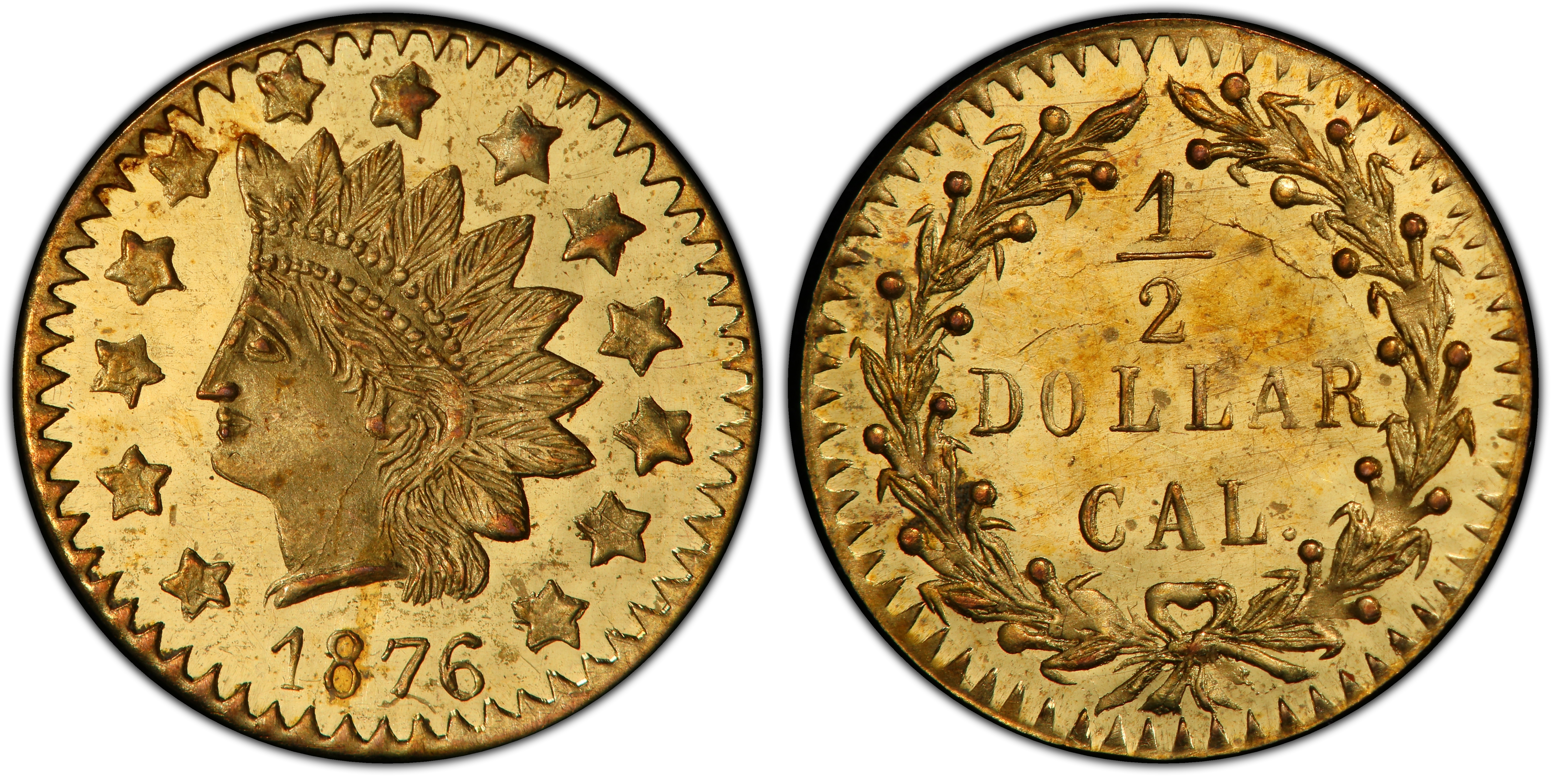
Obverse & Reverse
The 1876 BG-1060 50 Cent piece emerges from the second great period of California fractional gold production (1859-1882), a fascinating era that followed the initial wave of Gold Rush coinage. By the mid-1870s, the fever of the initial rush had subsided, but California's economy remained robust and distinct from the rest of the nation. A chronic shortage of small denomination federal coinage persisted on the West Coast, making daily transactions for minor goods and services cumbersome. Unlike the earlier issues which were more directly intended to supplement official currency, these later pieces, often termed 'jeweler's issues,' were produced by jewelers and craftsmen like C.F. Mohrig. These pieces served a dual purpose: they partially alleviated the coin shortage while also catering to a growing market for souvenirs and keepsakes among locals and the increasing number of tourists visiting the romanticized 'Golden State.' The year 1876 was particularly significant as it marked the Centennial of the United States, an event that spurred the production of numerous commemorative and souvenir items nationwide, a trend that likely bolstered the market for these attractive miniature gold coins. The BG-1060, with its crisp Indian Head design, was a product of this environment. It was struck not with the crude hammer method of the 1850s, but with more sophisticated coining presses, allowing for a sharper, more uniform product often exhibiting prooflike surfaces. However, their legal status was ambiguous; the Private Coinage Act of 1864 had prohibited private currency, but enforcement was lax until the early 1880s, allowing minters like Mohrig to operate in a grey area of the law, producing these 'tokens' that functioned as de facto currency in local commerce before becoming cherished collectibles.
Associated EventPost-Gold Rush California Commerce
Reason For MintingTo alleviate a persistent shortage of small change in California and to serve as popular souvenirs for locals and tourists.
Minter HistoryChristoph Ferdinand Mohrig was a prominent German-born jeweler, watchmaker, and lapidary who operated a business in San Francisco from the 1850s into the 1880s. He was one of the most prolific and skilled producers of 'Period Two' California fractional gold. Unlike some of the clandestine early minters, Mohrig was a well-established public figure whose name appeared in city directories. His issues are known for their high-quality strikes and consistent design elements. He produced a wide variety of denominations and designs, often featuring Indian heads or Liberty portraits, and his work is considered among the most technically proficient of the private California minters of his era. His pieces, including the BG-1060, are a testament to the sophisticated craftsmanship that had developed in San Francisco's jewelry trade by the 1870s.
Historical SignificanceThe BG-1060 is a significant representation of the later period of private California coinage, illustrating the evolution from utilitarian currency substitutes to skillfully crafted commercial and souvenir pieces. It reflects the persistence of a localized economy and the lax enforcement of federal coinage laws decades after the Gold Rush. As a product of C.F. Mohrig, it stands as an artifact of one of the era's most important and artistic private minters.
N/A
DenominationG50C
Minting Period1876
Assayer/MinterChristoph Ferdinand Mohrig
Geographic OriginSan Francisco, California
Obverse DescriptionA stylized head of a Native American princess facing left, adorned with a feathered headdress. The portrait is surrounded by 13 six-pointed stars, representing the original colonies.
Obverse Inscription[No Inscription]
Reverse DescriptionThe denomination '50 CENTS' is enclosed within a wreath composed of two branches tied with a ribbon at the bottom. The legend 'CALIFORNIA GOLD' encircles the top periphery of the wreath.
Reverse InscriptionCALIFORNIA GOLD / 50 CENTS
CompositionGold
Stated Fineness Actual FinenessVaries, but typically between .500 and .800 fine gold.
Weight0.25 grams
Diameter10.00 mm
EdgePlain
Unknown
Survival Estimate75-150
Rarity ScaleHigh R-5
This variety is highly sought after due to its attractive Indian Head design, the high frequency of prooflike (PL) and deep prooflike (DPL/DMPL) examples, and its status as a product of the respected minter C.F. Mohrig. The superior strike quality compared to earlier, cruder issues makes it particularly appealing to collectors who prioritize aesthetic quality.
Key VarietiesThe primary variety is the BG-1060 as described. There are no major sub-varieties or official restrikes from the period. However, collectors should be aware of contemporary counterfeits and modern replicas, which are common for all California fractional gold. No special collector issues like patterns or trial pieces are known to exist for this specific variety.
Authentication TipsGenuine BG-1060 specimens exhibit a sharp, high-relief strike on the portrait and wreath. The surfaces, particularly on high-grade examples, are often deeply mirrored and reflective. Check for the specific die markers associated with this variety, including the positioning of the stars and letters. Counterfeits are often softly struck, have incorrect letter/star placement, exhibit a soapy or unnatural luster, and may be underweight or have the wrong gold content. Third-party certification by a reputable service like PCGS or NGC is highly recommended for this series.
Shopping ConsiderationsA premium quality example for its grade will possess deeply mirrored fields, providing a strong cameo contrast with the frosted devices on the Indian head and wreath. Seek out coins with minimal distracting contact marks, as the reflective fields make even minor imperfections highly noticeable. A sharp, full strike is paramount; check for complete details in the headdress feathers and the leaves of the wreath. Original, uncleaned surfaces with a hint of reddish-gold toning are highly desirable and command a significant premium. Avoid examples that have been harshly cleaned, polished, or show evidence of being removed from jewelry, as this severely impacts value and appeal.
A coin's grade is its condition, rated on a 1-70 scale. For rare coins, this is the most critical factor in determining value, as a tiny difference in preservation can mean a huge difference in price.
Relevant Grade TypesOriginal period issues of BG-1060 were business strikes, although many were struck with such care from polished dies that they exhibit prooflike qualities. They are found in Circulated (1-58) and, more commonly, Mint State (MS, 60-70) grades. The Prooflike (PL) and Deep Prooflike (DMPL or Deep Mirror PL) designations are particularly relevant and desirable for this issue. No official Proof (PR/PF) strikings were made during the original minting period, and there are no known later-date collector restrikes.
Mint State CharacteristicsUncirculated examples of BG-1060 are defined by their luster, which is typically bright and highly reflective. The highest quality pieces show a distinct cameo effect, with frosted design elements contrasting against deeply mirrored fields. Due to the quality of production, the strike is usually sharp and full. Common marks for the grade include tiny ticks or hairlines in the fields, which are very apparent due to the prooflike surfaces. A top-end MS example will have clean fields, a strong strike, and powerful eye appeal.
Circulated Wear PatternsOn circulated examples, wear first appears on the highest points of the design. On the obverse, this includes the cheek of the Indian princess and the tips of the feathers in her headdress. On the reverse, the high points of the wreath's leaves and the bow of the ribbon will show initial friction and flattening of detail. In lower grades (VF and below), the legends and stars will begin to lose their sharpness.
Key Factors For ValueThe single most important factor for this variety's value is the quality and depth of its prooflike surfaces. A coin designated 'DMPL' or 'Deep Prooflike' will command a substantial premium over a standard MS or even a PL example. Surface preservation is critical; clean, mark-free fields are essential for a high-end valuation. Strike clarity, particularly the sharpness of the portrait and wreath details, is also key. Lastly, exceptional eye appeal, often characterized by a strong cameo contrast and attractive original toning, can significantly elevate a coin's market value. A CAC sticker for this issue confirms premium quality for the grade and adds a further premium.
PCGS Price Guide
| Grade | Price | Population |
|---|---|---|
| 64 | $1,525.00 | 2 |
| 64+ | $1,750.00 | N/A |
| 65 | $2,500.00 | N/A |
| 65+ | $3,250.00 | N/A |
| 66 | $4,750.00 | N/A |