1872 G$1 BG-1207, PL (Regular Strike)
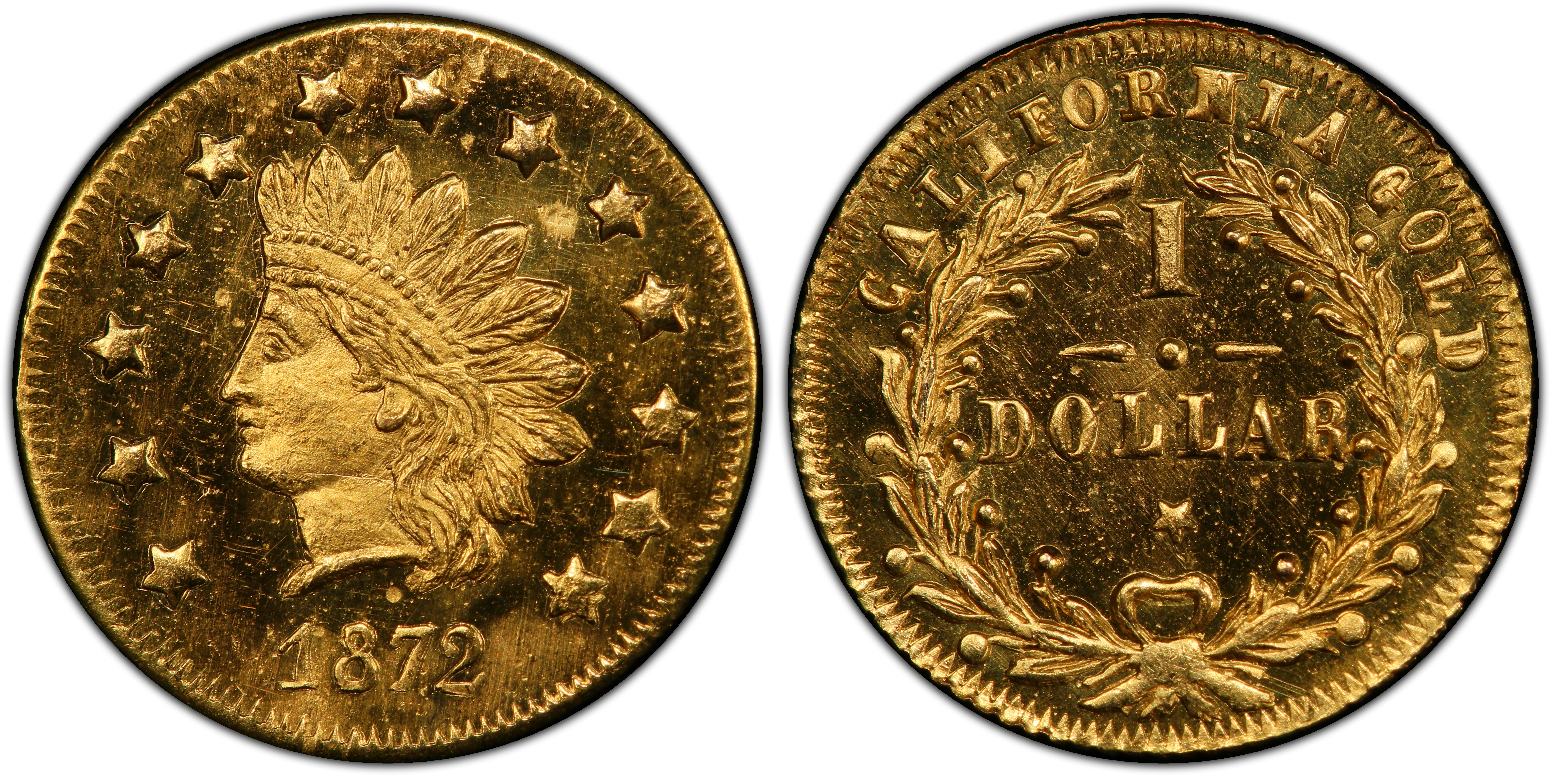
Obverse & Reverse
The 1872 Gold Dollar BG-1207 is a quintessential example of a 'Period Two' California Fractional Gold piece, a fascinating series born from the dual necessities of commerce and nostalgia in post-Gold Rush California. The initial wave of fractional gold, struck from 1852 to 1857, arose from an acute shortage of small change. Gold dust was impractical for minor transactions, and the output of the new San Francisco Mint was initially insufficient to meet the booming economy's needs. These early pieces, though often lightweight, genuinely circulated. However, by the 1870s, the economic landscape had changed. The U.S. Mint was in full operation, and the immediate need for private coinage had subsided. The continued production of fractional gold pieces shifted to serve a burgeoning tourist and souvenir market. These later issues, termed 'jeweler's issues' by numismatists, were produced by various San Francisco jewelers who recognized a market for charming, gold-based mementos of the Golden State. Antoine Louis Nouizillet, a French jeweler in San Francisco, was a key figure in this second period. Unlike the earlier, more utilitarian issues, these coins were often more fanciful in design, lighter in weight relative to their face value, and produced with an eye towards jewelry and keepsakes rather than daily commerce. The Coinage Act of 1864 had prohibited private coinage, but enforcement was lax until the early 1880s, allowing men like Nouizillet to operate in a legal gray area. They were often careful to produce pieces that could be argued were tokens or charms rather than circulating coins, despite the denomination. The BG-1207, with its classic Indian Head motif—a design popularized by federal coinage—was an appealing and recognizable design for these purposes. These pieces capture a moment when California was transitioning from a raw frontier to a place of myth and tourism, and the gold that once fueled its economy was now being packaged into tiny, collectible symbols of its adventurous past.
Associated EventCalifornia Gold Rush Aftermath & Souvenir Trade
Reason For MintingPrimarily struck to be sold as souvenirs and keepsakes to tourists and locals in San Francisco, capitalizing on the romanticism of the Gold Rush.
Minter HistoryAntoine Louis Nouizillet was a French-born jeweler and watchmaker who established a business in San Francisco. He was one of the most prolific and skilled producers of 'Period Two' California Fractional Gold. Nouizillet's operations were active during a time when the legal status of private minting was ambiguous. He was known for creating various designs, including Indian Heads and Liberty Heads, often in partnership with other jewelers like M. Deriberpe (D.N. mintmark) and F. Routhier (N.R. mintmark). His pieces are generally characterized by a higher quality of die work and craftsmanship compared to some of his contemporaries. Around 1859-60, it is believed he sold his business to Robert B. Gray & Co., who may have continued to use his existing dies for a time. Nouizillet's work represents the commercial pivot of fractional gold from a circulating medium to a desirable collectible and souvenir item.
Historical SignificanceThe BG-1207 is historically significant not as a circulating coin, but as a tangible artifact of California's burgeoning tourism industry and the commercialization of the Gold Rush legacy. It represents the final chapter of private gold coining in the United States, produced under legally questionable circumstances and intended more as a memento than as money, perfectly encapsulating the transition of gold from a daily economic tool to a powerful symbol of the American West.
BG-1207
DenominationG$1
Minting Period1872
Assayer/MinterAntoine Louis Nouizillet
Geographic OriginSan Francisco, California
Obverse DescriptionA Native American portrait in left profile, commonly referred to as an Indian Head. The portrait is somewhat crude in style, typical of jeweler's issues. The head is adorned with a feathered headdress. The field is surrounded by 13 five-pointed stars, typically unevenly spaced. The date '1872' is below the bust.
Obverse Inscription1872
Reverse DescriptionThe denomination '1 DOLLAR' is enclosed within a wreath. The wreath is composed of two branches, tied at the bottom with a ribbon or bow. The design is simple and direct, clearly stating the face value.
Reverse Inscription1 DOLLAR
CompositionGold
Stated Fineness Actual FinenessVaries, but typically ranges from 14 to 22 karats for jeweler's issues.
Weight0.50 grams
Diameter11.50 mm
EdgePlain
Unknown
Survival Estimate76-200 (based on R-4 rating)
Rarity ScaleR-4 (Very Scarce)
This coin is highly appealing as a representative of the 'Period Two' jeweler's issues of California Fractional Gold. Its classic Indian Head design, affordability relative to 'Period One' issues, and defined rarity make it a popular entry point and a staple for specialists completing a Breen-Gillio variety set. The connection to San Francisco's post-Gold Rush history adds a strong layer of historical allure.
Key VarietiesThe BG-1207 itself is a specific die variety. Within the broader 1872 Indian Head dollar series, there are other Breen-Gillio varieties (e.g., BG-1208) which differ in the specifics of the portrait, star placement, or reverse wreath. No later-date Proof restrikes or special collector issues are known for this specific variety; all known examples are considered original business strikes from the 1872-1882 period.
Authentication TipsGenuine BG-1207 pieces have a specific 'look' that is sharp yet often slightly crude. The strike can be uneven. Compare the style of the Indian Head portrait and the wreath to high-resolution images of certified examples. Counterfeits and modern replicas often have a mushy or soapy appearance, incorrect weight, or a brassy color. Many replicas, particularly those made for jewelry in the 20th century, incorporate a bear on the reverse, which is an immediate red flag as genuine denominated fractionals of this period do not. Third-party grading by PCGS or NGC is highly recommended for authentication.
Shopping ConsiderationsA premium quality example for its grade will exhibit a sharp strike, particularly on the feathers of the headdress and the details of the reverse wreath. Seek out coins with smooth, prooflike (PL) or deep mirror prooflike (DMPL) surfaces, as this variety is often found with reflective fields. Original, undisturbed luster is paramount. Common problems include evidence of jewelry mounting (solder, tooling, or edge filing), harsh cleanings which leave hairlines, and excessive distracting marks in the fields. Given their small size, even minor imperfections can be magnified. An attractive, original piece with a CAC sticker will command a significant premium, as it indicates superior quality and eye appeal for the grade.
A coin's grade is its condition, rated on a 1-70 scale. For rare coins, this is the most critical factor in determining value, as a tiny difference in preservation can mean a huge difference in price.
Relevant Grade TypesOriginal examples of BG-1207 were struck as business strikes, though many were sold as souvenirs and never circulated. They are found in both Circulated grades (AG-3 to AU-58) and, more commonly, in Mint State grades (MS-60 to MS-70). No true Proofs were struck during the original minting period. The designation 'PL' (Prooflike) is often applied to examples from polished dies that exhibit reflective surfaces but were not specially struck as Proofs.
Mint State CharacteristicsUncirculated examples of BG-1207 are characterized by their luster, which can range from satiny to deeply reflective (Prooflike). The strike is a key determinant of quality; many are weakly struck in the centers, showing a lack of detail in the Indian's hair and the wreath's bow. A well-struck example with full details is highly desirable. Due to the softness of the gold and the production methods, it is common to see minor planchet flaws or small, scattered contact marks, even on high-grade specimens.
Circulated Wear PatternsWear first appears on the highest points of the design. On the obverse, look for friction and flattening on the cheekbone of the Indian portrait and the highest feathers of the headdress. On the reverse, the high points of the wreath's leaves and the ribbon bow will show initial wear. In lower grades (VF and below), the stars on the obverse will begin to lose their sharpness and the legends will become soft.
Key Factors For ValueThe primary drivers of value for a BG-1207 are grade and surface quality. A high-grade Mint State coin (MS-63 or better) with original, brilliant or prooflike surfaces will command a strong premium. Eye appeal is crucial; examples with a clean, sharp strike and minimal distracting marks are prized. Conversely, coins that have been harshly cleaned, polished, or removed from jewelry are worth significantly less. A CAC sticker indicating A-grade quality for the assigned numerical grade adds a substantial premium, confirming superior eye appeal and originality.
PCGS Price Guide
| Grade | Price | Population |
|---|---|---|
| 63 | $4,500.00 | 2 |
| 63+ | $4,750.00 | N/A |
| 64 | $5,000.00 | 1 |
| 64+ | $5,500.00 | N/A |
| 65 | $8,000.00 | 1 |