1876 G50C BG-1065, PL (Regular Strike)
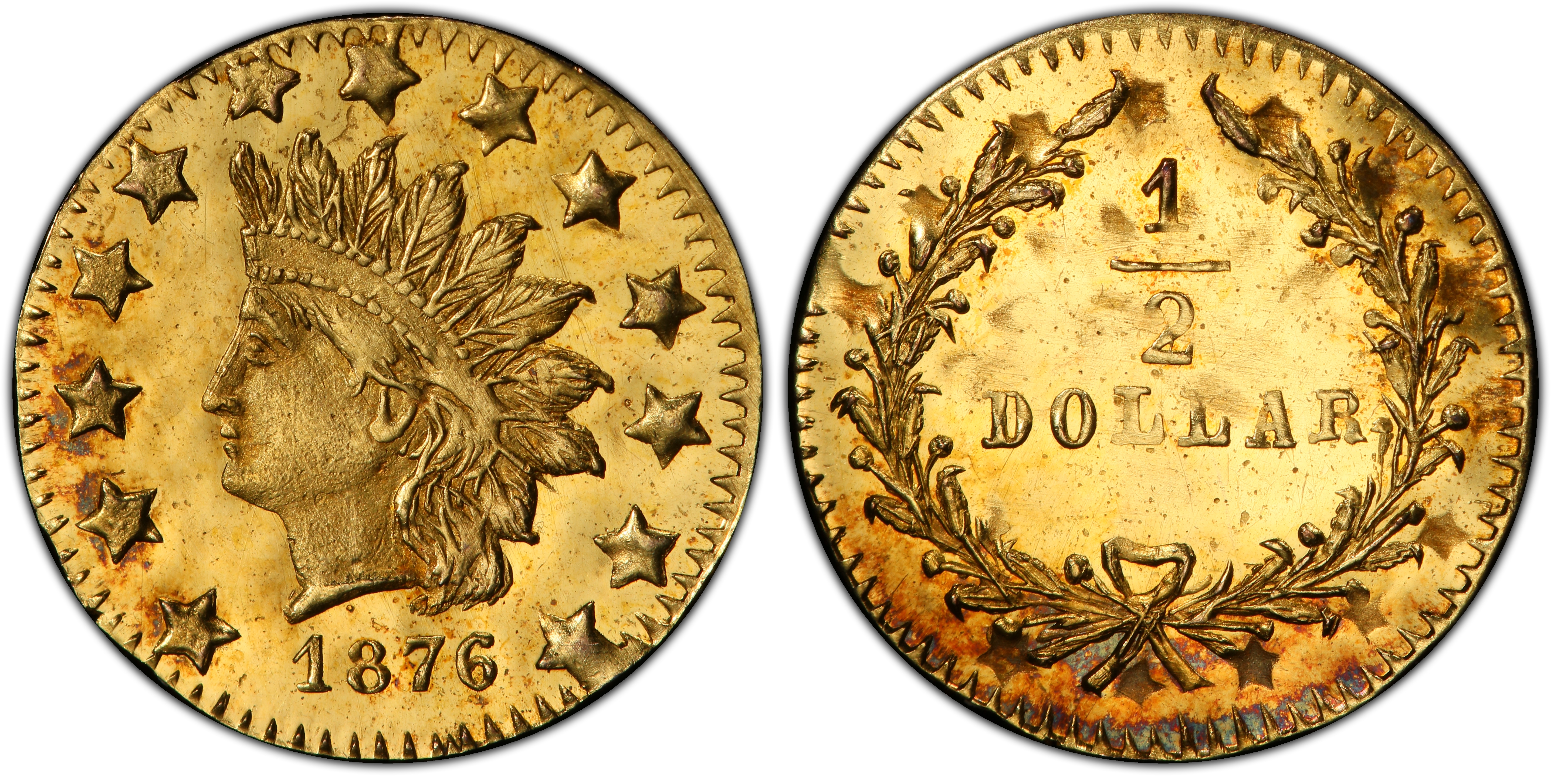
Obverse & Reverse
The 1876 BG-1065 fifty-cent piece emerges from the second major phase of California Fractional Gold production, a period numismatists designate as 'Period Two' (circa 1858-1882). Unlike their 'Period One' predecessors, which were struck out of genuine commercial necessity to alleviate a shortage of small change during the initial Gold Rush, these later issues served a different purpose. By the mid-1870s, the United States Mint in San Francisco was in full operation, supplying the region with ample federal coinage. The raison d'être for fractional gold had shifted from commerce to commemoration and curiosity. These small gold pieces, including the BG-1065, were produced by various jewelers and artisans in San Francisco primarily as souvenirs for tourists, collectors, and citizens nostalgic for the heady days of the '49ers. The year 1876 was particularly significant as it marked the nation's Centennial, an event that spurred the production of countless tokens and keepsakes across the country, a trend the California jewelers readily embraced. The Coinage Act of 1864 had officially prohibited private coinage, but the law was not aggressively enforced against these small, low-value 'tokens' until the Secret Service cracked down in the early 1880s. This legal gray area allowed for a prolific output of diverse designs. The BG-1065, with its popular Indian Head motif, was designed to be attractive and exotic to buyers. These pieces were not intended to contain their full face value in gold; they were a form of token sold at a premium. Their production was often crude, using the 'hammer method' where dies were struck by hand, leading to variability in strike quality. Despite their unofficial status, they represent a fascinating chapter in the story of Western expansion, capturing the transition of California from a raw frontier to a place with a history worth mythologizing and selling. The BG-1065 is a tangible artifact of this Gilded Age tourist trade and the enduring allure of California gold.
Associated EventPost-Gold Rush California Tourism & U.S. Centennial
Reason For MintingPrimarily struck as a souvenir or keepsake for the tourist trade, not for general circulation.
Minter HistoryThe specific minter for the BG-1065 die pair is not definitively known, which is common for many 'Period Two' issues. Production was decentralized among several San Francisco jewelers who often operated anonymously or with simple initials. Prominent makers of the era included firms like Deriberpe & Nouizillet (D.N.) and Frontier & Deviercy (F.D.), but attributing this specific, unmarked variety is not possible with current research. These artisans were skilled metalworkers who capitalized on the public's fascination with gold, creating a vibrant and competitive market for these popular miniature tokens.
Historical SignificanceThe BG-1065 is a prime example of a 'Period Two' California Fractional Gold piece, significant not as a coin for circulation but as a historical artifact of American tourism and commercial nostalgia. It demonstrates the evolution of private minting from a necessary service to a novelty business and reflects the lax enforcement of federal coinage laws in the 19th-century American West. Its existence is a testament to the enduring romanticism of the Gold Rush.
BG-1065
Denomination50 Cents
Minting Period1876
Assayer/MinterUnknown Private Minter
Geographic OriginSan Francisco, California
Obverse DescriptionA stylized head of a Native American princess facing left, wearing a feathered headdress. The portrait is encircled by thirteen six-pointed stars, representing the original colonies. The date, 1876, is positioned below the bust truncation.
Obverse Inscription1876
Reverse DescriptionThe denomination '50 CENTS' is displayed prominently across two lines in the center, enclosed within a continuous, ornate wreath of leaves and berries. The wreath is tied at the bottom with a bow.
Reverse Inscription50 CENTS
CompositionGold
Stated Fineness Actual FinenessVariable, typically of lower fineness than official U.S. coinage.
Weight0.25 grams
Diameter10.00 mm
EdgePlain
Unknown
Survival Estimate31-75 (per R-5 rating)
Rarity ScaleR-5
This variety appeals to collectors due to its connection to the romanticized Gold Rush era, the popular Indian Head design, and its status as a dated, denominated gold token from the U.S. Centennial year. Its defined rarity (R-5) adds to its desirability, offering a tangible challenge for specialists in the extensive California Fractional Gold series.
Key VarietiesThe primary variety is the regular business strike (BG-1065). No original proof strikings are known, as these were not produced for that purpose. While the user input mentions 'PL' (Prooflike), this is a surface characteristic found on some regular strikes and not a separate issue. No later-date restrikes or official patterns are known for this private issue. Collectors focus on die states and strike quality.
Authentication TipsAuthentic pieces must have a denomination ('50 CENTS'); tokens that say 'CAL GOLD' or have a bear on the reverse are typically modern replicas or fantasy pieces. The style of the Indian Head and the wreath should be carefully compared to known genuine examples, as fakes often have crude, poorly defined features. The gold should have the characteristic color and luster of 19th-century alloys, not the brassy look of modern copies. Diagnostics for BG-1065 include a specific die crack that often develops at the top of the obverse, running through the stars above the headdress, though not all specimens will show this.
Shopping ConsiderationsA premium quality example for its grade will exhibit a sharp, well-centered strike, which is uncommon as many were struck with uneven pressure. Look for full definition in the feathers of the headdress and the details of the wreath's leaves. Original, lustrous surfaces are highly prized; many surviving examples have been cleaned or used as jewelry, so evidence of polishing, solder, or rim damage should be avoided. A warm, reddish-gold or orange-peel toning is considered attractive. Avoid specimens with excessive planchet flaws or weakness on the date or denomination. The 'PL' designation indicates deeply mirrored fields and commands a significant premium.
A coin's grade is its condition, rated on a 1-70 scale. For rare coins, this is the most critical factor in determining value, as a tiny difference in preservation can mean a huge difference in price.
Relevant Grade TypesOriginal period issues of BG-1065 were all business strikes, although they were intended for sale as souvenirs rather than for circulation. They are found in Circulated (1-58) grades, though this is less common, and more frequently in Mint State (MS, 60-70) grades. No true Proof (PR/PF) examples were struck during the original period of issue. The 'PL' (Prooflike) designation is sometimes assigned to business strikes that exhibit unusually mirrored surfaces from polished dies, but these are graded on the MS scale.
Mint State CharacteristicsUncirculated examples are defined by their luster, which is typically soft and satiny rather than deeply frosty like federal issues. The strike is a key determinant of quality; many are softly struck, especially on the highest points like the feathers and the central 'CENTS'. A well-struck MS example will have bold details throughout. Due to the softness of the gold and rudimentary handling, even high-grade specimens often show minor contact marks or planchet striations. A truly clean surface is rare and commands a strong premium.
Circulated Wear PatternsOn circulated examples, wear first appears on the high points of the obverse: the cheek, the eyebrow, and the tips of the feathers in the headdress. On the reverse, the highest points of the leaves in the wreath and the lettering of the denomination will show initial friction and flattening. In lower grades (VF and below), the individual feathers will begin to merge, and the legend will appear soft and less defined.
Key Factors For ValueThe primary drivers of value for a BG-1065 are grade and surface quality. An example with original, undisturbed luster will always be worth more than a cleaned or polished piece of the same grade. Strike sharpness is critical; a fully struck specimen can be worth double a weakly struck one in the same numerical grade. Eye appeal, including attractive original toning and a lack of distracting marks, plays a major role. Finally, certification by PCGS or NGC is standard for this series, and a sticker from CAC indicating premium quality for the grade adds a significant premium.
PCGS Price Guide
| Grade | Price | Population |
|---|---|---|
| 63 | N/A | N/A |
| 64 | $1,075.00 | 2 |
| 64+ | $1,350.00 | N/A |
| 65 | $2,750.00 | N/A |