1876/5 G50C BG-1059, PL (Regular Strike)
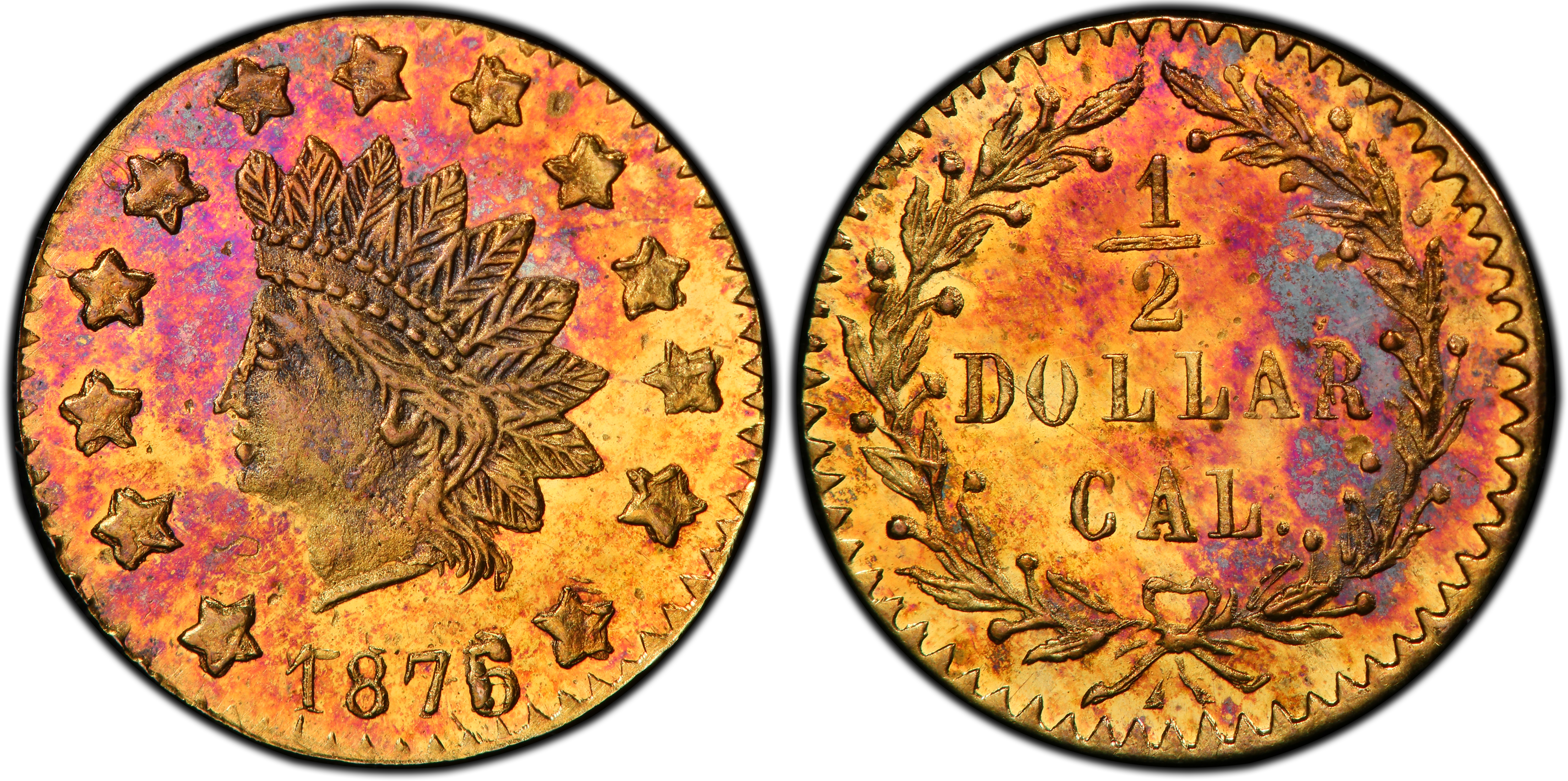
Obverse & Reverse
The 1876/5 BG-1059 50-cent piece emerges from the second period (1859-1882) of California Fractional Gold production, a fascinating chapter in American numismatics born from the crucible of the Gold Rush. Following the initial 1848 gold discovery, a massive influx of prospectors and merchants created a thriving, yet chaotic, economy severely hampered by a lack of small-denomination coinage. Gold dust and nuggets were impractical for everyday transactions, leading private jewelers and metallurgists to fill the void by striking their own fractional-value coins beginning in 1852. These pieces, denominated as 25 cents, 50 cents, and one dollar, served as a crucial medium of exchange. However, by the time this BG-1059 variety was struck, the initial, urgent commercial need had largely subsided. The United States government had established a branch mint in San Francisco in 1854, and federal coinage was more readily available. The Coinage Act of 1864 further complicated matters by outlawing private coinage, though enforcement was lax until the early 1880s. Consequently, many 'Period Two' issues, including those by Christopher Mohrig, transitioned from being essential currency to popular souvenirs and keepsakes. They were tangible, affordable mementos of the romanticized Gold Rush era, often sent back East by residents. The 1876/5 overdate itself is a product of this frugal, entrepreneurial environment; rather than creating an entirely new die for 1876, a punch for the digit '6' was simply impressed over the '5' on a previous year's die. This variety, with its Indian Head motif—a popular and distinctly American design choice of the era—represents the final phase of this unique and quasi-legal minting tradition before federal authority finally clamped down, ending a vibrant chapter of private enterprise in American monetary history.
Associated EventCalifornia Gold Rush
Reason For MintingInitially struck to alleviate a severe shortage of small change for commerce, later issues like this one were primarily produced as popular souvenirs and curios.
Minter HistoryChristopher Ferdinand Mohrig was a German immigrant and prominent San Francisco manufacturing jeweler. He was one of the most prolific and skilled producers of California Fractional Gold during the second period. Operating his business from the 1860s into the 1880s, Mohrig was known for the quality of his dies and the consistent, professional appearance of his issues. Unlike some of the cruder early pieces, Mohrig's coins were well-struck and featured standardized, popular designs like the Indian Head and Liberty Head motifs. He cleverly navigated the ambiguous legal landscape following the 1864 Coinage Act, continuing production by often using earlier dates or, as seen in this variety, by re-purposing existing dies.
Historical SignificanceThe BG-1059 is significant as a representative of the later 'souvenir' phase of California Fractional Gold. It showcases the manufacturing practices of a key private minter, C.F. Mohrig, and the economic use of overdating a die. It stands as a physical artifact of a period when private citizens took monetary matters into their own hands, blurring the lines between necessity, commerce, and memorabilia before the complete federal monopolization of coinage.
BG-1059
Denomination50 Cents
Minting Period1876
Assayer/MinterChristopher Ferdinand Mohrig
Geographic OriginSan Francisco, California
Obverse DescriptionA female head in profile facing left, wearing a feathered headdress in the style of the contemporary U.S. Indian Head cent. The portrait is encircled by thirteen six-pointed stars.
Obverse InscriptionNo textual inscription; design consists of the Indian Head and 13 stars.
Reverse DescriptionThe denomination '50 CENTS' is displayed within a continuous wreath of leaves and berries, tied with a bow at the bottom. Below the bow is the date. The overdate is visible as the digit 6 is clearly punched over the underlying digit 5.
Reverse Inscription50 CENTS 1876/5
CompositionGold
Stated Fineness Actual FinenessOften around .900, but variable as these were private issues.
Weight0.25 grams
Diameter10.00 mm
EdgePlain
Unknown
Survival Estimate100-150
Rarity ScaleR-4
This variety appeals to collectors for several reasons: it is an affordable entry point into the California Fractional Gold series, it features the popular Indian Head design, and it is a distinct overdate (1876/5) that is easily identifiable. The availability of high-grade, prooflike examples adds to its desirability.
Key VarietiesThe primary variety is the 1876/5 overdate itself, as cataloged by Breen-Gillio (BG-1059). While this specific item is a regular business strike, many examples were produced with mirrored, prooflike (PL) or deep prooflike (DPL) surfaces, which are not true proofs but rather the result of polished dies and planchets used to enhance souvenir appeal. These PL and DPL examples are highly sought after and command significant premiums. There are no known later-date restrikes or pattern issues associated with BG-1059.
Authentication TipsGenuine pieces exhibit a sharp, well-defined strike, particularly in the details of the headdress and the wreath. The overdate feature should be clear under magnification, with remnants of the '5' visible beneath the '6'. Counterfeits are common in this series and are often brassy in color, have a soapy or soft appearance to the details, and may have incorrect weight or a seam on the edge. Authentication by a reputable third-party grading service (PCGS or NGC) is highly recommended.
Shopping ConsiderationsA premium quality example for its grade will possess deeply mirrored fields if designated PL or DPL, with significant reflective contrast against frosted devices (cameo). Look for sharp striking details, especially on the feathers of the headdress and the numerals of the date. Common issues to avoid are signs of cleaning, which will manifest as hairlines in the fields, or evidence of having been mounted in jewelry, such as solder marks or rim damage. Original, unblemished surfaces with a pleasing reddish-gold or honey-gold patina are most desirable. The clarity and prominence of the underlying '5' in the overdate can also add to an example's appeal for variety specialists.
A coin's grade is its condition, rated on a 1-70 scale. For rare coins, this is the most critical factor in determining value, as a tiny difference in preservation can mean a huge difference in price.
Relevant Grade TypesOriginal issues of BG-1059 were business strikes intended for sale as souvenirs. They are found in Circulated grades (AU-50 to AU-58 are most common for circulated examples) and, more frequently, in Mint State (MS, 60-70) grades. No true Proofs were struck during the original period of issue. However, many were struck using polished dies, resulting in coins with reflective surfaces. Grading services designate these as 'Prooflike' (PL) or 'Deep Prooflike' (DPL), which are not a different grade type but rather a surface characteristic of a Mint State coin. These PL and DPL designations are highly prized by collectors.
Mint State CharacteristicsAn uncirculated BG-1059 typically exhibits frosty to satiny luster. High-grade examples, especially those designated PL or DPL, will have deeply reflective, mirror-like fields. The strike is generally sharp, though minor weakness on the highest points of the feathers or wreath is not uncommon. Due to the small size and handling, even high-grade specimens may show minor ticks or contact marks, but premium examples will be clean and free of distracting imperfections.
Circulated Wear PatternsWear first appears on the high points of the design: the cheek and the front feathers of the Indian's headdress on the obverse, and the leaves and bow of the wreath on the reverse. On lower-grade circulated examples, the stars and the finer details of the feathers will begin to merge with the fields.
Key Factors For ValueThe primary drivers of value for this coin are grade and surface characteristics. A Mint State coin will be worth significantly more than a circulated one. The PL and DPL designations add a substantial premium, with DPL coins being the most valuable. Eye appeal is critical; examples with clean surfaces, a sharp strike, and attractive original color command the highest prices. For this issue, a CAC sticker, indicating premium quality for the grade, is highly valued by collectors and typically results in a higher market price.
PCGS Price Guide
| Grade | Price | Population |
|---|---|---|
| 63 | $825.00 | 2 |
| 63+ | $1,000.00 | N/A |
| 64 | $1,150.00 | 3 |
| 64+ | $1,350.00 | N/A |
| 65 | $1,750.00 | 2 |
| 65+ | $2,000.00 | N/A |
| 66 | N/A | N/A |