1872 G$1 BG-1120, PL (Regular Strike)
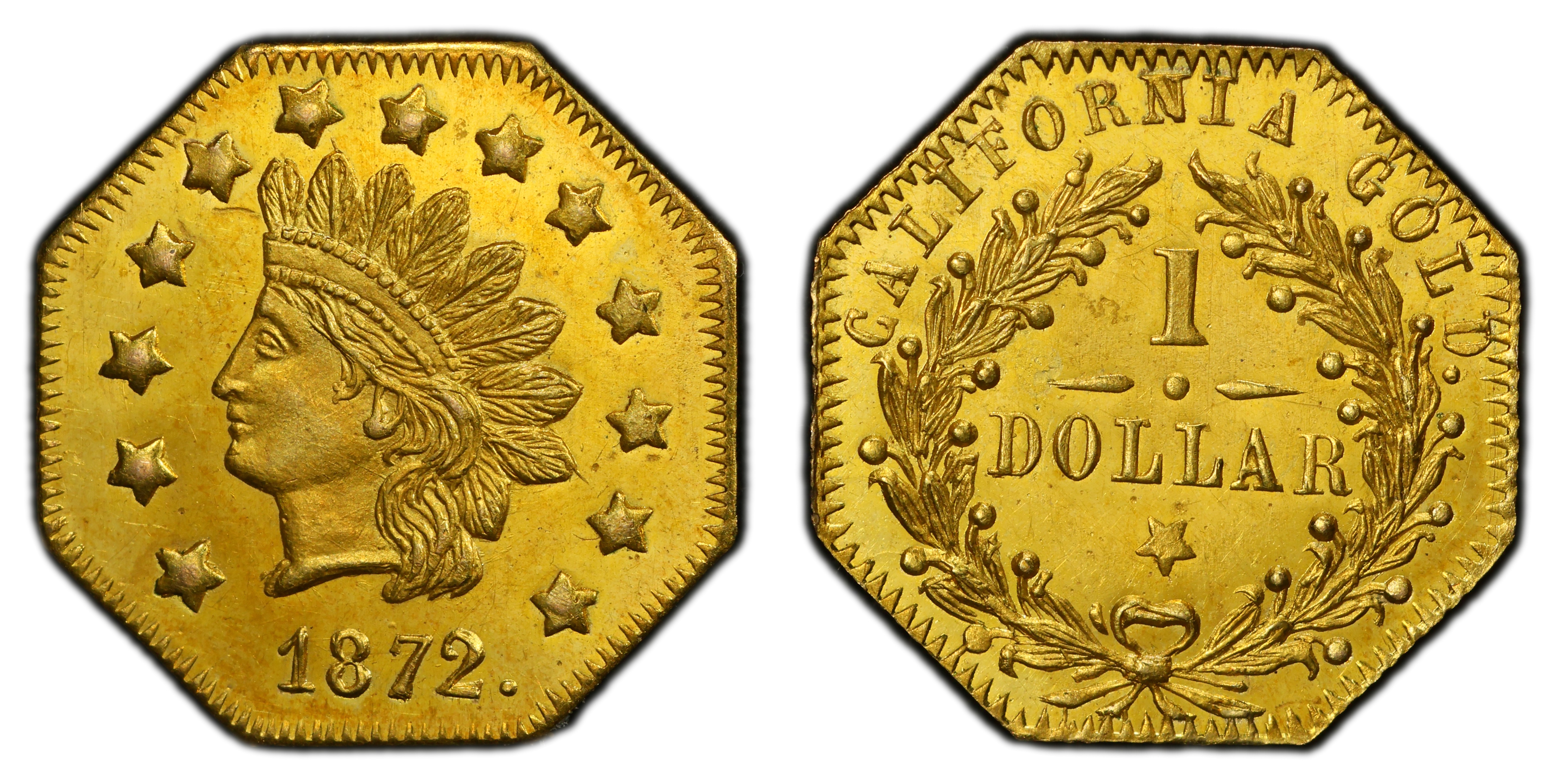
Obverse & Reverse
The 1872 G$1, cataloged as Breen-Gillio 1120, emerges from the second great era of California Fractional Gold production, known as 'Period Two' (1858-1882). Unlike the 'Period One' issues, which were struck out of genuine commercial necessity to alleviate a severe shortage of small change during the initial Gold Rush, the Period Two pieces were created primarily as souvenirs and keepsakes. By the 1870s, the United States Mint in San Francisco was in full operation, producing ample federal coinage for the region's economy. The acute need for private coins had vanished. However, the romance and legend of the Gold Rush had not. Jewelers in San Francisco, many of French origin, recognized a continuing market for miniature gold coins among tourists, collectors, and locals who cherished them as mementos of the heady days of '49. These pieces were not intended to, nor did they, circulate in any meaningful way. The Coinage Act of April 22, 1864, had made private coinage illegal, but the law was not strictly enforced by the Secret Service against these small, denominated tokens until 1883. This legal gray area allowed for their continued production. The BG-1120, with its iconic Indian Head motif, was a product of this environment. Struck from locally sourced gold, these pieces were often produced with meticulous care, frequently employing prooflike dies to enhance their aesthetic appeal for the souvenir trade. Their octagonal shape was a nostalgic nod to the famous fifty-dollar 'slugs' of the 1850s, further cementing their role as historical keepsakes rather than utilitarian currency.
Associated EventPost-Gold Rush California Economy
Reason For MintingPrimarily struck as souvenirs and collector's items to capitalize on the nostalgia of the California Gold Rush.
Minter HistoryThe specific minter or jeweler responsible for the BG-1120 die pair is unknown, which is common for many 'Period Two' issues. Production during this era was decentralized among various San Francisco jewelers who created their own designs and dies. These artisans, often anonymous to history, catered to the robust souvenir market. Their work is characterized by artistic flair and often higher quality strikes than the earlier, more utilitarian circulation issues.
Historical SignificanceThe BG-1120 is significant not as a circulating coin, but as a tangible artifact of California's post-Gold Rush cultural memory. It represents the commercialization of the Gold Rush legend itself, demonstrating how the event had transitioned from a frantic economic reality into a romanticized historical period worthy of commemoration. These pieces are a key part of the numismatic story of private minting in the United States, marking the final phase before federal laws were fully enforced.
BG-1120
Denomination$1
Minting Period1872
Assayer/MinterUnknown private minter, likely a San Francisco jeweler.
Geographic OriginSan Francisco, California
Obverse DescriptionA stylized head of Liberty facing left, wearing a feathered headdress. The portrait is often called an 'Indian Head'. She is surrounded by 13 six-pointed stars, representing the original colonies. The date '1872' is below the bust.
Obverse Inscription1872
Reverse DescriptionThe denomination '1' and the word 'DOLLAR' are enclosed within a decorative wreath of leaves and berries, tied with a bow at the bottom.
Reverse Inscription1 DOLLAR
CompositionGold
Stated Fineness Actual FinenessVariable, but typically lower than federal issues, often ranging from .500 to .850 fine.
Weight0.49 grams
Diameter11.20 mm
EdgePlain
Unknown
Survival EstimateFewer than 35 known examples. The NGC Census lists 18 graded examples.
Rarity ScaleHigh R-6 (13-30 known) to possibly Low R-7 (4-12 known). Some sources cite a more conservative Low R-5.
This variety is highly sought after for its rarity, octagonal shape, and attractive Indian Head design. The frequent prooflike (PL) or deep mirror prooflike (DMPL) surfaces, a hallmark of high-quality Period Two issues, add significant eye appeal. It appeals to specialists in California gold as well as type collectors seeking a representative one-dollar piece.
Key VarietiesThe primary issue is the business strike, often found with prooflike surfaces. No specific major varieties, patterns, or official restrikes of the BG-1120 from the period are known to exist. All known examples are considered original 'souvenir' strikings from 1872.
Authentication TipsAuthentic pieces must have a denomination ('DOLLAR') on the reverse. Be wary of modern replicas which often feature a bear on the reverse or lack a denomination. Genuine examples often exhibit a slightly crude, hand-made quality, and may have weak areas in the strike, particularly on the highest points of the design. The weight and dimensions should be close to the established standard. Referencing high-quality images in the Breen-Gillio reference work or major auction archives is critical. Third-party grading is highly recommended.
Shopping ConsiderationsA premium quality example for this issue is defined by a sharp strike, especially on the details of the headdress feathers and the wreath leaves. Seek out coins with deep, watery prooflike fields, as these are the most desirable. Because they were made as souvenirs and often kept as jewelry, check carefully for evidence of mounting, tooling, or harsh cleaning which would significantly impair value. Original, undisturbed surfaces with a touch of reddish-gold toning command the highest prices. Avoid examples with excessive contact marks, as the mirrored fields make these abrasions particularly noticeable.
A coin's grade is its condition, rated on a 1-70 scale. For rare coins, this is the most critical factor in determining value, as a tiny difference in preservation can mean a huge difference in price.
Relevant Grade TypesOriginal issues were business strikes, although struck with prooflike dies for the souvenir market. They are found in Circulated grades (AU-50 to AU-58, though rare) and, more commonly, Mint State (MS, 60-70). The Prooflike (PL) and Deep Mirror Prooflike (DMPL) designations are extremely relevant and desirable for this variety. No true Proofs were struck in the modern sense, and there are no known later-date restrikes.
Mint State CharacteristicsUncirculated examples of BG-1120 are characterized by their luster, which is typically highly reflective and prooflike rather than satiny. The strike can be uneven; it is common to see weakness on the highest points of the feathers and the wreath even on high-grade examples. Due to the soft gold and mirrored surfaces, even light contact marks can be prominent. A top-tier MS example will pair a sharp strike with clean, unabraded fields.
Circulated Wear PatternsOn circulated examples, wear first appears on the high points of the headdress feathers, Liberty's cheek, and the eyebrow. On the reverse, the highest parts of the wreath leaves and the bow will show the first signs of friction and flattening. In lower grades, the stars and date will begin to lose their sharpness.
Key Factors For ValueThe primary value driver is the surface quality. A coin with deep, clean, prooflike fields will command a significant premium over a hazy or heavily marked example of the same numerical grade. Sharpness of strike is the second key factor. Finally, overall eye appeal, which includes attractive toning and a lack of distracting flaws, is paramount. A CAC sticker is highly valued for this issue, as it confirms both the grade and the superior quality for that grade.
PCGS Price Guide
| Grade | Price | Population |
|---|---|---|
| 62 | $2,100.00 | 1 |
| 62+ | $2,350.00 | N/A |
| 63 | $3,000.00 | N/A |
| 63+ | $3,750.00 | N/A |
| 64 | $5,250.00 | 2 |
| 64+ | $5,750.00 | N/A |
| 65 | $6,500.00 | 1 |