1875 G$1 BG-1127, PL (Regular Strike)
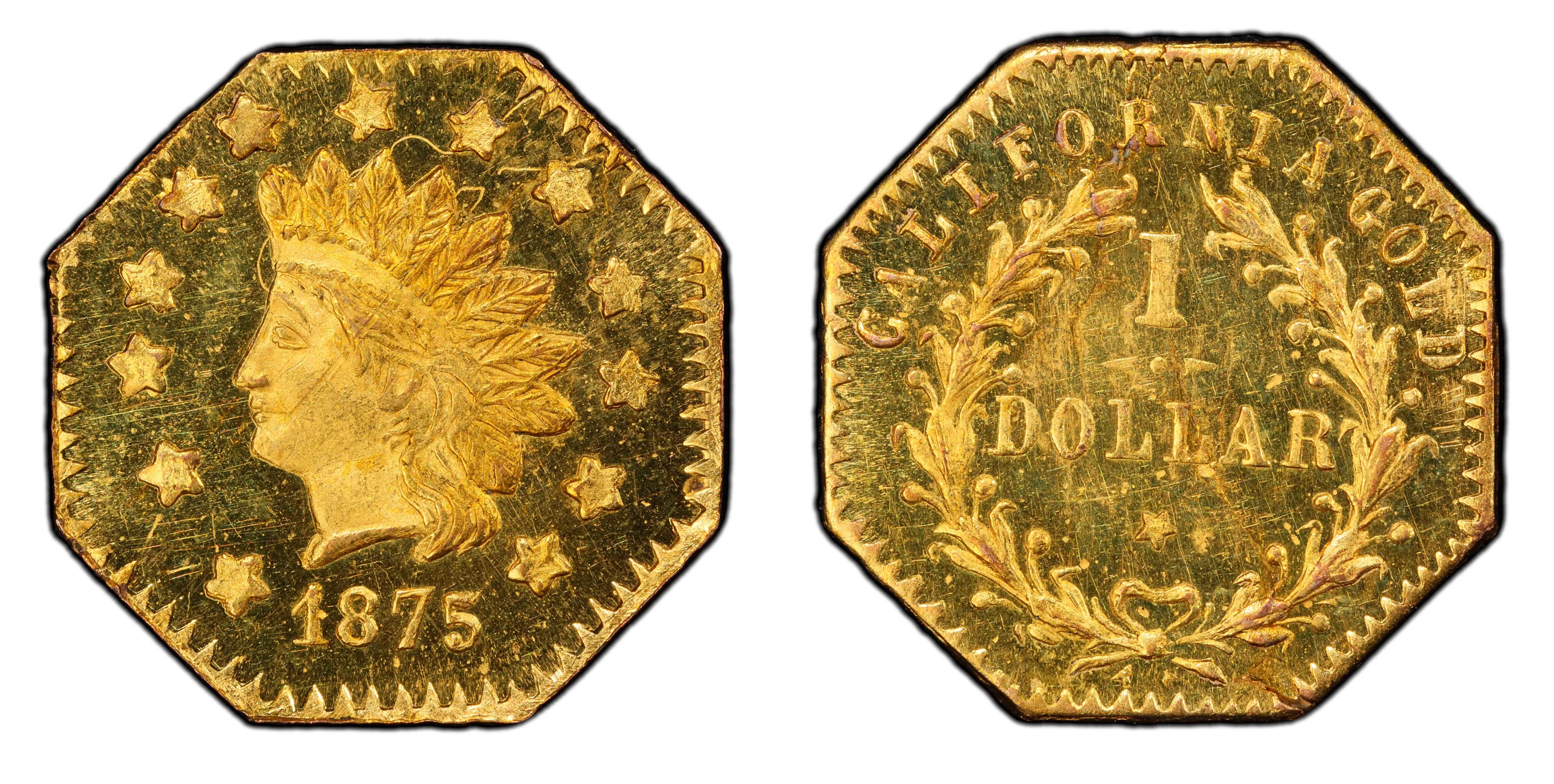
Obverse & Reverse
The 1875 octagonal one dollar piece, cataloged as Breen-Gillio 1127, represents the twilight of a fascinating and often misunderstood era of American currency. These small gold tokens, born of necessity and commercial opportunism, are relics of California's prolonged 'hard money' economy. Following the 1849 Gold Rush, California was flooded with gold dust but severely lacked circulating coinage, particularly for small transactions. Federal branch mints struggled to keep up, and private minters filled the void. By the 1870s, the initial acute shortage had eased, but the cultural preference for gold and silver remained deeply ingrained, and the U.S. government was actively hostile towards private coinage. The Act of April 7, 1864, made private coinage illegal, but production of these 'tokens' or 'charms' continued clandestinely and often skirted the law by omitting the word 'Dollar' or 'D.' However, demand persisted, and a new generation of jewelers and entrepreneurs, like Robert B. Gray & Co., began producing pieces primarily for the souvenir and jewelry trade, though they undoubtedly circulated as currency when convenient. These 'Period Three' (1872-1882) pieces are distinguished by their often cruder, more stylized designs compared to their earlier, more functional counterparts. They were a novelty, a memento of the great Gold Rush, yet still crafted from California gold. The BG-1127 variety, with its Indian princess motif, captures this later period's spirit. It wasn't meant to solve a currency crisis but to satisfy a tourist's desire for a keepsake and a local's preference for tangible gold. The 'PL' or Prooflike designation on certain specimens indicates they were struck using highly polished dies on polished planchets, resulting in a mirror-like finish that enhanced their appeal as gift items. Their existence is a testament to the enduring legacy of the Gold Rush and the independent, bullion-based economy that characterized California for decades.
Associated EventPost-California Gold Rush Economic Period
Reason For MintingPrimarily created to serve the robust souvenir and gift market in California, capitalizing on the region's fame for gold, while also occasionally filling minor, localized needs for small-denomination currency.
Minter HistoryThe specific minter of BG-1127 is unconfirmed, as was common for Period Three pieces to avoid legal repercussions. However, stylistic elements and punches are often attributed to the workshop of Robert B. Gray & Co. of San Francisco. Gray was a prominent manufacturing jeweler and gold assayer during this period, known for producing a wide variety of small gold novelties, tokens, and charms that mimicked currency. His firm was a major supplier of these popular keepsakes, and many of the unsigned pieces from this era are believed to have originated from his enterprise.
Historical SignificanceThis coin is significant not as a tool of commerce but as a cultural artifact. It marks the transition of private California gold from a necessary form of currency (Period One) to a nostalgic souvenir (Period Three). Its existence demonstrates the persistent demand for gold items and the clever ways jewelers navigated federal laws against private coinage. It is a tangible link to the tourism and romanticism that began to define the memory of the Gold Rush in the late 19th century.
BG-1127
Denomination$1
Minting Period1875
Assayer/MinterUnknown Private Minter (Possibly Robert B. Gray & Co.)
Geographic OriginSan Francisco, California
Obverse DescriptionA stylized head of a female figure facing left, intended to be an 'Indian Princess' rather than a classic Liberty. She wears a feathered headdress with the word LIBERTY inscribed on the band. The portrait is surrounded by 13 six-pointed stars.
Obverse InscriptionLIBERTY
Reverse DescriptionThe denomination '1' and 'DOLLAR' are enclosed within a wreath of two olive branches tied with a bow at the bottom. The date '1875' is positioned below the bow. The phrase 'CALIFORNIA GOLD' appears in an arc above the wreath. A small bear hallmark is sometimes visible below the wreath, though often weak or absent.
Reverse InscriptionCALIFORNIA GOLD / 1 / DOLLAR / 1875
CompositionGold
Stated Fineness Actual FinenessVaries, typically between .500 and .750 fine (12-18 karat gold).
Weight0.52 grams
Diameter11.50 mm
EdgePlain
Unknown
Survival EstimateFewer than 150 believed to exist.
Rarity ScaleR-6 (Very Rare)
The BG-1127 is sought after for its attractive 'Indian Princess' design, its octagonal shape, and its status as a large-denomination ($1) Period Three piece. The Prooflike (PL) designation adds significant appeal, as the mirrored fields and frosted devices create a stunning cameo effect that is highly prized by collectors and rare for this type.
Key VarietiesNo major varieties of BG-1127 are widely recognized for the original 1875 strike. The primary distinction among survivors is the quality of the strike and the presence of Prooflike or Deep Mirror Prooflike (DMPL) surfaces. There are no known official restrikes. However, the world of California Fractional Gold is rife with contemporary counterfeits and modern replicas, which are distinct from the original 1872-1882 issues.
Authentication TipsAuthentic BG-1127 pieces have a specific die state and 'look.' The stars are often weakly struck. The lettering should match known genuine examples; fakes often have poorly formed or incorrectly styled letters. The weight and specific gravity should be correct for its gold content. Genuine pieces often have a slightly 'crude' or handmade feel, whereas modern fakes can appear too perfect or have a cast-like texture. Third-party certification by PCGS or NGC is highly recommended for any California Fractional Gold purchase.
Shopping ConsiderationsFor a premium quality BG-1127, especially a PL example, a buyer should seek a sharp strike on the central devices, particularly on the details of the headdress and the wreath. The primary appeal of a PL coin is the contrast between the mirrored fields and any frosted devices; look for clean, reflective fields with minimal distracting marks. Because these pieces are small and were often used as jewelry, check carefully for evidence of soldering, harsh cleaning, or ex-jewelry mounting, which would drastically reduce the value. Original, unmolested surfaces with a hint of reddish-gold toning are most desirable.
A coin's grade is its condition, rated on a 1-70 scale. For rare coins, this is the most critical factor in determining value, as a tiny difference in preservation can mean a huge difference in price.
Relevant Grade TypesOriginal period issues were business strikes intended for souvenir sales and limited circulation, found in Circulated (1-58) and Mint State (MS, 60-70) grades. No true 'Proof' (PR/PF) examples were struck during the original period of issue as collector specimens. However, some business strikes were produced using highly polished dies, creating Prooflike (PL) or Deep Mirror Prooflike (DMPL) surfaces. These are not a different type of coin but rather a special characteristic of the business strike, and they command significant premiums.
Mint State CharacteristicsAn uncirculated BG-1127 will show no evidence of wear. Luster can range from satiny to deeply reflective on PL examples. Strike quality is a major factor; many are weakly struck, especially on the stars and the word 'LIBERTY' on the headdress. A well-struck example with full details is rare. Due to the small size, even minor contact marks can be distracting. A premium MS coin will have a sharp strike, clean surfaces, and strong eye appeal, with PL examples valued for the depth and clarity of their reflectivity.
Circulated Wear PatternsWear first appears on the high points of the design. On the obverse, check the cheek, the feathers of the headdress, and the lettering of LIBERTY. On the reverse, the high points of the bow knot and the leaves in the wreath will show the first signs of friction and flatness. In lower grades (VF and below), the central numerals and letters will lose their sharpness and begin to merge with the fields.
Key Factors For ValueFor the BG-1127, value is driven by several key factors in order: 1) Grade and surface preservation – a high-grade, uncleaned coin is paramount. 2) The Prooflike (PL) designation – a PL or DMPL coin can be worth multiples of a standard business strike in the same numerical grade. 3) Strike quality – a sharp, fully detailed strike is rare and commands a strong premium. 4) Eye appeal – coins with attractive, original toning and minimal distracting marks are always more desirable. The presence of a CAC sticker, indicating premium quality for the grade, adds a significant premium for this series.
PCGS Price Guide
| Grade | Price | Population |
|---|---|---|
| 63 | $2,000.00 | N/A |
| 63+ | $2,350.00 | N/A |
| 64 | $2,850.00 | 2 |
| 64+ | $3,250.00 | N/A |
| 65 | $4,500.00 | N/A |