1874 G$1 BG-1110, PL (Regular Strike)
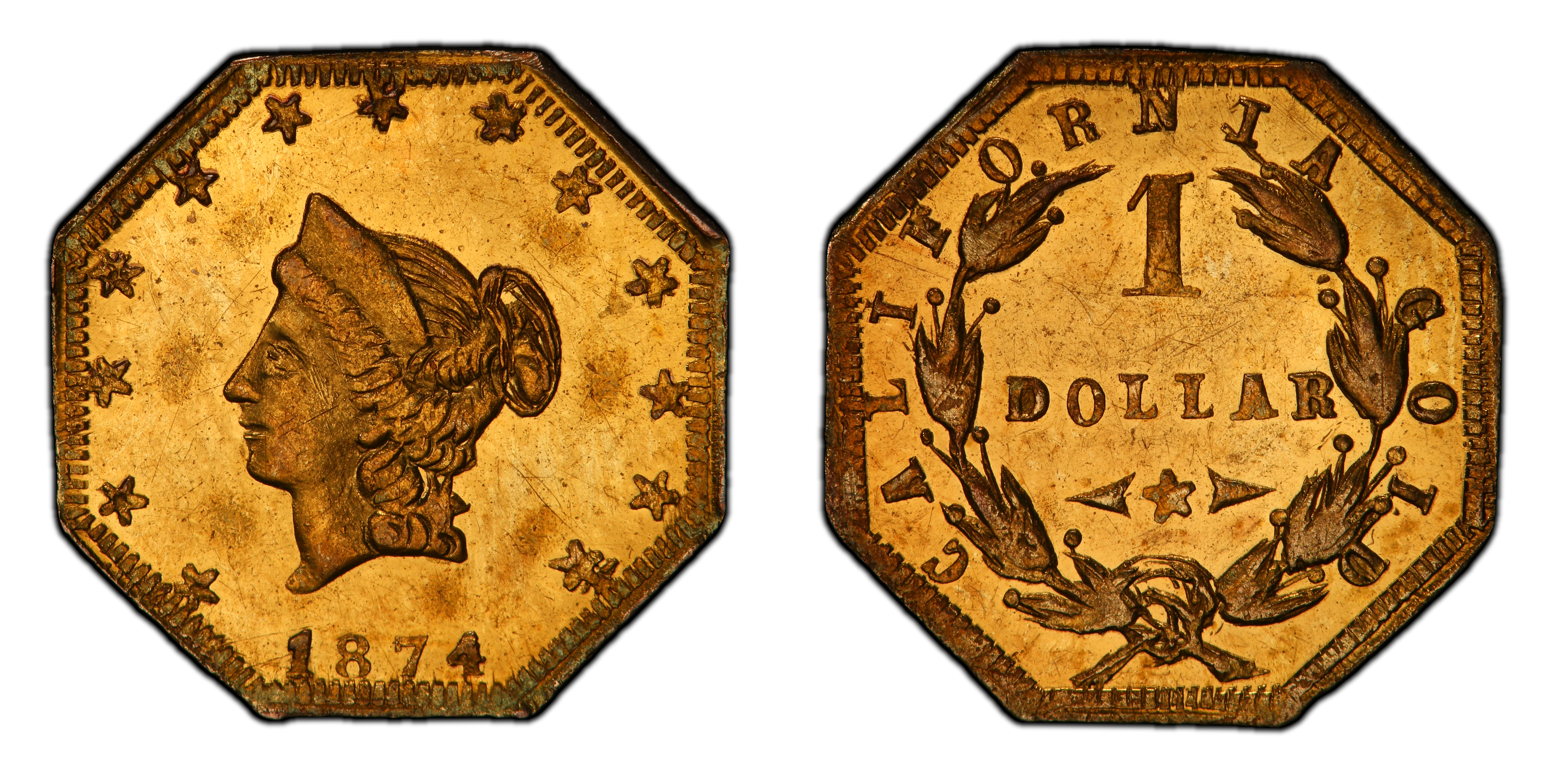
Obverse & Reverse
The 1874 G$1 BG-1110 is a product of the fascinating 'Period Three' (1872-1882) of California Fractional Gold production. By this era, the raw necessity for small-denomination coinage that characterized the Gold Rush had long since passed. The United States government had established a branch mint in San Francisco in 1854, and federal coinage was plentiful. However, a thriving market for gold 'charms' or 'tokens,' styled after the earlier, functional fractional gold pieces, had emerged. These were sold as souvenirs, keepsakes, and jewelry items to tourists and locals alike, capitalizing on the romanticism of the Gold Rush. Manufacturers, often jewelers operating in San Francisco, found a loophole in federal anti-counterfeiting laws passed in 1864. The legislation prohibited private coinage, but these Period Three pieces cleverly circumvented the law by omitting the word 'DOLLAR' and featuring designs not in direct imitation of U.S. coinage. The BG-1110 is a quintessential example of this phenomenon. Its obverse features a stylized Indian Princess head, a popular motif of the time, while the reverse presents a highly unusual and artistic depiction of a peacock, its tail feathers fanned out in elaborate detail. This 'Peacock' design is unique to this variety and its sibling, the half-dollar BG-1011, and represents a departure from the more traditional wreath or eagle motifs. These pieces were never intended to be a circulating medium of exchange; their purpose was purely commercial and commemorative. They were lightweight and their gold content was worth far less than their implied one-dollar face value, making them profitable items for their creators. Today, they are prized by collectors not for their intrinsic value, but for their artistry, their direct connection to the post-Gold Rush souvenir trade, and their relative scarcity.
Associated EventPost-California Gold Rush Souvenir Trade
Reason For MintingTo serve the growing tourist and jewelry market in California with gold 'charms' reminiscent of the earlier, functional fractional gold coins.
Minter HistoryThe specific minter for the BG-1110 variety remains anonymous, a common characteristic for Period Three California Fractional Gold. Production is attributed to various San Francisco jewelers and token makers who capitalized on the demand for gold souvenirs. These artisans operated in a quasi-legal space, creating pieces that resembled coins but were legally classified as tokens or charms to avoid federal counterfeiting statutes. Their work is characterized by creative designs and a focus on novelty appeal rather than utilitarian function.
Historical SignificanceThe BG-1110 is historically significant as a prime example of Period Three California Fractional Gold, illustrating the evolution of private gold minting from a necessity during the Gold Rush to a commercial enterprise catering to nostalgia and tourism. Its unique 'Peacock' reverse design showcases the artistic freedom and market-driven creativity of the era's private manufacturers, providing a tangible link to the cultural and economic landscape of 1870s San Francisco.
N/A
DenominationG$1
Minting Period1874
Assayer/MinterUnknown, likely a San Francisco-based jeweler or 'souvenir' coin manufacturer.
Geographic OriginSan Francisco, California
Obverse DescriptionA female head facing left, often identified as an Indian Princess, adorned with a feathered headdress. Thirteen stars encircle the portrait, representing the original colonies. The date '1874' is positioned below the bust.
Obverse Inscription1874
Reverse DescriptionA highly stylized depiction of a peacock facing left, with its tail feathers displayed in a full, ornate fan. The denomination '1' is to the left of the peacock's head and 'G' is to the right. The legend 'CALIFORNIA GOLD' is inscribed in an arc above, separated by a central star.
Reverse InscriptionCALIFORNIA GOLD / 1 G
CompositionGold
Stated Fineness Actual FinenessTypically ranges from .300 to .500 fine (9 to 12 Karat), significantly below the standard for federal gold coinage.
Weight0.46 grams
Diameter11.50 mm
EdgePlain
Unknown
Survival Estimate50-75
Rarity ScaleR-6
The BG-1110 is highly sought after primarily for its unique and artistically rendered 'Peacock' reverse, which stands out among all California Fractional Gold designs. Its status as a scarce, one-year type coin further enhances its desirability among specialists.
Key VarietiesThe primary variety is the regular business strike, designated as BG-1110. It is known to exist with both a plain edge (PL) and, much more rarely, a reeded edge (RD). No known contemporary Proofs or later restrikes were made. It shares its distinctive peacock design with the half-dollar variety, BG-1011.
Authentication TipsAuthentic examples often exhibit a slightly soft or 'mushy' strike, particularly on the peacock's breast and the highest points of the feathers. The 'G' on the reverse is often weakly struck. The surfaces should have a consistent, original luster, though many have been cleaned or used as jewelry. Counterfeits may appear overly sharp or have incorrect lettering fonts, incorrect weight, or a brassy appearance. The diagnostic die crack often seen on the reverse, running from the rim through the 'I' in CALIFORNIA to the peacock's head, can be a key attribution and authentication point.
Shopping ConsiderationsA premium quality example for its grade will display a sharper-than-average strike, especially on the intricate tail feathers of the peacock and the details of the headdress on the obverse. Look for pieces with minimal distracting marks and a pleasing, original reddish-gold or yellow-gold patina. Many surviving examples have been cleaned or ex-jewelry, evidenced by rim damage, solder marks, or unnaturally bright, hairlined surfaces. A buyer should prioritize originality and eye appeal over the assigned numerical grade. A well-struck, original AU-58 with great color can be more desirable than a weakly struck, cleaned MS-62.
A coin's grade is its condition, rated on a 1-70 scale. For rare coins, this is the most critical factor in determining value, as a tiny difference in preservation can mean a huge difference in price.
Relevant Grade TypesOriginal issues were business strikes intended for the souvenir market, not circulation, but are graded on the same scale. They are found in Circulated (1-58) grades, though this 'circulation' was often from handling or use in jewelry, and Mint State (MS, 60-70) grades. No Proofs (PR/PF) were struck during the original period of issue, and no later-date Proof restrikes are known to exist for this variety.
Mint State CharacteristicsUncirculated examples of BG-1110 are characterized by their luster, which is typically soft and satiny rather than deeply prooflike. The strike is a critical factor; most specimens are somewhat weakly struck, particularly on the central portion of the peacock's fanned tail and the 'G' of the denomination. A well-struck MS example is a significant rarity. Due to their small size and handling as souvenirs, even high-grade specimens may show minor contact marks or planchet flaws.
Circulated Wear PatternsWear first appears on the highest points of the design. On the obverse, this includes the cheek of the Indian Princess and the details of the feathers in the headdress. On the reverse, the highest points of the peacock's fanned tail feathers and its breast will show the first signs of friction and flattening. In lower grades (VF and below), the finer feather details will merge and the legends will become soft.
Key Factors For ValueBeyond the numerical grade, value is driven by three main factors: strike, surface quality, and eye appeal. A sharply struck coin showing full detail in the peacock's tail commands a substantial premium. The presence of original, undisturbed luster is paramount; cleaned, polished, or damaged (ex-jewelry) coins are heavily discounted. Eye appeal, encompassing attractive original toning and a lack of distracting marks, is also key. A CAC sticker for this issue is highly valued as it confirms both the grade and the quality of the surfaces for the assigned grade.
PCGS Price Guide
| Grade | Price | Population |
|---|---|---|
| 63 | $6,000.00 | 1 |