1867 G50C BG-1018, PL (Regular Strike)
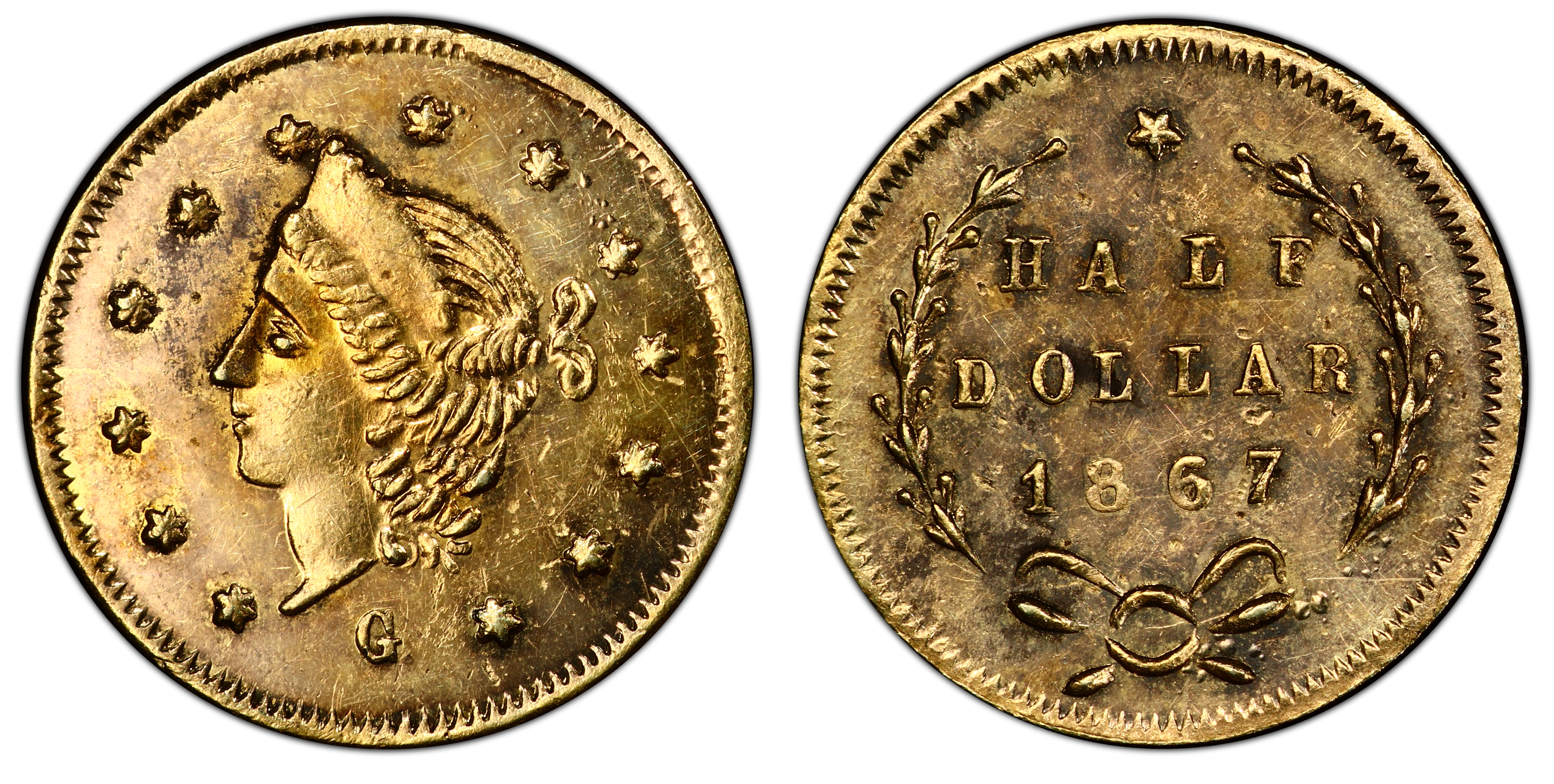
Obverse & Reverse
The 1867 G50C BG-1018 is a product of the second period of California Fractional Gold production (1859-1882). Following the initial Gold Rush boom, the acute shortage of small circulating coinage had been somewhat alleviated by the output of the San Francisco Mint, which opened in 1854. However, local commerce, particularly for small daily transactions, still faced challenges. The first wave of fractional gold (Period One, 1852-1857) was struck out of genuine necessity to facilitate trade. By the time this 1867 piece was created, the dynamic had shifted. While still serving a limited monetary role, these Period Two issues were increasingly produced as souvenirs, keepsakes, and curiosities for tourists and locals nostalgic for the height of the Gold Rush. The Coinage Act of 1864 had made private coinage illegal, but the law was not strictly enforced in the West until the early 1880s, allowing jewelers and private minters to continue their work. These tiny gold pieces, often containing less gold than their face value implied, functioned as a form of token currency, accepted by local merchants who understood their intrinsic and practical value. The minters, frequently jewelers by trade, leveraged their skills to create these intricate, miniature coins. The production method was typically manual, using a hammer to strike the dies, which often resulted in inconsistent strike quality and numerous die varieties. The BG-1018, with its classic Liberty Head motif, emulated the designs of official U.S. coinage to foster public acceptance and trust, a common practice among private minters of the era. These coins are not just economic artifacts; they are symbols of the enduring legacy of the Gold Rush and the independent, entrepreneurial spirit that defined 19th-century California.
Associated EventCalifornia Gold Rush Era
Reason For MintingTo supplement the scarce supply of official small denomination coinage and to serve as popular souvenirs of the Gold Rush.
Minter HistoryRobert B. Gray & Co. was a prominent San Francisco jewelry firm known for producing a variety of California Fractional Gold pieces. Like many of their contemporaries, they were not a formal mint but rather skilled craftsmen who identified a commercial niche. Their issues are often identified by a small 'G' initial, although not all their attributed pieces bear this mark. They operated during a period when the lines between jeweler, assayer, and private minter were often blurred, capitalizing on the high demand for both currency and gold-related novelties in the bustling post-Gold Rush economy.
Historical SignificanceThe BG-1018 is significant as a representative of the 'jeweler's issue' or Period Two fractional gold coins. It illustrates the transition of these pieces from purely utilitarian currency to commercial souvenirs, reflecting the evolving economy and culture of California more than a decade after the initial gold strikes. Its existence demonstrates the prolonged local need for small change and the federal government's slow extension of monetary authority to its western territories.
N/A
DenominationG50C
Minting Period1867
Assayer/MinterAttributed to Robert B. Gray & Co.
Geographic OriginSan Francisco, California
Obverse DescriptionA Liberty Head facing left, modeled after the contemporary designs of official U.S. gold coinage. The portrait is surrounded by thirteen stars, representing the original colonies.
Obverse Inscription1867
Reverse DescriptionThe denomination '1/2' is enclosed within a wreath. The wreath is open at the top.
Reverse Inscription1/2
CompositionGold
Stated Fineness Actual FinenessVariable, typically ranging from 14 to 22 carats. Period Two issues often had lower gold content than Period One issues.
Weight0.25 grams
Diameter10.00 mm
EdgePlain
Unknown
Survival Estimate75-125
Rarity ScaleR-4+
This coin appeals to collectors for its direct connection to the California Gold Rush, its miniature artistry, and its status as a tangible piece of private minting history. The BG-1018 is a popular, collectible variety within the extensive and complex series of fractional gold. Prooflike (PL) examples are especially desirable for their reflective surfaces and enhanced eye appeal.
Key VarietiesThe primary variety is the regular business strike. No original proof strikings are known. Collectors should be aware of the distinction between Period One (circulating currency) and Period Two (souvenir) issues within the broader series, as this greatly affects historical context and value. While there are over 500 Breen-Gillio varieties in the entire series, the BG-1018 itself does not have major documented sub-varieties from its original minting period. No special collector restrikes are known for this specific variety.
Authentication TipsGenuine pieces are typically very thin and lightweight. Many were crudely struck by hand, so weak or uneven strikes can be a sign of authenticity. Counterfeits are often thicker, have a soapy or cast-like appearance, and may feature incorrect design details, such as bears on the reverse, which were not used on genuine 19th-century issues. A key diagnostic is the presence of the denomination; authentic Period Two pieces are denominated, whereas many later souvenir tokens are not to comply with the law. Verification by a reputable third-party grading service (PCGS or NGC) is highly recommended.
Shopping ConsiderationsFor a premium quality BG-1018, look for a sharp, well-centered strike, particularly on the stars and the details of the wreath. Original, lustrous surfaces are paramount; many surviving examples have been cleaned or polished, which severely impacts their value. A Prooflike (PL) designation from a grading service indicates superior surface reflectivity and commands a significant premium. Avoid examples that are bent, holed, or have significant rim damage, as these were common issues for such small, delicate coins. Eye appeal is key; an example with a pleasing, original reddish-gold hue will be more desirable than a washed-out or discolored specimen.
A coin's grade is its condition, rated on a 1-70 scale. For rare coins, this is the most critical factor in determining value, as a tiny difference in preservation can mean a huge difference in price.
Relevant Grade TypesOriginal period issues were business strikes intended for circulation and as souvenirs, and are found in Circulated (1-58) and Mint State (MS, 60-70) grades. No proofs were struck during the original period of issue. The 'PL' (Prooflike) designation is a modifier applied to business strikes that exhibit mirror-like surfaces from being struck with fresh, polished dies. These are not a separate issue type but are highly prized variants of the regular strike.
Mint State CharacteristicsAn uncirculated BG-1018 is defined by the absence of wear. Quality is determined by the strength of the strike, the quality of the luster, and the presence of contact marks. Strikes are often inconsistent due to the hammer-striking process; a fully struck example with sharp details on Liberty's hair and the wreath is rare and desirable. Luster is typically satiny or, in the case of PL examples, highly reflective. Due to their small size and handling in groups, even high-grade specimens can show minor contact marks.
Circulated Wear PatternsWear first appears on the highest points of the design: Liberty's cheek, hair, and the high points of the wreath leaves on the reverse. As wear progresses, the stars on the obverse will begin to lose their definition and merge with the fields. In lower grades (VF and below), the date and the fraction on the reverse will become faint.
Key Factors For ValueFor the BG-1018, the most significant value drivers are grade and surface quality. A Mint State coin is worth substantially more than a circulated one. The 'PL' designation can multiply the coin's value. Beyond grade, eye appeal plays a crucial role; collectors will pay a premium for a sharply struck coin with clean, original surfaces and attractive toning. Conversely, coins that have been cleaned, polished, or damaged are heavily penalized in the market. A CAC sticker, indicating premium quality for the grade, adds a significant premium.
PCGS Price Guide
| Grade | Price | Population |
|---|---|---|
| 62 | N/A | 1 |
| 63 | $775.00 | 1 |