1852 G50C BG-1076, PL (Regular Strike)
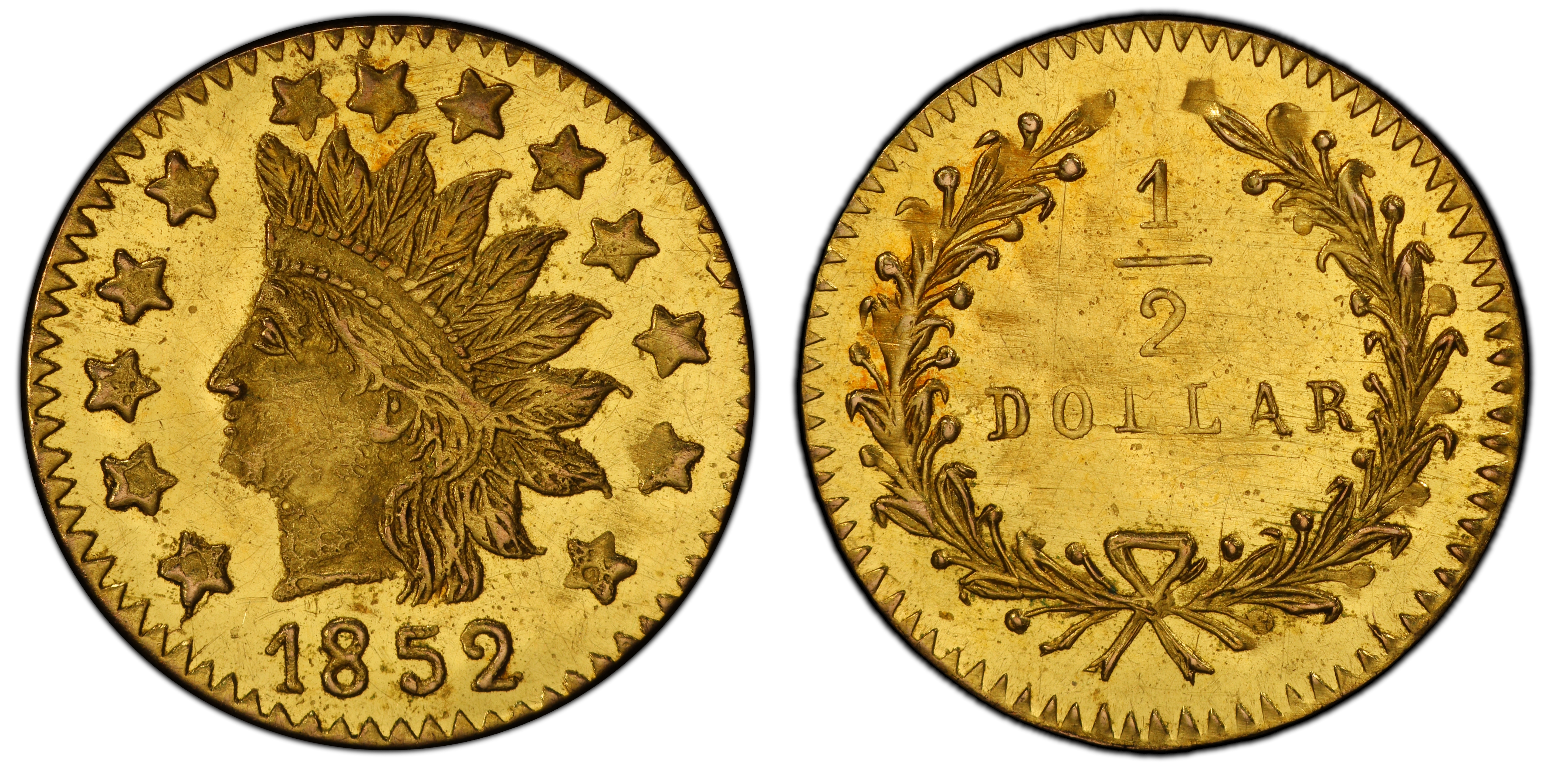
Obverse & Reverse
The 1852 BG-1076 50 Cents piece is a quintessential artifact from the first period (1852-1857) of private California gold coinage, a direct response to the acute shortage of small-denomination currency that plagued the booming economy of the Gold Rush. Following the discovery of gold at Sutter's Mill in 1848, a massive influx of prospectors and merchants descended upon California, creating vibrant, chaotic marketplaces. While raw gold dust and nuggets were abundant, they were impractical for everyday transactions. A 'pinch' of gold for a drink at a saloon was an imprecise and often contentious method of payment. The smallest circulating U.S. coin was the silver trime, and the smallest gold coin was the dollar, leaving a massive gap for subsidiary coinage. Into this monetary vacuum stepped enterprising jewelers and metalsmiths, many of French origin, who possessed the skills to strike coins. Antoine Louis Nouizillet, a San Francisco jeweler, was one of these key figures. Using locally sourced gold, which naturally contained a high silver content giving the coins a lighter color, these minters produced quarter dollar, half dollar, and dollar pieces. The BG-1076 variety, with its Indian Head motif, was a product of this initial wave of necessity-driven coinage. These tiny coins, often crudely struck by hand with a hammer, were not official U.S. issues but were accepted in local commerce due to the dire need for a medium of exchange. Their intrinsic value was almost always less than their face value, making them technically tokens, but their utility was undeniable. As the U.S. established a branch mint in San Francisco in 1854 and federal coinage became more plentiful, the commercial need for these fractional pieces waned. Many were likely melted down. By the second period of fractional gold (1859-1882), production shifted from serving commerce to satisfying the growing demand for souvenirs and jewelry items, solidifying their legacy as cherished mementos of one of America's most dynamic eras.
Associated EventCalifornia Gold Rush
Reason For MintingTo alleviate a severe shortage of small-denomination coinage for daily commercial transactions in Gold Rush-era California.
Minter HistoryAntoine Louis Nouizillet was a French jeweler who operated a business in San Francisco during the Gold Rush. He was a key producer of Period One (1852-1856) California fractional gold. Like many of his contemporaries, he utilized his skills as a metalsmith to meet the region's desperate need for small change. Nouizillet was also involved in several partnerships that produced fractional gold, including Deriberpe and Nouizillet (marked D.N.) and Nouizillet and F. Routhier (N.R.). Around 1859, he sold his business, including his dies and punches, to another jeweler, Robert B. Gray, who continued to produce fractional gold pieces.
Historical SignificanceThe BG-1076 and its contemporaries represent a fascinating chapter in American monetary history, demonstrating private enterprise stepping in to solve a critical failure in the supply of official government currency. They are tangible links to the daily life of miners and merchants during the Gold Rush and are among the most iconic and collected private territorial issues. Their existence highlights the economic chaos and ingenuity that defined the American West.
N/A
Denomination50 Cents
Minting Period1852
Assayer/MinterAntoine Louis Nouizillet
Geographic OriginSan Francisco, California
Obverse DescriptionA Native American portrait in profile facing left, commonly referred to as an Indian Head. The portrait wears a feathered headdress. The field is surrounded by thirteen six-pointed stars, with the date 1852 below the truncation of the bust.
Obverse Inscription1852
Reverse DescriptionA simple wreath composed of two branches tied together at the bottom with a bow. Within the wreath, the denomination is expressed on two lines as '50 CENTS'. The legend 'CALIFORNIA GOLD' encircles the wreath along the upper periphery.
Reverse InscriptionCALIFORNIA GOLD / 50 CENTS
CompositionGold
Stated Fineness Actual FinenessVaries, typically 14 to 22 karats. Period One issues were generally of higher fineness than later issues but were still intrinsically worth less than their face value.
EdgePlain
Unknown
Survival EstimateFewer than 75; likely in the 31-75 range.
Rarity ScaleLow R-6
This variety is highly sought after as a representative of the earliest period of fractional gold production. Its simple, classic design, direct connection to the Gold Rush, and high rarity make it a prized possession for specialists in territorial gold and pioneer numismatics.
Key VarietiesThe BG-1076 is a specific die marriage and is collected as such. No major varieties are noted for this specific issue. There are no known original proof strikes or later restrikes. The most significant numismatic example is the Jay Roe collection specimen, which was used as the plate coin in the second edition of the Breen-Gillio reference 'California Pioneer Fractional Gold.' Being the reference plate coin grants this specific example a unique and highly desirable pedigree.
Authentication TipsGenuine Period One fractionals like BG-1076 were struck, not cast. Look for sharp details (commensurate with the grade) and a lack of casting bubbles or seams. The 'feel' of the coin should be correct; fakes are often made of brass and can feel light or have an incorrect luster. A key diagnostic for many fakes and modern replicas is the presence of a bear on the reverse; genuine Period One issues do not feature bears. The best authentication method is comparison to known genuine examples, such as the plate coin image in the Breen-Gillio reference, and professional certification by PCGS or NGC.
Shopping ConsiderationsFor a premium quality example, look for a sharp, well-centered strike, as many were crudely produced by hand. The stars on the obverse and the lettering on the reverse are often unevenly impressed; a coin with full, clear legends commands a premium. Seek examples with original, undisturbed surfaces that exhibit the characteristic lighter gold color from the natural silver alloy. Avoid coins that have been harshly cleaned, polished, or used as jewelry, as is common for the type. High-grade examples often exhibit prooflike or reflective fields, which are highly desirable. Given the rarity, any example without significant impairments is considered a worthy acquisition.
A coin's grade is its condition, rated on a 1-70 scale. For rare coins, this is the most critical factor in determining value, as a tiny difference in preservation can mean a huge difference in price.
Relevant Grade TypesAll original examples of BG-1076 are business strikes intended for circulation and are found in Circulated (1-58) and Mint State (MS, 60-70) grades. No proofs were struck during the original minting period. While some examples may be described as 'Prooflike' (PL) due to polished dies, this is a surface characteristic of a business strike, not a separate method of manufacture. There are no known later-date collector restrikes.
Mint State CharacteristicsUncirculated examples of BG-1076 are rare. Strike quality varies significantly due to the hammer-striking process. A top-tier specimen will show sharp definition on the feathers of the headdress and the details of the wreath. The luster is typically frosty to semi-prooflike. The fields are prone to light handling marks and striations from the primitive planchet preparation process. A fully struck coin with clean, reflective fields is exceptionally rare and desirable.
Circulated Wear PatternsWear first appears on the high points of the design. On the obverse, friction will first dull the luster on the Indian's cheek, the eyebrow, and the highest feathers in the headdress. On the reverse, the highest points of the wreath's leaves and the bow will show initial wear. In lower grades (VF and below), the finer details of the feathers will merge, and the letters in the legends will begin to soften and fade into the fields.
Key Factors For ValueThe primary value drivers are grade and surface quality. An example with original, uncleaned surfaces commands a significant premium over a cleaned or polished coin of the same grade. Strike quality is also critical; a fully struck piece is much more valuable than a weakly impressed one. Eye appeal, including attractive original color and any prooflike contrast, adds significantly to the value. Finally, a pedigree to a famous collection, such as the Jay Roe collection (which contained the Breen-Gillio plate coin for this variety), adds immense desirability and market value. A CAC sticker for this issue confirms premium quality for the grade and results in a substantial price increase.
PCGS Price Guide
| Grade | Price | Population |
|---|---|---|
| 63 | $1,375.00 | 1 |
| 67 | N/A | N/A |