1875 G$1 BG-1126, PL (Regular Strike)
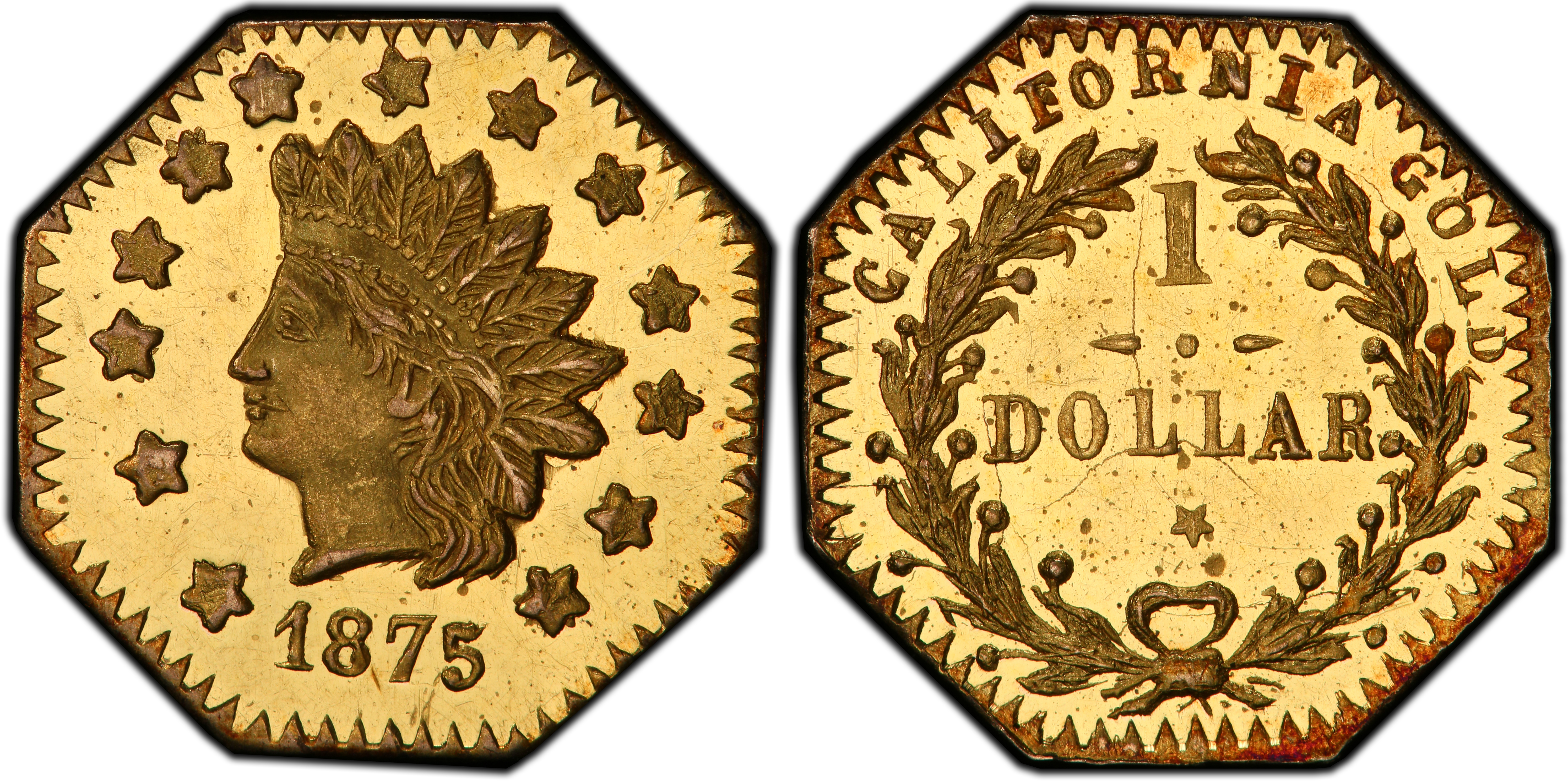
Obverse & Reverse
The 1875 Octagonal Gold Dollar, cataloged as Breen-Gillio 1126, is a quintessential example of a 'Period Two' California Fractional Gold piece. These fascinating and diminutive coins arose from the unique economic conditions of California, which remained flush with gold but starved for small-denomination coinage long after the initial 1849 rush. The first period of fractional gold (1852-1857) saw pieces struck with the genuine intent of serving as circulating money to alleviate a severe shortage of federal coinage. However, by the 1870s, the landscape had changed. The San Francisco Mint was in full operation, and the immediate, desperate need for private coinage had subsided. The second period (1858-1882) issues, often termed 'jeweler's pieces,' were produced in a legally grey area. The Coinage Act of 1864 had expressly forbidden private coinage, but enforcement in the West was lax until the early 1880s. Enterprising jewelers like Christopher Mohrig continued to strike fractional gold, catering to a new market: not just commerce, but tourism and nostalgia. These tiny gold pieces were popular as souvenirs, mementos of the romanticized Gold Rush era, and were often used in jewelry. As such, their gold content was frequently less than their face value would imply, a fact generally understood and accepted by the public who used them more as tokens than true money. The BG-1126 was struck in this environment, a product of lingering tradition and commercial opportunism. Its octagonal shape was a nod to the massive $50 'slugs' of the Gold Rush's peak, adding to its historical appeal. Surviving examples are tangible links to post-Gold Rush San Francisco, a city rapidly transforming but still defined by the precious metal that built it.
Associated EventPost-Gold Rush California Economy
Reason For MintingPrimarily struck to be sold as souvenirs and keepsakes, capitalizing on the romanticism of the Gold Rush, rather than to fill a circulating coinage need.
Minter HistoryChristopher Ferdinand Mohrig was a prominent and prolific San Francisco jeweler and die-sinker. He is believed to have been a key figure in the production of Period Two California Fractional Gold. Unlike the semi-anonymous nature of many earlier minters, Mohrig's work is better documented. He operated a successful business and was known for producing a wide variety of tokens, medals, and fractional gold pieces. His designs, often featuring Indian heads or Liberty heads, were characteristic of the era's aesthetic. The pieces attributed to him are generally well-made for the type, though often underweight, reflecting their primary purpose as commercial novelties rather than official currency.
Historical SignificanceThe BG-1126 represents the evolution of California Fractional Gold from a necessary medium of exchange to a popular souvenir item. It highlights the lax enforcement of federal coinage laws in the 19th-century American West and the entrepreneurial spirit of San Francisco jewelers who created a market for tangible, golden reminders of the region's unique history. Its existence is a testament to the enduring legacy and allure of the California Gold Rush.
N/A
Denomination$1
Minting Period1875
Assayer/MinterChristopher Ferdinand Mohrig
Geographic OriginSan Francisco, California
Obverse DescriptionFeatures a stylized Indian Head, facing left. The portrait is adorned with a feathered headdress. Thirteen stars, representing the original colonies, encircle the bust along the octagonal border. The date, 1875, is positioned below the truncation of the neck.
Obverse Inscription1875
Reverse DescriptionA wreath of two branches, tied with a bow at the bottom, encircles the denomination. The design is simple and functional, typical of the jeweler's issues of the period. Die cracks are commonly noted within the wreath on this variety.
Reverse Inscription1 DOLLAR
CompositionGold
Stated Fineness Actual Fineness EdgePlain
Unknown
Survival Estimate31-75
Rarity ScaleR-5
The BG-1126 is popular for its classic Indian Head design, desirable octagonal shape, and status as a scarce, attributable one-dollar denomination from the widely collected California Fractional Gold series. Its connection to a known minter, C.F. Mohrig, adds to its historical appeal.
Key VarietiesThe primary variety distinction for collectors is the quality of the surfaces. Business strikes are the norm, but deeply mirrored, Prooflike (PL) examples are highly sought after and command significant premiums. No true Proofs were struck, and there are no known major die varieties from the original minting period. Collectors should be aware of modern replicas, which are typically gold-plated brass and have no numismatic value.
Authentication TipsGenuine pieces were hammer-struck, often resulting in slightly uneven strikes or weakness in peripheral details. Look for sharp, albeit sometimes crude, details compared to the soft, soapy look of modern casts. The gold should have a natural, slightly alloyed color, not the bright, brassy look of modern plated fakes. The inscription 'DOLLAR' is a key diagnostic; many contemporary counterfeits and later tokens omitted this word to circumvent counterfeiting laws. Finally, comparing the piece to high-resolution images of certified examples can help identify die markers, such as the known die cracks on the reverse of BG-1126.
Shopping ConsiderationsA premium quality example of BG-1126 is defined by a sharp, well-centered strike, especially on the high points of the Indian's cheek and headdress feathers, and on the details of the wreath. Original, lustrous surfaces are paramount; many examples have been cleaned or used as jewelry, and these should be avoided or purchased at a significant discount. Look for coins with attractive, undisturbed reddish-gold or olive-gold patina. Prooflike (PL) designated examples are particularly desirable and represent the pinnacle of quality for this issue. Check carefully for hidden problems like tooling in the fields to 'improve' the appearance, or evidence of having been removed from a bezel.
A coin's grade is its condition, rated on a 1-70 scale. For rare coins, this is the most critical factor in determining value, as a tiny difference in preservation can mean a huge difference in price.
Relevant Grade TypesAll original 1875 BG-1126 dollars were produced as business strikes for commercial sale. They are found in Circulated grades (AG-3 to AU-58) and, more commonly for this souvenir-driven issue, in Mint State (MS-60 to MS-70). No true Proof (PR/PF) examples were struck during the original period of issue. However, due to the use of polished dies on polished planchets to enhance their appeal as novelties, many specimens exhibit highly reflective, mirror-like surfaces. When these characteristics are exceptional, grading services designate them as Prooflike (PL), which is a desirable attribute of a business strike, not a separate type of minting.
Mint State CharacteristicsUncirculated examples of BG-1126 are defined by their luster, which can range from soft and satiny to deeply prooflike. Strike quality varies; a sharp strike across all elements is rare and highly valued. Due to the primitive minting process and soft gold, even high-grade Mint State examples will typically show minor planchet imperfections or faint handling marks. Weakness is often seen on the stars or parts of the wreath. A superior MS coin will have strong luster, a solid strike for the issue, and minimal, non-distracting marks.
Circulated Wear PatternsWear first appears on the highest points of the design. On the obverse, check for friction and flattening on the Indian's cheekbone, the eyebrow, and the tips of the highest feathers in the headdress. On the reverse, the highest points of the leaves and the bow of the wreath will show wear first. In lower circulated grades (Fine and below), the date and stars will begin to merge with the fields, and the individual leaves of the wreath will become indistinct.
Key Factors For ValueFor the BG-1126, the primary value drivers are grade and surface quality. A high-grade Mint State coin (e.g., MS-63 or higher) is worth multiples of a circulated or low-end uncirculated piece. The presence of a Prooflike (PL) designation from PCGS or NGC adds a significant premium. Eye appeal is critical; examples with original, uncleaned surfaces and attractive golden toning are highly prized. Conversely, coins that have been harshly cleaned, polished, or damaged (e.g., from jewelry use) are penalized heavily in the market. A CAC sticker, indicating premium quality for the grade, adds a strong premium for this series.
PCGS Price Guide
| Grade | Price | Population |
|---|---|---|
| 62 | N/A | 1 |
| 63 | $2,750.00 | N/A |
| 63+ | $3,250.00 | N/A |
| 64 | $4,500.00 | 1 |