1876/5 G$1 BG-1129, PL (Regular Strike)
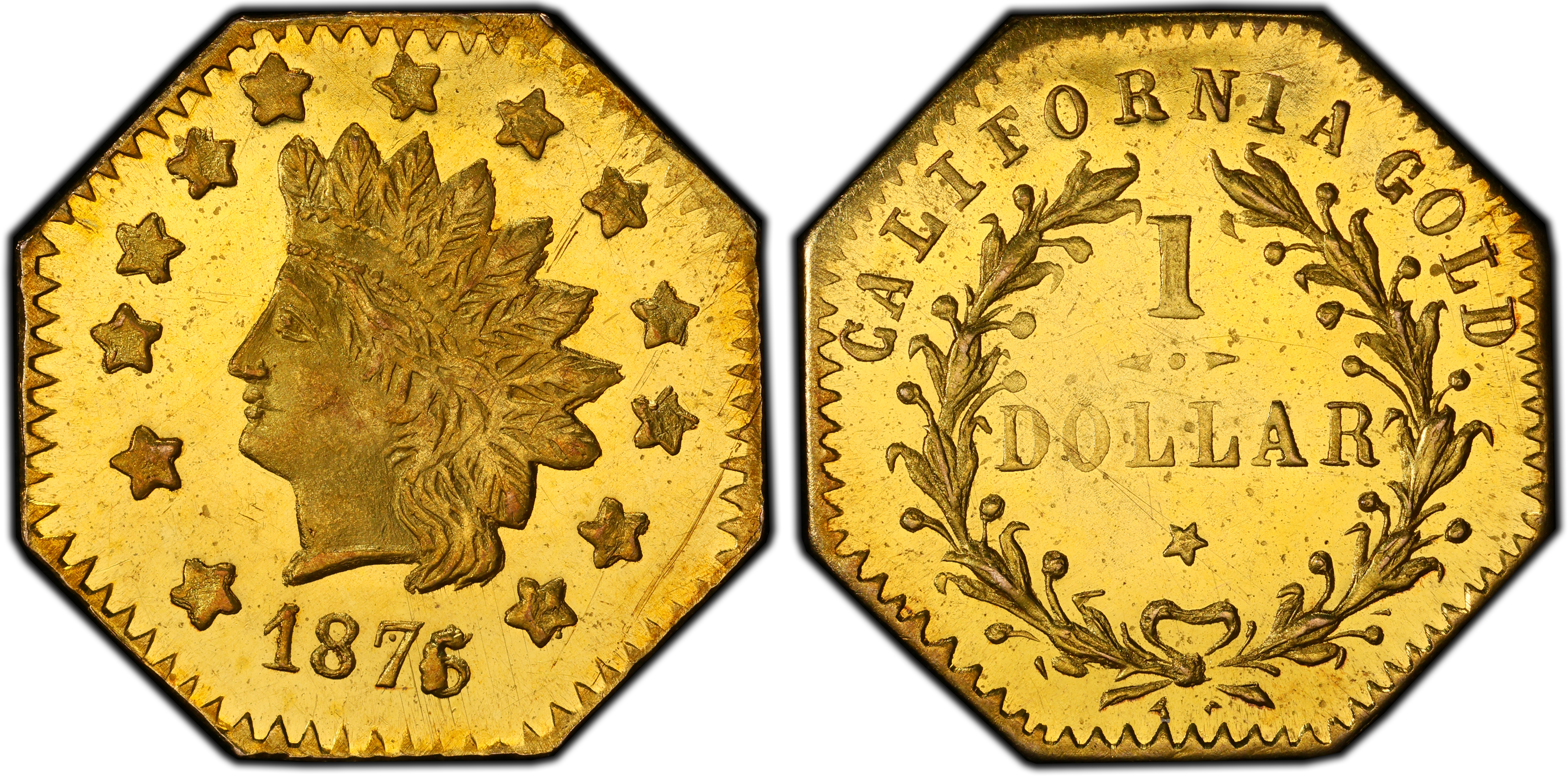
Obverse & Reverse
The 1876/5 BG-1129 Gold Dollar emerged from the second period (1859-1882) of California Fractional Gold production, a fascinating era that saw these miniature coins transition from instruments of commerce to popular souvenirs. By the mid-1870s, the initial impetus for fractional gold—an acute shortage of small change during the Gold Rush—had long subsided. The San Francisco Mint was in full operation, supplying the region with federal coinage. Instead, a robust market for mementos of the romanticized Gold Rush era had developed, catered to by jewelers and private minters. These 'jeweler's issues' were lighter and often of lower fineness than their Period One predecessors, with their value rooted more in novelty than in bullion. Christopher Ferdinand Mohrig, a San Francisco jeweler, was a prolific producer during this time, creating a wide array of attractive designs. However, his enterprise operated under a legal cloud. The Coinage Act of 1864 explicitly forbade private coinage, but enforcement was inconsistent. This legal ambiguity came to an abrupt end for Mohrig on August 10, 1876, when he was arrested by the U.S. Secret Service for violating the 1864 law. His dies and existing stock of coins were confiscated and subsequently destroyed. This event is critical to the history of the BG-1129; any examples dated 1876 were struck just before this raid, making them among the last of their kind from his workshop and contributing significantly to their rarity. The 1876/5 overdate feature itself tells a story of practicality, where Mohrig repurposed a leftover 1875 die to meet production needs for the new year, a common practice among private minters looking to economize.
Associated EventCalifornia Gold Rush aftermath and tourism boom
Reason For MintingPrimarily produced as souvenirs and keepsakes for tourists and collectors, rather than for general circulation.
Minter HistoryChristopher Ferdinand Mohrig was a prominent San Francisco jeweler and one of the key figures in the production of Period Two California Fractional Gold. He is credited with a wide range of varieties cataloged in the Breen-Gillio reference (from BG-790 through BG-799V and others). His minting operations ceased abruptly on August 10, 1876, upon his arrest by the Secret Service for the illegal manufacture of private coins. The confiscation and destruction of his equipment explain the scarcity of many of his later issues.
Historical SignificanceThe BG-1129 is significant as a tangible artifact from the end of the legal gray area for private minting in California. Its date and minter are directly tied to federal enforcement actions that effectively halted this unique chapter of American numismatic history. It represents the final evolution of fractional gold from a circulating medium to a commercial souvenir before its ultimate suppression.
BG-1129
Denomination$1
Minting Period1876
Assayer/MinterChristopher Ferdinand Mohrig
Geographic OriginSan Francisco, California
Obverse DescriptionAn Indian Head, facing left, wearing a feathered warbonnet. The portrait is encircled by 13 six-pointed stars. The date, showing a 6 clearly punched over a 5, is positioned below the bust truncation.
Obverse Inscription1876/5
Reverse DescriptionThe denomination '1 DOLLAR' is displayed across two lines within a dense wreath of leaves and berries. The wreath is open at the top.
Reverse Inscription1 DOLLAR
CompositionGold
Stated Fineness Actual FinenessTypically varied for Period Two issues, often between .500 and .800 fine.
Weight0.48 grams
Diameter11.50 mm
EdgePlain
Unknown
Survival Estimate76-200 (Consistent with R-4 rating)
Rarity ScaleR-4
This variety is highly sought after for its clear 1876/5 overdate, its connection to the historically significant minter C.F. Mohrig, and the story of his arrest which ended production. The scarce Prooflike (PL) examples, with their mirrored fields, command a significant premium and are prized for their exceptional eye appeal.
Key VarietiesThe primary variety is the 1876/5 overdate itself. No major sub-varieties from the original minting period are widely recognized. No later-date restrikes or patterns are known to exist for this specific Breen-Gillio number.
Authentication TipsGenuine examples are characteristically thin and struck in solid gold, not plated. A key diagnostic for Mohrig's work is a frequent softness of strike in the central areas. For the BG-1129, examine the overdate carefully; the underlying '5' should be clearly visible, particularly its upper and lower curves, beneath the '6'. Counterfeits are often thicker, have a soapy or cast-like appearance, and may exhibit incorrect details in the wreath or the style of the numerals. The presence of original, flashy, prooflike surfaces is a good indicator of authenticity, as this finish is difficult for forgers to replicate convincingly.
Shopping ConsiderationsA premium quality example for its grade will exhibit intensely reflective, prooflike fields, which provide a strong cameo contrast with the devices. While central softness on the Indian's cheek and the wreath is typical and should be expected, look for examples where the peripheral details—stars, date, and legends—are as sharp as possible. Luster and pristine surfaces are paramount; avoid specimens that have been harshly cleaned, polished, or show evidence of being mounted in jewelry (a common fate for these pieces). The 1876/5 overdate should be bold and unambiguous. A CAC sticker on a PL-designated coin provides third-party verification of premium quality and is highly desirable for this issue.
A coin's grade is its condition, rated on a 1-70 scale. For rare coins, this is the most critical factor in determining value, as a tiny difference in preservation can mean a huge difference in price.
Relevant Grade TypesOriginal issues are business strikes, though many were struck with polished dies and sold as souvenirs, not intended for heavy circulation. They are found in Circulated (1-58) and, more commonly, Mint State (MS, 60-70) grades. The 'PL' (Prooflike) designation is a crucial qualifier for high-grade examples and indicates deeply mirrored surfaces, distinct from the satiny luster of a standard business strike. No true Proofs were struck during the original period of issue.
Mint State CharacteristicsUncirculated examples of BG-1129 are defined by their surface preservation and luster quality. A typical strike exhibits weakness on the high points of the Indian's cheek and the center of the wreath. The key differentiator for top-tier examples is the quality of the fields; PL (Prooflike) and DMPL (Deep Mirror Prooflike) specimens boast watery, reflective surfaces that create a beautiful cameo effect. Due to their small size and handling as souvenirs, even high-grade pieces may show minor ticks or hairlines, but the most desirable examples are clean and free of distracting marks.
Circulated Wear PatternsWear first appears on the highest points of the design. On the obverse, friction will dull the luster and show flatness on the Indian's cheekbone, the bridge of the nose, and the feathers at the top of the headdress. On the reverse, the highest leaves and berries in the center of the wreath will be the first to show wear. In lower grades (VF and below), the date and stars will begin to lose their sharpness.
Key Factors For ValueThe single most important value driver is the Prooflike designation. A certified MS-63 PL is worth significantly more than a standard MS-63. Beyond that, the strength of the overdate, the degree of cameo contrast, originality of the surfaces (avoiding cleaned or polished examples), and overall eye appeal are paramount. Central strike weakness is common and generally accepted, but examples with unusually sharp centers command a premium. A CAC sticker significantly increases value, confirming the quality of the grade and eye appeal.
PCGS Price Guide
| Grade | Price | Population |
|---|---|---|
| 63 | $2,250.00 | 1 |
| 63+ | $2,750.00 | N/A |
| 64 | $3,500.00 | 3 |
| 64+ | $3,850.00 | N/A |
| 65 | $4,250.00 | 1 |
| 65+ | $5,750.00 | N/A |
| 66 | $7,000.00 | 1 |