1871-L G50C BG-1029, PL (Regular Strike)
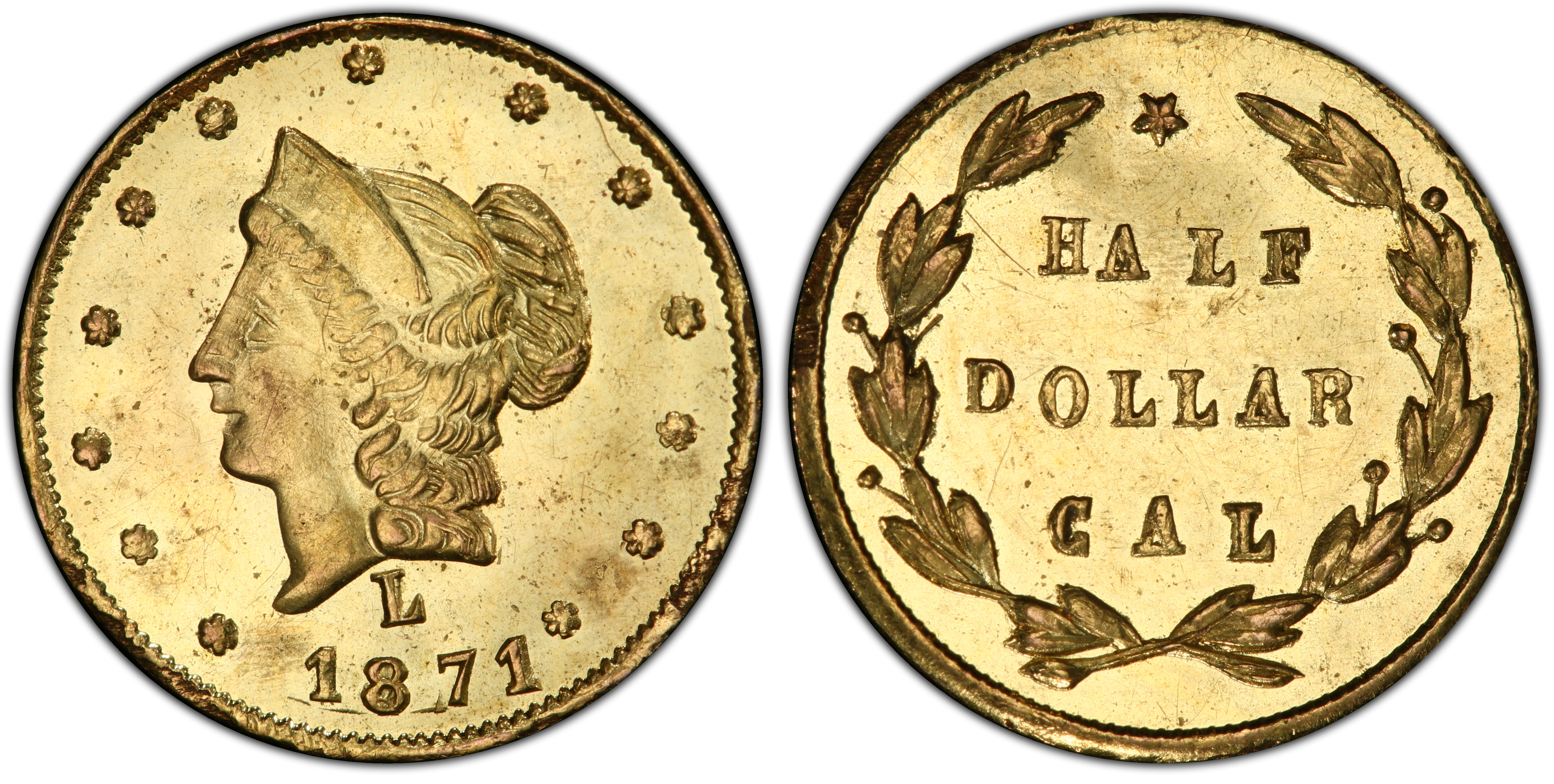
Obverse & Reverse
The 1871-L G50C, cataloged as Breen-Gillio 1029, is a quintessential example of 'Period Two' California Fractional Gold. These small-denomination gold pieces arose from a unique economic environment in post-Gold Rush California. While the initial wave of fractional gold (Period One, 1852-1857) was struck to alleviate a severe shortage of small change for daily transactions, the context for Period Two (1858-1882) had shifted dramatically. By the 1870s, the San Francisco Mint was in full operation, supplying ample federal coinage and rendering privately minted gold unnecessary for commerce. Instead, these later issues were primarily produced by jewelers as souvenirs, keepsakes, and novelty items for tourists and locals fascinated by the Gold Rush romance. They captured the allure of California gold in a tiny, affordable format. The minter, Antoine Louis Nouizillet, was a prominent French jeweler in San Francisco, one of several who dominated this trade. These jewelers often used shared die punches, leading to stylistic similarities across different makers' coins. The 'L' on this variety is believed to be the mark of a specific, though unidentified, die sinker working for Nouizillet. The production quality of Period Two pieces was often lower than their Period One predecessors, but they were made in a wider array of designs, including the classic Liberty Head seen here. Despite the Act of June 8, 1864, which prohibited private coinage, production of these 'tokens' or 'charms' continued, often with backdating to circumvent the law, though this 1871-dated piece was struck contemporaneously. Their low intrinsic value (the gold content was worth far less than 50 cents) confirmed their status as novelties rather than circulating money. Today, they are a complex and avidly collected series, representing the transition of California's economy from a frontier society to a more established state, and the romantic commercialization of its Gold Rush heritage.
Associated EventPost-California Gold Rush economic development and tourism.
Reason For MintingPrimarily struck to be sold as souvenirs, jewelry, and curiosities rather than to circulate as money.
Minter HistoryAntoine Louis Nouizillet was a French-born jeweler who operated in San Francisco during the mid-19th century. He was one of the key figures in the production of California Fractional Gold, particularly during Period One and the early part of Period Two. Around 1859-1860, Nouizillet sold his business, including his dies and punches, to Robert B. Gray & Co., another significant producer. However, evidence suggests Nouizillet or others continued to strike pieces using dies attributed to him, like this 1871 issue. His work is part of a larger, interconnected group of French jewelers, including M. Deriberpe and Frontier, Deviercy & Co., who collectively defined the style of these miniature gold pieces.
Historical SignificanceThis coin is significant not as a circulating medium, but as a tangible artifact of how the California Gold Rush was memorialized and commercialized. It represents a mature souvenir market that capitalized on the mystique of gold and the Wild West, a practice that continues to this day. Numismatically, it is an important piece within the vast and intricate Breen-Gillio classification system, which categorizes hundreds of varieties of these privately issued gold tokens.
BG-1029
DenominationG50C (Gold 50 Cents)
Minting Period1871
Assayer/MinterAntoine Louis Nouizillet
Geographic OriginSan Francisco, California
Obverse DescriptionA head of Liberty facing left, her hair tied in a bun, wearing a coronet. She is surrounded by 13 six-pointed stars. The date '1871' is below the bust, and the initial 'L' is in the field behind the neck.
Obverse Inscription1871
Reverse DescriptionThe denomination '1/2' is enclosed within a wreath of two olive branches tied with a ribbon at the bottom. The legend 'CALIFORNIA GOLD' encircles the top periphery of the wreath.
Reverse InscriptionCALIFORNIA GOLD 1/2
CompositionGold
Stated Fineness Actual FinenessVaries, but typically between 14 and 22 karats.
Weight0.25 grams
Diameter10.00 mm
EdgePlain
Unknown, but likely a few hundred to a few thousand.
Survival Estimate76-125 known.
Rarity ScaleR-4+
The BG-1029 is appealing for its classic Liberty Head design, specific attribution to a known 19th-century jeweler, and its status as a representative of the popular 'souvenir' era of fractional gold. The 'PL' (Prooflike) designation for some examples adds a significant layer of appeal, indicating they were struck with polished dies on polished planchets, resulting in mirrored fields.
Key VarietiesThe primary variety is the regular business strike. No major varieties from the original minting period are widely recognized for BG-1029 itself. There are no known official restrikes or patterns associated with this specific variety. The 'PL' or Prooflike designation is a manufacturing characteristic of certain regular-strike coins and not a separate issue, but is highly sought after by collectors.
Authentication TipsAuthentic pieces exhibit sharp, well-defined details, especially in the hair and stars, though strike weakness is common. The 'L' initial should match known exemplars in style and position. Counterfeits are common and often have a soapy, indistinct look, incorrect weight, or a brassy color. The style of the numerals in the date and the lettering is a key diagnostic; compare with high-resolution images from major grading services. The surfaces on genuine prooflike examples should show deep reflectivity in the fields, distinct from the frosted devices.
Shopping ConsiderationsA premium quality example for this variety, especially in MS-62 or higher, will exhibit a sharp strike with full details on Liberty's coronet and the wreath leaves. For 'PL' examples, the contrast between the mirrored fields and any frosted devices is paramount. Look for original, undisturbed luster and avoid pieces that have been cleaned, whizzed, or previously mounted in jewelry, a common fate for these items. Pay close attention to small, detracting contact marks on the high points of the design, such as Liberty's cheek and the '1/2' on the reverse. A CAC sticker on a coin of this type confirms its quality for the grade and often commands a significant premium.
A coin's grade is its condition, rated on a 1-70 scale. For rare coins, this is the most critical factor in determining value, as a tiny difference in preservation can mean a huge difference in price.
Relevant Grade TypesOriginal period issues were business strikes, though many were sold as souvenirs and never circulated. They are found in both Circulated (1-58) and Mint State (MS, 60-70) grades. No true Proofs were struck during the original period of issue. The 'PL' (Prooflike) designation is applied to business strikes that exhibit deeply mirrored surfaces from being struck with freshly polished dies, and these are considered a subset of the regular strike, not a separate issue like a true Proof.
Mint State CharacteristicsIn uncirculated grades, the BG-1029 typically shows bright, satiny luster. High-grade examples designated 'PL' have highly reflective, mirrored fields. The strike can be inconsistent; a well-struck example will show clear definition in Liberty's hair strands and the fine details of the wreath. Due to their small size and handling as novelties, even Mint State examples can have minor ticks and contact marks. The surfaces should have a consistent, original skin.
Circulated Wear PatternsWear first appears on the highest points: Liberty's cheek, the hair above the eye, and the coronet. On the reverse, the high points of the wreath leaves and the numerals '1/2' will show the first signs of friction. In lower circulated grades (VF and below), the stars will begin to lose their points and the legends will become soft.
Key Factors For ValueFor the BG-1029, the primary value drivers are grade and surface quality. A high Mint State grade (e.g., MS-63 or higher) carries a significant premium. The 'PL' designation can double the value or more compared to a non-PL coin in the same numerical grade. Originality is crucial; coins with original luster and attractive deep gold toning are prized over cleaned or polished examples. Strike sharpness is a key differentiator, with well-struck pieces commanding more. Finally, a CAC sticker provides third-party verification of quality and significantly increases market value.
PCGS Price Guide
| Grade | Price | Population |
|---|---|---|
| 62 | N/A | 1 |