1875/3 G50C BG-1058, PL (Regular Strike)
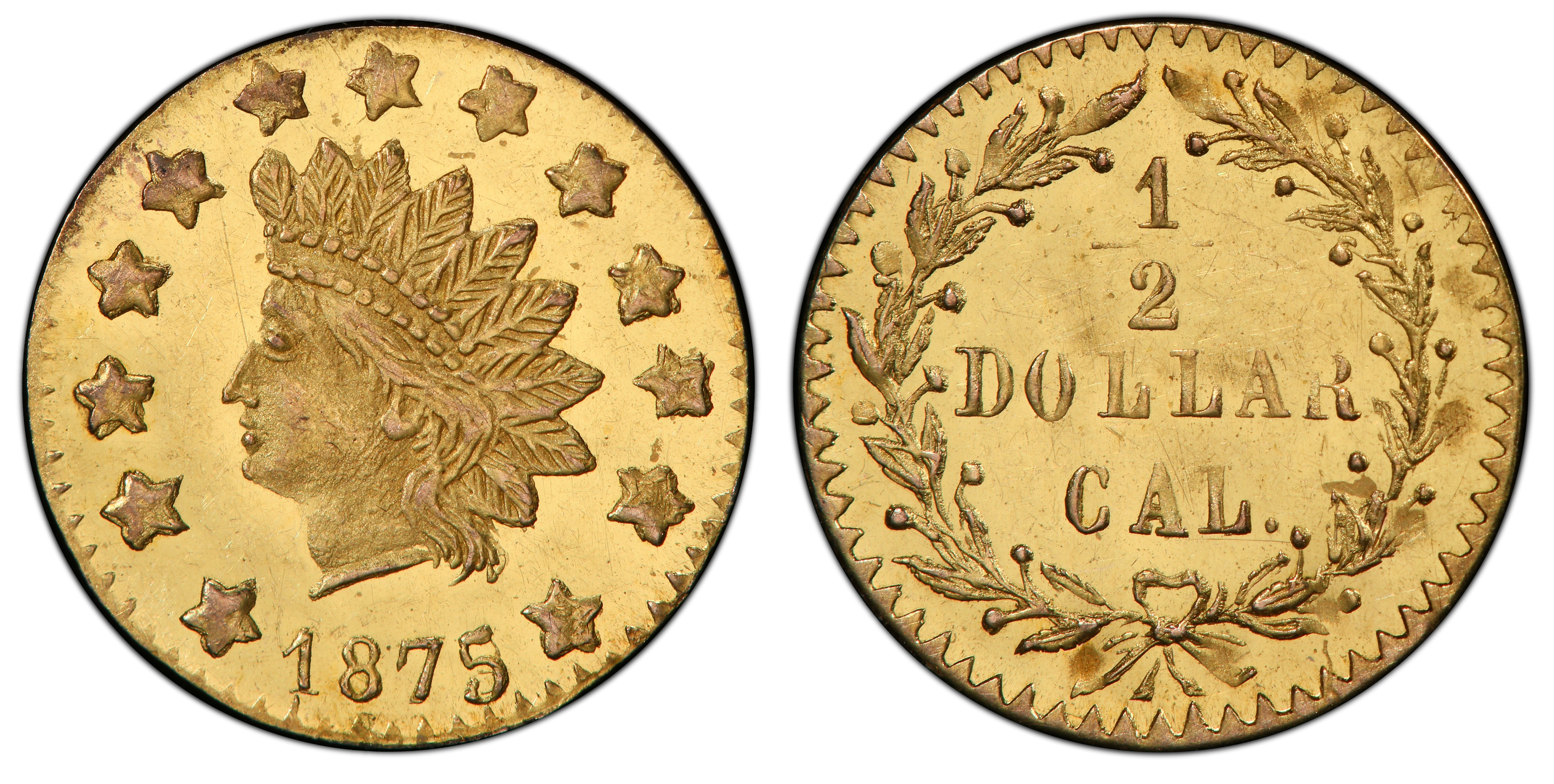
Obverse & Reverse
The issuance of California Fractional Gold, small-denomination gold tokens, represents a fascinating and complex chapter in American monetary history, born directly from the crucible of the Gold Rush. Following the initial strikes in 1848, a flood of gold dust and nuggets saturated the California economy, but a severe shortage of circulating small change persisted. The smallest U.S. coin was the silver half-dime, and even these were scarce on the West Coast. Miners and merchants were forced to use pinches of gold dust for minor transactions, a notoriously inaccurate and inconvenient system. To fill this commercial void, private jewelers and metallurgists began striking their own small-denomination coins in 25-cent, 50-cent, and one-dollar sizes starting in 1852. These pieces, often called 'tokens' or 'charms' to circumvent federal laws against private coinage, were indispensable for daily commerce. The 1875/3 BG-1058 variety emerged during the later 'Period Three' (1872-1882) of this coinage. By this time, the U.S. Mint in San Francisco was well-established, and the initial, desperate need for small change had subsided. The motivation for producing these later issues shifted. They were now primarily created as souvenirs and jewelry items, catering to a sense of nostalgia for the Gold Rush era and the public's fascination with California's golden identity. The overdate feature, 1875 punched over an 1873 die, is a telling detail, revealing the cost-saving measures of the private minters who would reuse and re-punch obsolete dies to continue production. While the minter is not explicitly named on the piece, numismatic scholarship, primarily through die state analysis by Mike Locke and others, attributes this variety to the workshop of Robert B. Gray & Co., a prominent San Francisco jewelry and die-sinking firm. These later-period pieces are often found with better-than-average strikes compared to their earlier, utilitarian counterparts, reflecting their intended market as keepsakes rather than workhorse currency.
Associated EventPost-California Gold Rush Economic Development
Reason For MintingPrimarily created as souvenirs and jewelry items during a period when the acute need for circulating small change had diminished.
Minter HistoryRobert B. Gray & Co. was a well-known San Francisco firm of jewelers, watchmakers, and die sinkers active in the latter half of the 19th century. While they did not sign their coinage dies, extensive die-state research and stylistic comparisons of punches and planchet characteristics have linked them to a significant number of Period Three California Fractional Gold pieces. Their work is generally characterized by competent engraving and consistent quality, reflecting their primary business as jewelers rather than emergency minters.
Historical SignificanceThe BG-1058, like other Period Three fractionals, marks the evolution of this private coinage from a vital commercial necessity to a nostalgic souvenir industry. It serves as a tangible link to the legacy of the Gold Rush and the unique economic conditions of 19th-century California. The overdate feature provides a clear window into the pragmatic and economical practices of private minters of the era.
BG-1058 (Breen-Gillio)
Denomination50 Cents
Minting Period1875
Assayer/MinterRobert B. Gray & Co. (presumed)
Geographic OriginSan Francisco, California
Obverse DescriptionA large, defiant-style bust of a female figure representing Liberty, facing left. She wears a beaded headdress or coronet inscribed with 'LIBERTY'. The portrait is surrounded by 13 six-pointed stars, seven to the left and six to the right. The date '1875' is below the bust.
Obverse InscriptionLIBERTY / 1875
Reverse DescriptionThe denomination '1/2' is enclosed within a wreath of two olive branches tied together at the bottom with a ribbon. The design is simple and unadorned, characteristic of the 'PL' (Plain) reverse type identified by Breen-Gillio.
Reverse Inscription1/2
CompositionGold
Stated Fineness Actual FinenessVaries, but typically between 10k and 14k (.417 to .585 fine).
Weight0.25 grams
Diameter9.80 mm
EdgePlain
Unknown
Survival Estimate50-75 known
Rarity ScaleR-5 (Very Scarce)
This variety is highly sought after due to the clear and dramatic 1875/3 overdate, which is visible even on circulated examples. It combines the general popularity of California Fractional Gold with the specific numismatic interest in die varieties. The 'Defiant Eagle' style Liberty Head is also considered attractive by collectors.
Key VarietiesThe primary variety for this specific issue is the 1875/3 overdate itself. Within the broader G50C category, there are dozens of varieties from different minters, dates, and with different design elements (e.g., Liberty heads vs. Indian heads, various wreath styles on the reverse). No special collector restrikes or patterns are known for this specific BG-1058 die marriage.
Authentication TipsThe key diagnostic is the clear remnant of the underlying '3' visible within the lower loop of the '5' in the date. The top curve of the '3' can often be seen just to the left of the top curve of the '5'. Genuine examples exhibit a specific die state, including characteristic die polishing lines and punch placements. Counterfeits of California fractionals are rampant; many are brass or low-karat gold and often have a soapy, indistinct look. Compare the style of the Liberty portrait and stars to high-resolution images of certified examples. Weight and diameter should be close to the established norms.
Shopping ConsiderationsA premium quality example for this variety is defined by a bold and clear overdate. Look for a sharp strike, especially on the letters of 'LIBERTY' in the coronet and the details of the wreath. The surfaces should be clean and free of distracting marks, tooling, or evidence of having been mounted in jewelry, which is a common issue for this series. Original, uncleaned surfaces with some remaining luster command a significant premium. Avoid examples with excessive cleaning, which imparts a dull, lifeless appearance, or those with significant rim bumps or scratches.
A coin's grade is its condition, rated on a 1-70 scale. For rare coins, this is the most critical factor in determining value, as a tiny difference in preservation can mean a huge difference in price.
Relevant Grade TypesOriginal period issues like BG-1058 were business strikes, although intended more as souvenirs than for heavy circulation. They are found in Circulated grades (AU-58 and below) and Mint State grades (MS-60 to MS-70). No Proof examples were struck during the original period of issue, and there are no known later-date collector restrikes for this specific die pairing.
Mint State CharacteristicsAn uncirculated BG-1058 will exhibit frosty or semi-prooflike luster in the fields. The strike is typically sharp for a Period Three issue, but weakness may sometimes be seen on the highest points, such as the hair detail above Liberty's eye and the bow on the reverse wreath. Because they were made as keepsakes, contact marks can be light, but many were mishandled over the years, so finding a truly 'gem' (MS-65 or higher) example is very difficult. The gold color can range from a bright yellow to a deeper reddish-orange depending on the alloy and original toning.
Circulated Wear PatternsWear first appears on the high points of Liberty's cheek, the hair just above her ear, and the 'LIBERTY' inscription on the coronet. On the reverse, the highest points of the wreath leaves and the ribbon bow will show initial flatness. In lower grades (VF and below), the stars will begin to lose their points and the date, particularly the overdate detail, can become less distinct.
Key Factors For ValueFor the BG-1058, value is driven by three main factors. First, the grade and surface quality; an example with original luster and minimal marks will always command a premium. Second, the strength and clarity of the 1875/3 overdate; the more dramatic and obvious the underlying '3', the more desirable the coin. Third, overall eye appeal is critical. Coins that have not been harshly cleaned and retain their original 'skin' and attractive gold toning are highly prized by specialists. A CAC sticker for this issue indicates superior quality for the grade and will add a significant premium.
PCGS Price Guide
| Grade | Price | Population |
|---|---|---|
| 62 | N/A | 1 |
| 63 | $700.00 | 1 |
| 63+ | $850.00 | N/A |
| 64 | $1,100.00 | 1 |
| 67 | N/A | N/A |