1870 G$1 BG-1118, PL (Regular Strike)
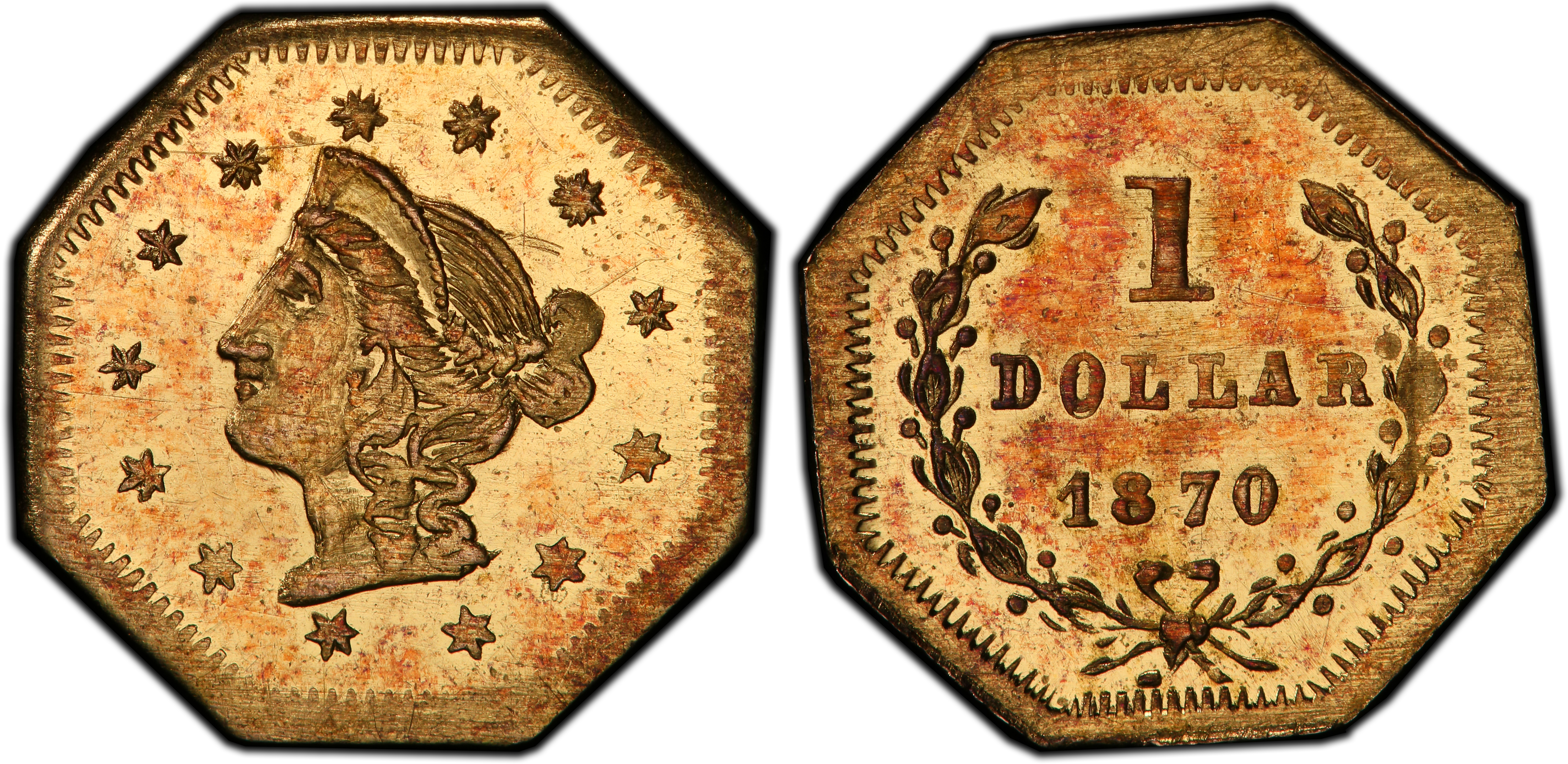
Obverse & Reverse
The 1870 G$1 BG-1118 belongs to the second major phase of California Fractional Gold production, designated by researchers Walter Breen and Ronald Gillio as 'Period Two: Suppressed Jewelers' Issues (1859-1882).' Unlike the earlier 'Period One' pieces that were struck to alleviate a severe shortage of small change during the Gold Rush, these later issues were created primarily as souvenirs and keepsakes. By 1870, the San Francisco Mint was producing ample federal coinage, rendering private issues for circulation unnecessary. Instead, jewelers like Robert B. Gray & Co. catered to a burgeoning tourist trade and a national fascination with the 'Wild West.' These tiny gold dollars were affordable mementos of a California visit or the Gold Rush adventure. Technically, the private minting of coins was made illegal by the Coinage Act of 1864. However, the law was not strictly enforced against these small, low-value tokens until the Secret Service cracked down in the early 1880s, effectively ending their production. The BG-1118 is a quintessential 'Period Two' issue. It was not intended to pass in commerce at its face value and its gold content was not commensurate with a federal dollar. Its production via the 'hammer method'—where a planchet was placed between two dies and struck with a sledgehammer—resulted in inconsistent strike quality. The BG-1118 is colloquially known to collectors as the 'Goofy Head' variety due to its crude, almost cartoonish engraving of the Liberty portrait, a stark contrast to the refined work of the U.S. Mint. This naive artistry, rather than being a detriment, has become its defining and most charming characteristic, making it a highly sought-after type coin within the series.
Associated EventPost-Gold Rush California Tourism
Reason For MintingTo serve as a popular and affordable souvenir for tourists and collectors, capitalizing on the romanticism of the California Gold Rush.
Minter HistoryRobert B. Gray & Co. was a prominent San Francisco manufacturing jeweler active during the 'Period Two' era of fractional gold. In late 1858 or 1859, Gray acquired the business of another fractional gold producer, Antoine Louis Nouzillet, including his dies and hubs. Gray produced pieces using Nouzillet's old dies before creating his own, which are often identifiable by a 'G' hallmark, though this is not present on the BG-1118 dollar. Gray's firm was a significant contributor to the souvenir gold market, known for producing some of the heavier and more intrinsically valuable Period Two issues. In 1871, Gray sold his interests to the California Jewelry Company.
Historical SignificanceThe BG-1118 is historically significant not as a circulating coin, but as a cultural artifact representing the commercialization of the Gold Rush legend. It marks the transition of fractional gold from a necessary medium of exchange to a nostalgic souvenir, illustrating how California's identity was packaged and sold to a curious nation.
BG-1118
Denomination$1
Minting Period1870
Assayer/MinterRobert B. Gray & Co.
Geographic OriginSan Francisco, California
Obverse DescriptionAn octagonal planchet featuring a crudely rendered Liberty Head facing left, surrounded by 13 stars. The portrait is distinct for its naive style, with simple, almost primitive features, earning it the 'Goofy Head' nickname. The hair is rendered with minimal detail, and the facial expression is somewhat vacant.
Obverse Inscription Reverse DescriptionThe central design is the denomination '1' and 'DOLLAR' on two lines, with the date '1870' below. This is enclosed within a wreath of 18 leaves (nine per side) tied with a bow at the bottom. The legend 'CALIFORNIA GOLD' appears in an arc above the wreath, following the upper octagonal edges.
Reverse InscriptionCALIFORNIA GOLD / 1 / DOLLAR / 1870
CompositionGold
Stated Fineness Actual FinenessTypically varied from 14 to 22 karats for Period Two issues; not consistent.
Weight0.50 grams
Diameter11.00 mm
EdgePlain
Unknown
Survival EstimateApproximately 70 in all grades (per PCGS). Considered scarce.
Rarity ScaleR-5 (31-75 Known)
The BG-1118 is highly popular due to its memorable 'Goofy Head' nickname and distinctively crude engraving, making it an essential and recognizable type coin for California Fractional Gold specialists. Its status as an affordable, tangible piece of Gold Rush-era history adds to its broad appeal.
Key VarietiesThe primary variety is the regular business strike. While the user input specified 'PL' (Prooflike), these pieces were not struck as true Proofs. Some examples exhibit reflective surfaces due to the nature of the dies and striking process, earning them a 'PL' designation from grading services. These Prooflike examples are scarcer and command a premium. There are no known major die varieties, patterns, or official restrikes for BG-1118.
Authentication TipsAuthentic examples have a distinctive, somewhat soft strike from the hammer method. The 'Goofy Head' portrait is the key diagnostic; its crude features should be compared to known genuine examples. The reverse often shows weakness in the wreath. Common counterfeits are often cast, showing pitting or a soapy texture, or are struck with modern, overly sharp details that lack the character of the originals. Weight and size should be reasonably close to the norms for the series. A triangular die chip is sometimes noted on the lower reverse rim on genuine examples.
Shopping ConsiderationsA premium quality example for its grade will exhibit a bold strike on the central portrait and the date, which can often be weak. Original, lustrous surfaces are highly desirable and scarce. Many surviving examples have been cleaned or used as jewelry; look for pieces with untouched, 'crusty' original skin. Attractive, reddish-gold or orange-gold toning can add significantly to eye appeal. Avoid examples with significant scratches, rim bumps, or evidence of being mounted, as these issues are common and severely impact value. A Prooflike (PL) designation from PCGS or NGC indicates superior surface quality and commands a strong premium.
A coin's grade is its condition, rated on a 1-70 scale. For rare coins, this is the most critical factor in determining value, as a tiny difference in preservation can mean a huge difference in price.
Relevant Grade TypesOriginal period issues were business strikes intended for sale as souvenirs, not for circulation, but they are graded along the same 70-point scale. They are found in both Circulated (1-58, from handling) and Mint State (MS, 60-70) grades. No true Proofs (PR/PF) were struck in 1870. The Prooflike (PL) designation is applied to business strikes that display mirrored fields, a quality that is not intentional but rather a product of fresh, polished dies, and these are highly sought after.
Mint State CharacteristicsUncirculated examples of BG-1118 are defined by their luster, which is typically semi-prooflike with a satiny texture. The strike is characteristically weak in areas, particularly on the highest points of the hair and the wreath leaves. Planchet quality can be irregular, with minor striations or adjustment marks from the crude manufacturing process considered normal. Bag marks are less common than handling marks, as these were not stored in bulk like federal coinage.
Circulated Wear PatternsWear first appears on the high points of Liberty's cheek, the hair just above the ear and eye, and the coronet. On the reverse, the highest points of the wreath leaves and the bow will show flatness and loss of detail first. In lower grades (VF and below), the finer details of the hair and wreath will merge, and the legends will begin to soften.
Key Factors For ValueThe primary value driver is grade, with a sharp jump for Mint State and an additional premium for the Prooflike (PL) designation. Beyond the grade, eye appeal is paramount. A sharply struck 'Goofy Head' on a lustrous, original planchet is the ideal. Coins with rich, attractive toning and minimal distracting marks will always command more than dull or cleaned counterparts. Certification by PCGS or NGC is standard for the series, and a CAC sticker indicating premium quality for the grade adds a significant premium.
PCGS Price Guide
| Grade | Price | Population |
|---|---|---|
| 61 | $1,500.00 | 1 |
| 62 | $2,200.00 | N/A |
| 62+ | $2,500.00 | N/A |
| 63 | $2,850.00 | 1 |
| 63+ | $3,250.00 | N/A |
| 64 | $4,750.00 | N/A |