1874/3 G50C BG-1052, PL (Regular Strike)
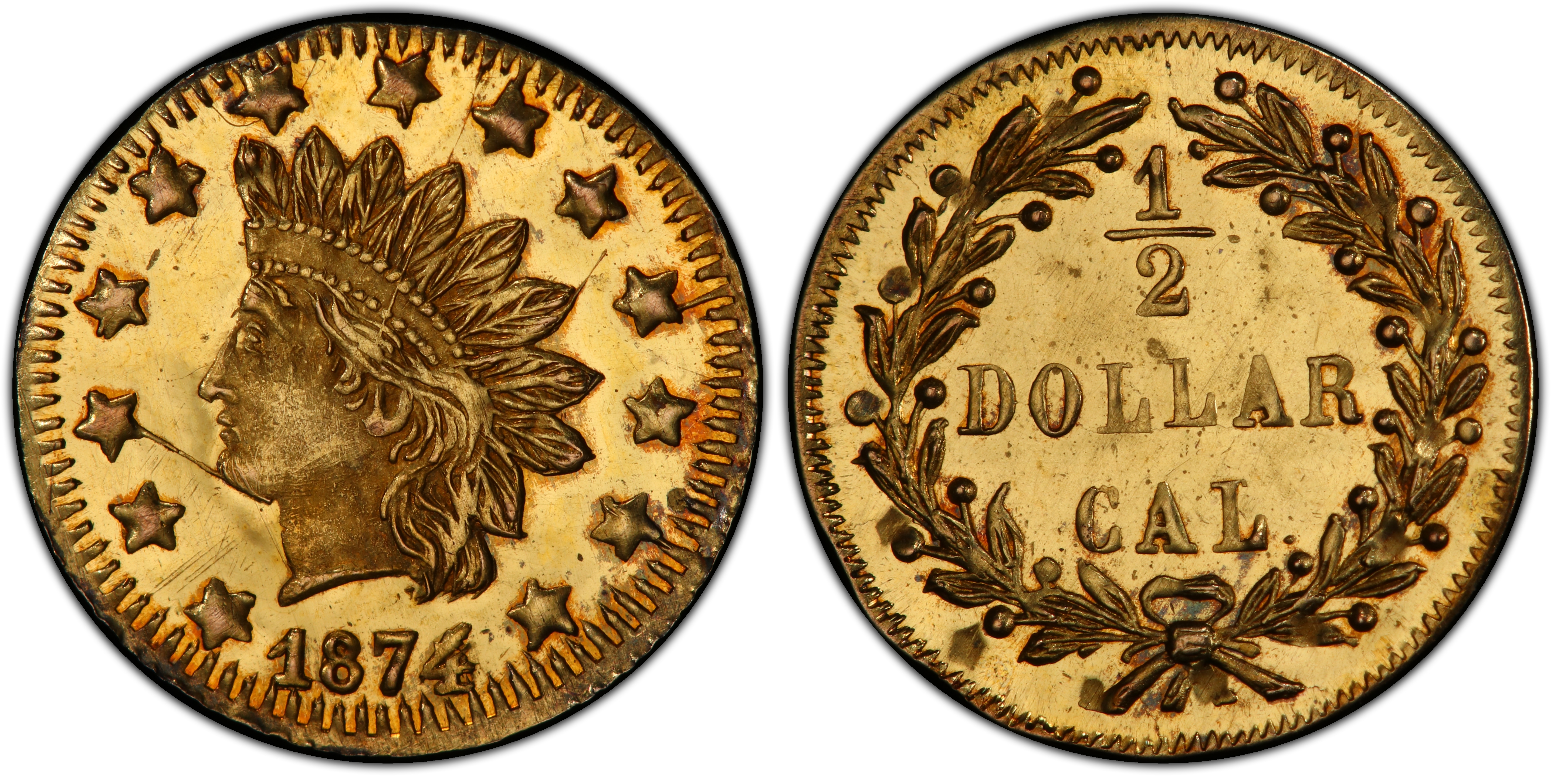
Obverse & Reverse
The 1874/3 50 Cents, cataloged as Breen-Gillio 1052, is a quintessential example of a 'Period Two' California Fractional Gold piece. Unlike their 'Period One' predecessors (1852-1857), which were struck to alleviate a severe shortage of small change during the initial chaos of the Gold Rush, these later issues were not intended for commerce. By the 1870s, the United States Mint in San Francisco was in full operation, producing ample quantities of federal coinage for the region's economy. The raison d'être for fractional gold had shifted entirely from necessity to novelty. These small gold tokens were now produced by various jewelers, primarily in San Francisco, as souvenirs and curiosities for tourists and locals alike. They captured the romanticism of the Gold Rush era in a tiny, affordable, golden memento. The production of these pieces existed in a legal gray area. The Coinage Act of 1864 had prohibited private coinage, but the law was not strictly enforced by the Secret Service against these small 'tokens' until 1883. This permissive environment allowed for a prolific output of hundreds of varieties throughout the 1860s and 1870s. The BG-1052 is notable for its clear 1874/3 overdate, indicating the re-use and modification of an older die, a common cost-saving practice among private minters. This specific variety, with its Indian Head motif—a popular design choice of the era, mimicking federal coinage—was struck to appeal to the public's fascination with the 'Wild West.' While the specific jeweler who produced this variety is lost to history, the style is consistent with the work of several known private minters of the day, such as Robert B. Gray & Co. or Christopher Mohrig. These pieces were often crudely struck by hand-hammering, resulting in inconsistent quality, but many, like the BG-1052, exhibit surprisingly sharp details and even prooflike surfaces, suggesting some care was taken in their manufacture for commercial sale as keepsakes.
Associated EventPost-Gold Rush Souvenir Market
Reason For MintingTo be sold as a souvenir or keepsake of the California Gold Rush era, capitalizing on tourist and local demand for such mementos.
Minter HistoryThe specific minter for BG-1052 is unknown, as was common for many 'Period Two' jewelers' issues to avoid potential legal trouble. The work is characteristic of several San Francisco jewelers active in the 1870s who produced a wide variety of these popular gold tokens. These artisans operated small-scale minting operations within their shops, using hand-engraved dies and manual presses or hammers to strike the pieces. Prominent makers of the period included Robert B. Gray & Co. and Christopher Ferdinand Mohrig, though a direct attribution for this variety is not confirmed.
Historical SignificanceThis coin is a tangible artifact of the commercialization of the Gold Rush legend. It represents a shift from the utilitarian private coinage of the early 1850s to a nostalgic souvenir industry that persisted for decades, illustrating how the memory of the Gold Rush was packaged and sold to a captivated public long after the initial fever had passed.
BG-1052
DenominationG50C (50 Cents)
Minting Period1874
Assayer/MinterUnknown San Francisco Jeweler
Geographic OriginSan Francisco, California
Obverse DescriptionAn Indian princess head facing left, wearing a feathered headdress. The portrait is surrounded by thirteen six-pointed stars. The date, showing a clear 4 punched over a 3, is positioned below the bust.
Obverse Inscription1874
Reverse DescriptionThe denomination '1/2' is in the center, enclosed within an open-ended wreath composed of agricultural elements. The legend 'CALIFORNIA GOLD' is absent, but implied by the context of the series. Some sources note die clashing is sometimes visible.
Reverse Inscription1/2
CompositionGold
Stated Fineness Actual FinenessVariable, typically between 14k and 22k for Period Two issues, often debased compared to federal coinage.
Weight0.75 grams
Diameter9.60 mm
EdgePlain
Unknown
Survival Estimate76-200 (based on R-4+ rating)
Rarity ScaleR-4+
The BG-1052 is highly sought after due to its clear 1874/3 overdate, which is a significant and easily identifiable variety. Its status as a 'Period Two' souvenir piece with the popular Indian Head design makes it a classic example of the series. The availability of examples with prooflike (PL) and deep mirror prooflike (DMPL) surfaces adds a further layer of desirability for specialists.
Key VarietiesThe primary variety is the 1874/3 overdate itself. A known diagnostic on some specimens is a die break extending from the chin of the Indian portrait to the third star. No later-date restrikes are known or cataloged for this specific variety.
Authentication TipsGenuine pieces will exhibit a sharp, albeit sometimes slightly crude, strike consistent with hand production. The overdate should be clear under magnification. Weights can be inconsistent but should be close to the standard for the type. Be wary of modern replicas which are often brassy in color, have mushy details, and may feature a bear on the reverse—a motif never used on genuine denominated fractional gold. Authentic pieces must have a denomination (e.g., '1/2', 'DOLLAR'). Consulting the Breen-Gillio reference guide is essential for die characteristic comparison.
Shopping ConsiderationsA premium quality example for this variety is defined by a sharp strike, particularly on the details of the headdress and the wreath. Luster is paramount; coins with original, reflective prooflike (PL) or deep mirror prooflike (DMPL) fields command significant premiums. The eye appeal of the 1874/3 overdate should be bold and unambiguous. Common problems to avoid are harsh cleanings, which strip the original patina and luster, and damage from jewelry use, such as solder marks, holes, or excessive rim damage. A diagnostic die break from the chin to star 3 can be a positive attribute, confirming the die state and authenticity.
A coin's grade is its condition, rated on a 1-70 scale. For rare coins, this is the most critical factor in determining value, as a tiny difference in preservation can mean a huge difference in price.
Relevant Grade TypesOriginal issues were business strikes, although produced for sale to collectors and tourists rather than for circulation. They are found in Circulated (1-58) grades, often from being carried as pocket pieces, and Mint State (MS, 60-70) grades. No true Proofs were struck during the original period of issue. The 'PL' (Prooflike) and 'DMPL' (Deep Mirror Prooflike) designations are applied to business strikes that were struck using fresh, highly polished dies, resulting in mirror-like fields. These are not a different type of coin but rather a special surface characteristic of a regular strike, and they are highly valued.
Mint State CharacteristicsUncirculated examples of BG-1052 are judged on the quality of their luster and strike. A typical piece may show some central weakness, but high-end examples will be sharp throughout. Luster ranges from satiny to deeply reflective (DMPL). Due to the private manufacturing process, minor planchet flaws or striking imperfections are common and should be considered characteristic of the issue. Bag marks are less common than on federal issues, but small handling marks can be present from decades of storage and trade.
Circulated Wear PatternsWear first appears on the high points of the design: the cheek and feathers of the Indian princess on the obverse, and the highest leaves and bow of the wreath on the reverse. On lower grade examples, the stars and the numbers of the date will begin to lose their sharpness and merge with the fields.
Key Factors For ValueFor the BG-1052, value is driven by three main factors: 1) Grade and Surface Quality: A high Mint State grade (MS-63 or better) with clean surfaces is the foundation. The presence of a PL or, especially, a DMPL designation can multiply the coin's value. 2) Strike and Overdate Clarity: A sharp, well-defined strike and a clear, easily visible 4/3 overdate are highly desirable. 3) Eye Appeal: Coins with attractive, original gold toning and no distracting marks or planchet flaws will always command a premium. A CAC sticker for this issue confirms quality within the grade and adds significant value.
PCGS Price Guide
| Grade | Price | Population |
|---|---|---|
| 62 | $500.00 | N/A |
| 62+ | $550.00 | N/A |
| 63 | $700.00 | 1 |
| 63+ | $775.00 | N/A |
| 64 | $850.00 | N/A |
| 64+ | $1,150.00 | N/A |
| 65 | $2,250.00 | 1 |
| 65+ | $2,500.00 | N/A |
| 66 | $3,750.00 | N/A |