1871 G50C BG-1011, PL (Regular Strike)
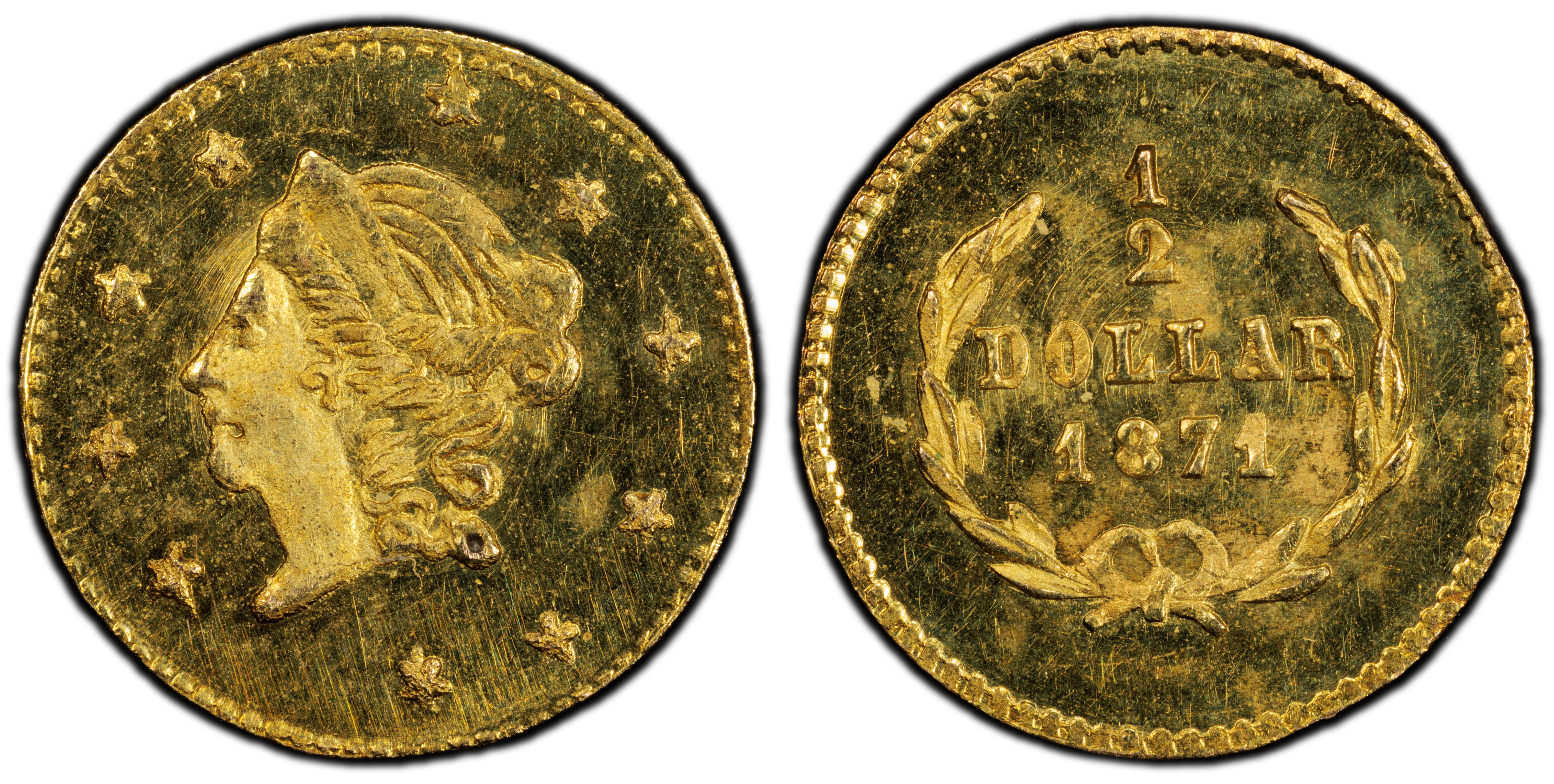
Obverse & Reverse
The 1871 BG-1011 half dollar is a product of the second major period of private coinage in California, a fascinating era that followed the initial chaos of the Gold Rush. By the 1870s, the economic landscape of California had matured. The frantic energy of the '49ers had given way to more organized mining and a burgeoning commercial society, centered in San Francisco. However, a persistent problem remained: a chronic shortage of small-denomination coinage for everyday transactions. The U.S. Mint in San Francisco, established in 1854, focused primarily on larger gold and silver coins, leaving a vacuum for small change. This void was eagerly filled by private minters, often jewelers by trade, who possessed the skills and equipment to strike small gold pieces. These 'fractional gold' coins, in denominations of 25 cents, 50 cents, and one dollar, became an essential, if unofficial, part of the local economy. The BG-1011 is considered a 'Period Two' issue (1859-1882), often called 'jeweler's issues.' Unlike the earlier Period One coins which more closely mimicked federal issues in weight and design, these later pieces were typically lighter and displayed more artistic freedom, though they still served a vital commercial purpose. They were produced using manual 'hammer' methods, where dies were struck by hand, leading to significant variation in strike quality. The passage of the Coinage Act of 1864 made private coinage illegal, but enforcement was lax in the remote West, allowing production of these pieces to continue until the early 1880s to meet the continued demand and also as popular souvenirs for a growing tourist trade. The BG-1011, with its classic Liberty Head design, represents the persistence of this uniquely Western solution to a national currency problem, embodying the independent and entrepreneurial spirit of Gold Rush California long after the initial fever had subsided.
Associated EventCalifornia Gold Rush and aftermath
Reason For MintingTo alleviate a severe and persistent shortage of small-denomination circulating coinage for daily commerce in post-Gold Rush California.
Minter HistoryThe specific minter of BG-1011 is unknown, a common trait for many Period Two California fractional gold issues. Most manufacturers during this period were French jewelers and their business partners operating in San Francisco. These skilled artisans, such as Deriberpe & Nouizillet (D.N.) or Frontier & Deviercy (F.D.), brought their metalworking expertise to bear, creating the dies and striking these miniature coins. Their primary business was jewelry, but coin minting was a profitable sideline that also provided a needed community service. Their work is characterized by artistic flair but often inconsistent technical quality due to hand-striking methods.
Historical SignificanceThe BG-1011 is a tangible artifact of a unique period in American monetary history where private citizens, out of necessity and for profit, created a functional, localized currency system. It demonstrates the economic isolation and self-reliance of the American West in the 19th century. These 'jeweler's issues' highlight the transition of fractional gold from purely utilitarian coinage to items of commerce and souvenirs, marking a mature phase of California's post-Gold Rush economy.
N/A
Denomination50 Cents
Minting Period1871
Assayer/MinterUnknown private minter, likely a San Francisco jeweler.
Geographic OriginSan Francisco, California
Obverse DescriptionA head of Liberty facing left, with thirteen stars surrounding the portrait. The date '1871' is positioned below the truncation of the neck.
Obverse Inscription1871
Reverse DescriptionThe denomination '1/2' is centered within a wreath of leaves and berries. The wreath is open at the top.
Reverse Inscription1/2
CompositionGold
Stated Fineness Actual FinenessVariable, but often lower than the equivalent federal coinage.
Weight0.25 grams
Diameter10.00 mm
EdgePlain
Unknown, but likely in the low thousands.
Survival Estimate501-1250
Rarity ScaleR-2
The BG-1011 is highly popular with collectors due to its classic, federally-inspired design, its status as a genuine circulating artifact of the Old West, and its relative affordability compared to rarer fractional varieties. The 'PL' (Prooflike) designation adds significant appeal, indicating an early strike from fresh dies with mirrored fields, which is uncommon for this typically utilitarian coinage.
Key VarietiesThe primary variety is the regular business strike. No original proof strikings are known. There are no major die varieties widely collected for BG-1011 itself, but the broader California Fractional Gold series is rife with hundreds of different BG-numbered varieties based on design, date, and denomination. Modern replicas and souvenir tokens from later periods exist and are a major source of confusion for new collectors; genuine pieces must be from the 1852-1882 period.
Authentication TipsAuthentication is paramount. Due to widespread counterfeiting, it is strongly advised to only purchase examples certified by major third-party grading services like PCGS or NGC. Genuine pieces have sharp details for the grade, correct weight and dimensions (though these can vary), and a characteristic luster. Counterfeits are often soapy in appearance, have incorrect weights, may be cast instead of struck, and are sometimes attracted to a magnet. Comparing a prospective purchase to high-resolution images of certified examples is a critical step.
Shopping ConsiderationsA premium quality BG-1011 is defined by a sharp, well-centered strike, especially on Liberty's hair details and the fine leaves of the reverse wreath. For a PL-designated coin, look for deep, clear reflectivity in the fields, which provides a strong cameo contrast with the devices. Original, undisturbed surfaces are critical; avoid examples that have been harshly cleaned, polished, or show evidence of tooling or repairs. Common problems include weak strikes (especially on the date), planchet flaws, and contact marks that are magnified by the coin's tiny size. A coin with a CAC sticker indicates premium quality for the grade and often commands a significant price jump.
A coin's grade is its condition, rated on a 1-70 scale. For rare coins, this is the most critical factor in determining value, as a tiny difference in preservation can mean a huge difference in price.
Relevant Grade TypesOriginal 1871 BG-1011 issues were business strikes intended for circulation and are graded on the standard 1-70 scale, found in Circulated grades (e.g., VF, XF, AU) and Mint State (MS, 60-70). No true Proofs were struck during the original minting period. However, some early strikes from fresh, polished dies exhibit mirrored surfaces and are designated as 'Prooflike' (PL) by grading services. These are still considered business strikes but are highly desirable and carry a premium.
Mint State CharacteristicsAn uncirculated BG-1011 will display full original luster, which is typically satiny but can be reflective and prooflike on early strikes. Strike quality varies; many examples are weakly struck on the stars or the date, so a fully-struck specimen is rare and desirable. Due to the softness of the gold and their use in circulation, even Mint State examples often show small planchet flaws or tiny contact marks that can affect the grade. Deeply mirrored fields with frosty devices define a top-tier PL example.
Circulated Wear PatternsWear first appears on the highest points of the design. On the obverse, this includes Liberty's hair above the eye and on the cheek. On the reverse, the high points of the wreath's leaves and berries will show friction first. As wear progresses, the finer details of the hair and leaves will merge, and the stars will begin to lose their definition.
Key Factors For ValueFor the BG-1011, value is driven by several key factors. Grade is paramount, with Mint State coins, especially those graded MS64 or higher, commanding exponential premiums. The PL designation adds another significant layer of value. Beyond grade, surface quality is crucial; an example with clean, original surfaces will always be worth more than a cleaned or damaged coin of the same grade. Strike sharpness and overall eye appeal, including any attractive reddish-gold toning, also play a major role. A CAC sticker confirming quality for the assigned grade provides a substantial boost in market value.
PCGS Price Guide
| Grade | Price | Population |
|---|---|---|
| 62 | N/A | N/A |
| 63 | N/A | N/A |
| 64 | $650.00 | 3 |
| 65 | N/A | N/A |
| 66 | N/A | N/A |
| 67 | N/A | N/A |