1876 G$1 BG-1114, PL (Regular Strike)
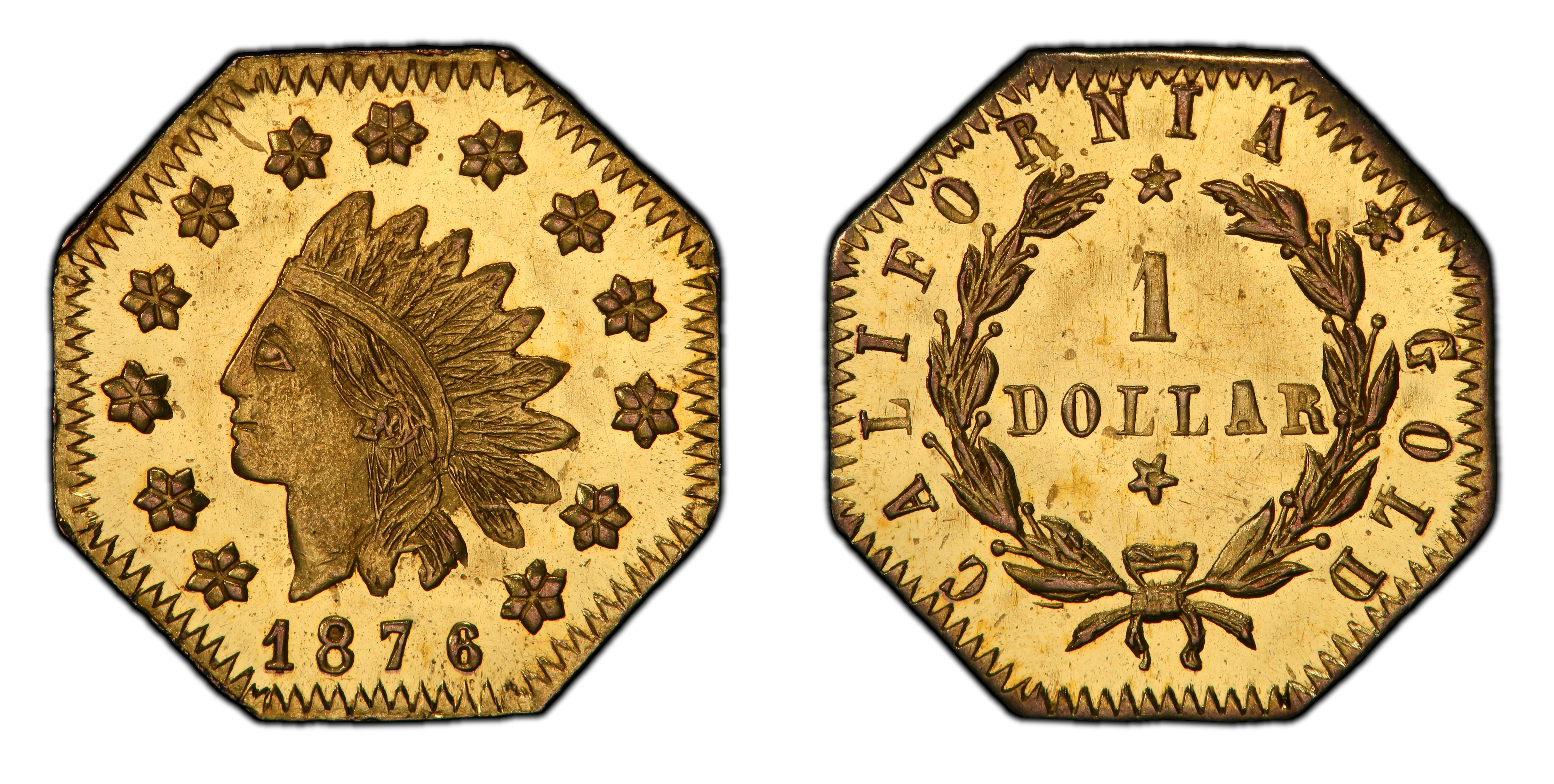
Obverse & Reverse
The 1876 G$1 BG-1114 is a product of the second and most prolific period of California Fractional Gold production (1859-1882), often termed the 'Jeweler's Period.' By the mid-1870s, the initial, acute shortage of small change that spurred the creation of these miniature gold pieces had largely subsided due to the output of the San Francisco Mint. However, demand for fractional gold persisted, driven by a combination of local commercial habit, a lingering distrust of paper money, and a burgeoning tourist and souvenir market. The Coinage Act of 1864 had explicitly forbidden the private issuance of coinage, rendering pieces like the BG-1114 technically illegal. This did little to deter the small-scale, often anonymous San Francisco jewelers who produced them. These minters operated in a gray market, leveraging their metallurgical skills to strike small-denomination gold pieces that were eagerly accepted in local commerce, particularly in the saloons and shops of the Barbary Coast. The year 1876 was significant as it marked the nation's Centennial, an event that fueled a national appetite for tokens and memorabilia. It is highly probable that many fractional gold pieces from this era were struck as much for their novelty and souvenir value as for their utility in trade. The BG-1114, with its classic Indian Head motif—a design popularized on federal coinage—would have been an attractive keepsake. These pieces were not official government issues and thus their gold content and weight were unregulated, often being worth intrinsically less than their face value. Their production was crude, typically involving a screw press or even a simple hammer-and-anvil method, resulting in significant variations in strike quality. The extreme rarity of the BG-1114 variety today suggests a very limited original production, likely the output of a single jeweler over a short period, whose identity is now lost to history.
Associated EventCalifornia Gold Rush Era (Late Period)
Reason For MintingTo satisfy a continued, albeit diminished, local demand for small gold change and to cater to a growing market for souvenirs and keepsakes.
Minter HistoryThe specific minter or jeweler who created the dies for BG-1114 is unknown. This anonymity is characteristic of the post-1864 period, as producers of these technically illegal coins sought to avoid federal scrutiny. The work is attributed to the community of jewelers and artisans, many of French origin, who were active in San Francisco during this era.
Historical SignificanceThis coin is a tangible artifact from the closing chapter of America's private coinage era. It represents the persistence of local customs and hard-money preferences in the post-Gold Rush West, and the transition of fractional gold from essential circulating currency to popular collectible souvenir items.
N/A
DenominationG$1
Minting Period1876
Assayer/MinterUnknown Private Minter
Geographic OriginSan Francisco, California
Obverse DescriptionFeatures a stylized female head facing left, often referred to as an 'Indian Head,' adorned with a feathered headdress. The portrait is surrounded by thirteen six-pointed stars arranged in a circle. The date '1876' appears below the bust.
Obverse Inscription1876
Reverse DescriptionA simple wreath of two olive branches, tied with a ribbon at the bottom, encircles the denomination. Within the wreath, the denomination is expressed as '1' over 'DOLLAR'.
Reverse Inscription1 DOLLAR
CompositionGold
Stated Fineness Actual Fineness EdgePlain
Unknown, but extremely small.
Survival EstimateFewer than 10; likely in the range of 4-6 known specimens.
Rarity ScaleHigh R-7
The BG-1114 is a classic rarity in the popular and challenging field of California Fractional Gold. Its appeal lies in its extreme scarcity, the iconic Indian Head design, its octagonal shape, and the high likelihood of proof-like surfaces on surviving examples. It is a trophy coin for advanced specialists.
Key VarietiesThere are no known major varieties of BG-1114 from the original minting period. All known examples are considered regular business strikes, though they were not intended for widespread circulation in the same manner as federal coinage. The 'PL' (Proof-Like) designation is not a separate variety but a desirable surface characteristic found on some specimens, resulting from being struck with freshly polished dies.
Authentication TipsAuthentication requires expert examination. Genuine examples are struck in gold, not brass or other alloys. Look for sharp, albeit sometimes uneven, die work consistent with hand-engraved dies of the period. The stars and lettering should have a particular style distinct from modern replicas. The planchet should be relatively thin. Any evidence of casting, such as a seam on the edge or a porous, bubbly surface, is a sign of a counterfeit. Comparison with high-resolution images of certified examples is essential.
Shopping ConsiderationsFor a 'premium quality' BG-1114, a buyer should prioritize sharpness of strike and pristine, original surfaces. Given the crude manufacturing, a fully struck example with complete details on the headdress feathers and wreath leaves is exceptional and commands a significant premium. The 'PL' or Proof-Like designation is highly desirable and indicates an early strike from the dies; look for deep, mirror-like reflectivity in the fields. As with all fractional gold, avoid examples that show evidence of having been mounted in jewelry (solder marks, tooling, bending) or have been harshly cleaned or polished, as this severely impairs value. Certification by PCGS or NGC is virtually mandatory for a transaction involving this rarity.
A coin's grade is its condition, rated on a 1-70 scale. For rare coins, this is the most critical factor in determining value, as a tiny difference in preservation can mean a huge difference in price.
Relevant Grade TypesAll original BG-1114 issues are business strikes, intended for limited circulation or use as keepsakes, and are graded on the Circulated (1-58) and Mint State (MS, 60-70) scales. No true Proofs were struck during the original period of issue. The 'PL' (Proof-Like) designation is sometimes applied to Mint State business strikes that exhibit mirrored fields, but these are not a separate issue type and should not be confused with true Proof coinage.
Mint State CharacteristicsAn uncirculated BG-1114 is defined by its luster. High-grade examples often exhibit highly reflective, proof-like fields, a result of the dies being polished before striking. The strike is often somewhat soft, particularly on the highest points of the Indian's cheek and the center of the wreath. Due to the softness of the gold and crude handling at the time of manufacture, even high-grade Mint State examples will typically show some light abrasions or contact marks. The color is often a bright, slightly greenish-gold.
Circulated Wear PatternsWear first appears on the high points of the design. On the obverse, check the cheek, ear, and the upper feathers of the headdress. On the reverse, the highest points of the wreath's leaves and the bow of the ribbon will show the first signs of friction. On lower-grade circulated examples, the stars and date will become faint and begin to merge with the fields.
Key Factors For ValueFor the BG-1114, rarity is paramount, but condition determines the ultimate value. A sharp, well-centered strike is a major plus. The most significant value driver is surface quality; an example with deep, original proof-like fields and minimal distracting marks will command a huge premium over a cleaned or abraded piece of the same grade. Eye appeal, encompassing attractive original color and a bold strike, is crucial. A CAC sticker on an already-certified coin provides a third-party endorsement of quality for the grade and would add a significant premium for an extreme rarity like this.
PCGS Price Guide
| Grade | Price | Population |
|---|---|---|
| 64 | $9,500.00 | 1 |