1868 G50C BG-1074, PL (Regular Strike)
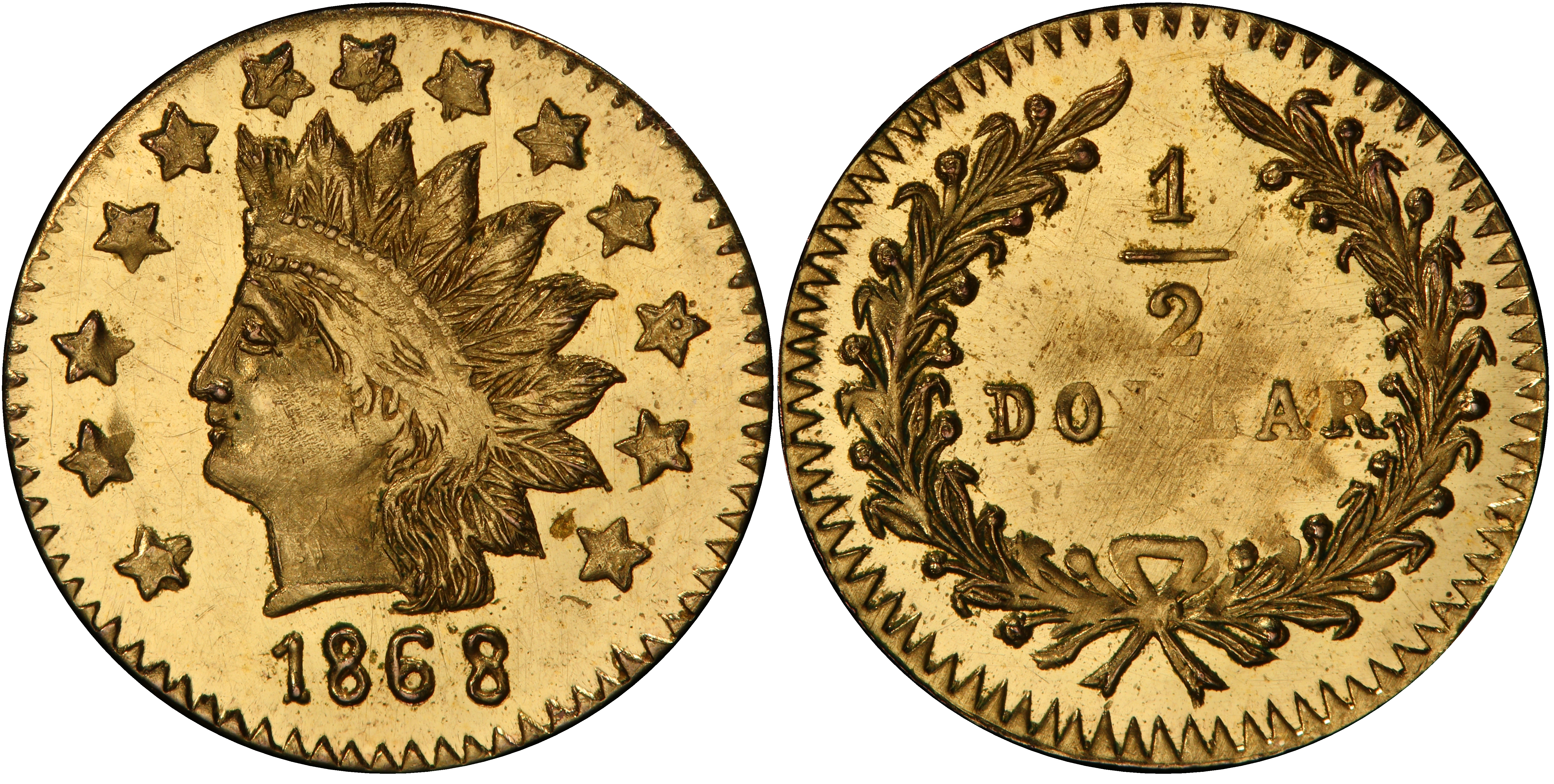
Obverse & Reverse
The 1868 BG-1074 fifty-cent piece emerges from the second major phase of California's private gold coinage, known to numismatists as 'Period Two' (1859-1882). Unlike the earlier 'Period One' issues, which were struck out of genuine commercial necessity to alleviate a dire shortage of small change during the initial Gold Rush, the coins of this later era served a different purpose. By 1868, the United States Mint in San Francisco was in full operation, and federally-issued coins had largely saturated the channels of commerce. The acute need for privately-minted fractional gold had passed. Instead, these later pieces, often called 'jeweler's issues,' were primarily created as souvenirs and keepsakes. They capitalized on the romantic allure of the Gold Rush, offering tourists and locals a memento of California's golden identity. Though the Coinage Act of 1864 had made private coinage illegal, the law was not strictly enforced against these small, low-value pieces until 1883. This legal gray area allowed numerous jewelers and artisans, many of whom remain anonymous, to produce a wide variety of designs. The BG-1074, with its Indian Head motif, was a popular design choice of the period, echoing the themes seen on federal coinage like the Indian Head Cent and gold dollar, thereby giving it a familiar and legitimate appearance. These pieces were not intended for vigorous circulation and their gold content was often less than their face value, solidifying their status as tokens rather than true currency. Their existence speaks to a post-Gold Rush California, an economy maturing from frantic extraction to one that understood how to market its own history.
Associated EventCalifornia Gold Rush Aftermath
Reason For MintingPrimarily struck as souvenirs and collector's items for the tourist trade, not for general circulation.
Minter HistoryThe specific minter or jeweler who produced the BG-1074 variety is unknown, a common trait for many Period Two California Fractional Gold issues. Production was decentralized among various San Francisco jewelers who created these small gold pieces as novelties rather than as a branded, circulating currency. Their anonymity was likely a feature, not a bug, as it kept their operations small-scale and below the serious scrutiny of federal authorities.
Historical SignificanceThe BG-1074 is significant not as a coin that fueled commerce, but as a cultural artifact representing the commercialization of the Gold Rush legacy. It marks the transition of California's private gold from a utilitarian necessity to a nostalgic commodity, a tangible piece of the 'Wild West' mythos sold to a new generation of visitors and residents. Its rarity and design make it a key representative of the 'jeweler's issue' period.
Not Applicable
Denomination50 Cents
Minting Period1868
Assayer/MinterUnknown Private Minter
Geographic OriginSan Francisco, California
Obverse DescriptionThe obverse features a crude but recognizable portrait of a Native American princess facing left, modeled after James B. Longacre's design for the U.S. Indian Head cent and gold coins. The portrait is surrounded by thirteen stars, representing the original colonies. The date '1868' is positioned below the bust.
Obverse Inscription1868
Reverse DescriptionThe reverse features the denomination '1/2' and the word 'DOLLAR' within a wreath of leaves and berries. The wreath is open at the top.
Reverse Inscription1/2 DOLLAR
CompositionGold
Stated Fineness Actual FinenessVariable, but generally lower than U.S. Mint standards of .900 fine.
Weight0.25 grams
Diameter10.00 mm
EdgePlain
Unknown
Survival Estimate13 to 20
Rarity ScaleR-6 (Very Rare)
The BG-1074 is highly sought after due to its R-6 rarity, attractive Indian Head design, and its status as a quintessential 'jeweler's issue' from the romantic post-Gold Rush era. The frequent appearance of prooflike surfaces adds to its aesthetic appeal, making gem-quality examples prized by specialists.
Key VarietiesThere are no major varieties of BG-1074 from the original minting period. All known examples are considered business strikes, although many were produced with polished dies and planchets, resulting in a prooflike (PL) or deeply mirrored appearance. These are not true Proofs but are special presentation strikes that command a significant premium.
Authentication TipsAuthentic BG-1074 specimens are struck in gold, not gilded base metal. They should bear the denomination 'DOLLAR'. Replicas from the 20th century often say 'CAL GOLD' or 'CHARM' and may feature a bear on the reverse, which is never seen on genuine Period Two issues. The strike is often weak in the centers, particularly on the high points of the hair and the '1/2' on the reverse. The style of the engraving, while crude, should match known examples; modern fakes often have a soapy or unnatural sharpness from modern manufacturing processes. The planchets are characteristically thin.
Shopping ConsiderationsA premium quality BG-1074 will exhibit deeply mirrored, prooflike fields with frosted devices. However, as noted in auction records, the central strike is often weak, so a coin should not be unduly penalized for softness on the highest points of the Indian's hair or the fraction on the reverse. Look for examples with minimal contact marks, as the reflective fields make any imperfection highly noticeable. Avoid coins that have been harshly cleaned, as this obliterates the delicate original surfaces. A strong overall eye appeal, defined by clean surfaces and a sharp contrast between the fields and devices, is the paramount factor in determining value for a given grade.
A coin's grade is its condition, rated on a 1-70 scale. For rare coins, this is the most critical factor in determining value, as a tiny difference in preservation can mean a huge difference in price.
Relevant Grade TypesOriginal BG-1074 issues were business strikes, often with special preparation, and are found in both Circulated (1-58) and Mint State (MS, 60-70) grades. Due to their nature as souvenirs, many were saved in high grades. The Prooflike (PL) designation is particularly relevant and common for this variety, indicating that the coin was struck using polished dies, resulting in mirror-like fields. There were no true Proof (PR/PF) coins struck during the original period of issue.
Mint State CharacteristicsUncirculated examples are defined by their luster. For this specific coin, high-grade examples often display a striking cameo contrast between heavily frosted devices and deeply mirrored fields. The strike is characteristically weak in the center, so a fully struck central device is exceptionally rare and desirable. The surfaces are very susceptible to minute bag marks and hairlines, which are magnified by the prooflike fields and can significantly impact the grade and eye appeal.
Circulated Wear PatternsOn circulated examples, wear first appears on the high points of the Indian's cheek, hair, and the feather in the headdress. On the reverse, the fraction '1/2' and the highest leaves of the wreath will show the first signs of friction. In lower grades (VF and below), the date and stars on the obverse will begin to lose their sharpness and merge towards the fields.
Key Factors For ValueThe primary value driver for the BG-1074 is the quality of its prooflike surface. A deep, clean, and reflective mirror with strong cameo frost will command a substantial premium over a merely lustrous or hazy example. Strike weakness in the center is expected, but coins with a sharper-than-average central strike are prized. Surface preservation is critical; distracting marks, hairlines, or evidence of cleaning in the delicate fields will dramatically reduce a coin's value. The presence of a CAC sticker is a significant value multiplier, confirming both the grade and the superior eye appeal for that grade.
PCGS Price Guide
| Grade | Price | Population |
|---|---|---|
| 63 | $1,050.00 | 2 |
| 63+ | $1,175.00 | N/A |
| 64 | $1,350.00 | 1 |