1871 G50C BG-1027, PL (Regular Strike)
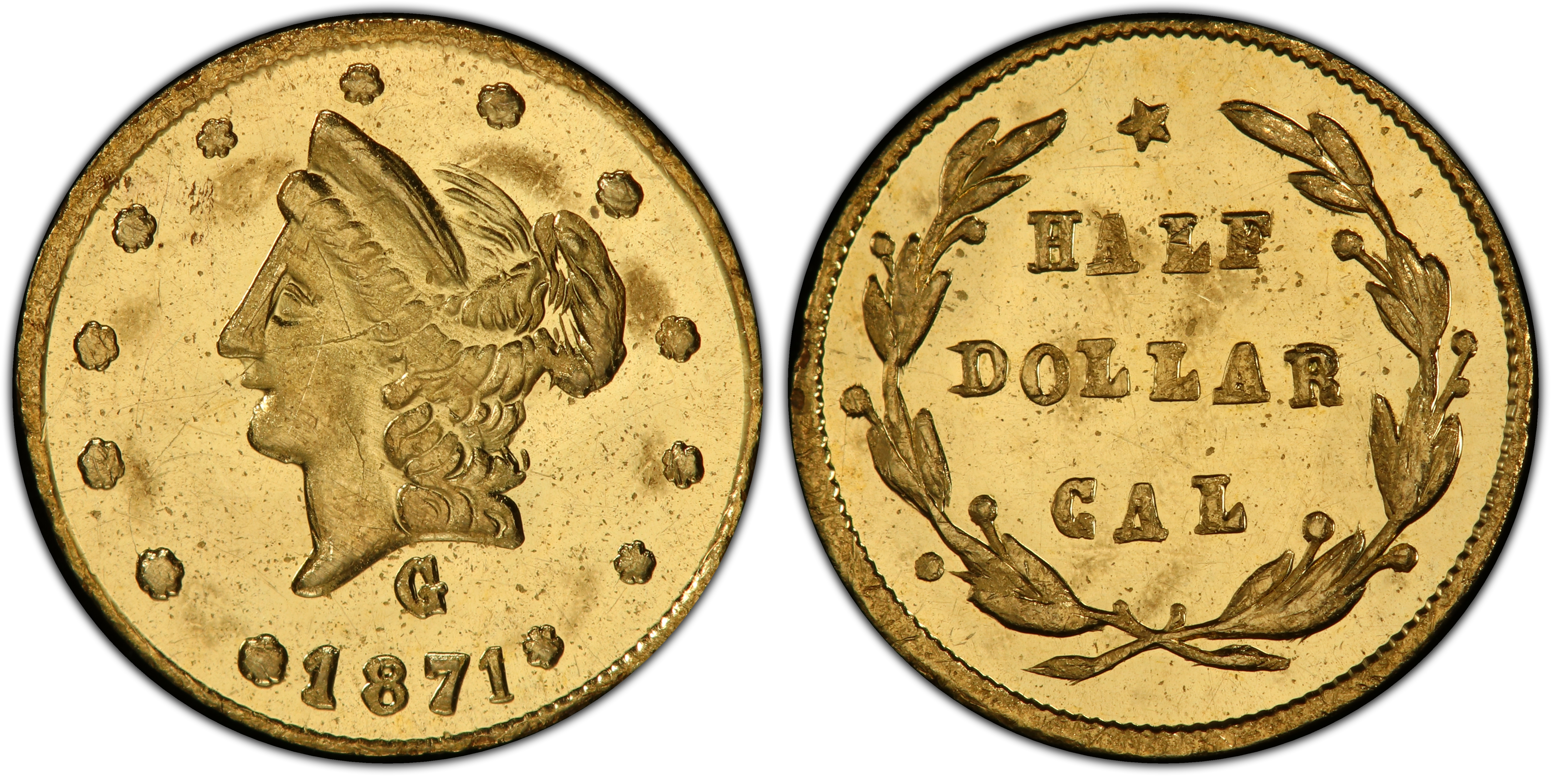
Obverse & Reverse
The 1871 50 Cents, cataloged as Breen-Gillio 1027, is a product of the second period (1858-1882) of California Fractional Gold production. Unlike the earlier 'Period One' issues struck out of commercial necessity during the height of the Gold Rush to alleviate a shortage of small change, these later pieces served a different purpose. By the 1870s, the San Francisco Mint was in full operation, supplying ample federal coinage for the region. The rationale for producing these minuscule gold coins had shifted from commerce to curiosities. San Francisco had blossomed into a major metropolis and a tourist destination, and a powerful sense of regional pride and nostalgia for the 'Days of '49' had taken hold. Enterprising local jewelers, many of whom had produced the earlier necessity coinage, recognized a market for high-quality souvenirs. They began striking a wide variety of beautifully crafted, albeit typically underweight, fractional gold pieces intended for sale to tourists, collectors, and locals who wished to send a tiny, glittering memento of California's golden identity to friends and family back East or abroad. These 'Jeweler's Issues' were often more ornate and varied in design than their utilitarian predecessors. The BG-1027 was struck in this environment, not to buy a drink at a saloon, but to be tucked away in a velvet-lined box as a keepsake. The Coinage Act of 1864 had made private coinage illegal, but the law was not strictly enforced against these small-denomination pieces until 1883, allowing jewelers to operate in a legal gray area. These pieces, therefore, represent a fascinating transition from private, functional currency to commercial numismatic art and memorabilia.
Associated EventPost-Gold Rush California Economic Expansion
Reason For MintingPrimarily created as souvenirs and keepsakes for tourists and collectors, not for general circulation.
Minter HistoryThe specific minter of the BG-1027 variety is not definitively known, a common trait for many Period Two issues. Production was often anonymous or marked with simple initials. Prominent San Francisco jewelers of the era, such as Robert B. Gray & Co., are known to have struck fractional gold in 1871, often marking their pieces with a 'G'. However, BG-1027 does not bear this hallmark. It was likely produced by one of the several skilled jewelers and die-sinkers active in San Francisco at the time who catered to the robust market for gold souvenirs. These craftsmen operated small-scale workshops, using hand-operated presses or simple hammer-striking methods to produce their wares, resulting in significant variation and a high degree of individuality between varieties.
Historical SignificanceThe BG-1027 is historically significant not as a circulating coin, but as a tangible artifact of California's evolving identity in the late 19th century. It represents the commercialization of the Gold Rush legacy and the birth of a market for numismatic souvenirs, demonstrating a shift from creating coinage for necessity to crafting it for nostalgia and profit.
BG-1027
Denomination50 Cents
Minting Period1871
Assayer/MinterUnknown Jeweler
Geographic OriginSan Francisco, California
Obverse DescriptionA classic Liberty Head design, facing left, styled after the contemporary federal gold coinage. The portrait is surrounded by thirteen six-pointed stars, representing the original colonies. The date '1871' is positioned below the bust.
Obverse Inscription1871
Reverse DescriptionThe central device is the denomination '1/2' and the word 'DOLLAR' contained within a wreath. The wreath is composed of two olive branches tied together at the bottom with a bow.
Reverse Inscription1/2 DOLLAR
CompositionGold
Stated Fineness Actual FinenessTypically varied between 14 to 22 karats for Period Two issues.
EdgePlain
Unknown
Survival EstimateFewer than 100
Rarity ScaleR-5 (Very Scarce: 31-75 known)
The 1871 BG-1027 appeals to collectors due to its status as a classic 'Period Two' Liberty Head type, its relative scarcity, and its connection to the romantic history of the California Gold Rush. The small size and detailed artistry make it a fascinating and historically rich collectible that is more accessible than the pioneer-era issues.
Key VarietiesThe primary variety is the regular business strike. While no contemporary patterns or proofs are known, examples with Proof-Like (PL) surfaces are highly sought after by collectors and command significant premiums. These PL examples were likely struck with freshly polished dies to enhance their appeal as jewelry or souvenir items. No official restrikes were made.
Authentication TipsAuthentic examples must have a clearly stated denomination ('DOLLAR'). Be wary of pieces that say 'CAL GOLD' or feature a bear on the reverse, as these are modern tokens or fantasy pieces. The strike on genuine fractionals can be uneven, with areas of weakness, a characteristic of hammer or early press striking. Many fakes are unnaturally sharp and uniform. The luster should be consistent with 19th-century gold, not brassy. Consulting the Breen-Gillio reference for die markers is the ultimate authentication method.
Shopping ConsiderationsA premium quality example for its grade will possess a sharp strike on the highest points of Liberty's hair and the details of the wreath's leaves and bow. Seek out specimens with clean, original surfaces that have not been harshly cleaned, polished, or used in jewelry. Original, Proof-Like (PL) surfaces are exceptionally rare and desirable. Common problems include rim bumps, scratches from handling, and evidence of solder or mounting from jewelry use. Given the coin's tiny size, even minor imperfections are magnified, so careful inspection with a loupe is essential. An attractive, uniform golden color adds to eye appeal.
A coin's grade is its condition, rated on a 1-70 scale. For rare coins, this is the most critical factor in determining value, as a tiny difference in preservation can mean a huge difference in price.
Relevant Grade TypesOriginal period issues were business strikes, although intended as souvenirs rather than for circulation. They are found in Circulated (1-58) grades, though this is less common, and Mint State (MS, 60-70) grades. No true Proofs were struck during the original period. However, coins struck from highly polished dies exist and are designated as Proof-Like (PL) by grading services; these are not a different type of issue but rather a special quality of the business strike and are highly prized.
Mint State CharacteristicsUncirculated examples of BG-1027 often exhibit a soft, satiny luster. The strike can be variable; many show some weakness on the stars or the leaves of the wreath. Due to the primitive minting technology, planchet quality can be inconsistent, sometimes showing adjustment marks or minor striations. Contact marks, even on high-grade pieces, are common due to the softness of the gold and the way these pieces were handled in bulk by their makers.
Circulated Wear PatternsWear first appears on the highest points of the design: the hair just above Liberty's eye and ear, her cheekbone, and the high points of the bow and leaves on the reverse wreath. On moderately worn examples, the individual hair strands will begin to merge, and the stars will lose their sharpness. In lower grades (VF and below), the date and legends will show significant flattening.
Key Factors For ValueThe primary value drivers are grade and surface quality. An original, uncleaned coin with minimal marks will always be worth more than a cleaned or damaged one of the same grade. Strike quality is also key; a sharply struck example is highly desirable. Eye appeal, including any Proof-Like reflectivity and pleasing original color, adds a significant premium. For this series, a CAC sticker indicating premium quality for the grade is highly sought after and can substantially increase the coin's value.
PCGS Price Guide
| Grade | Price | Population |
|---|---|---|
| 63 | $725.00 | 3 |
| 63+ | $850.00 | N/A |
| 64 | $1,200.00 | 1 |