1876 G50C BG-1064, PL (Regular Strike)
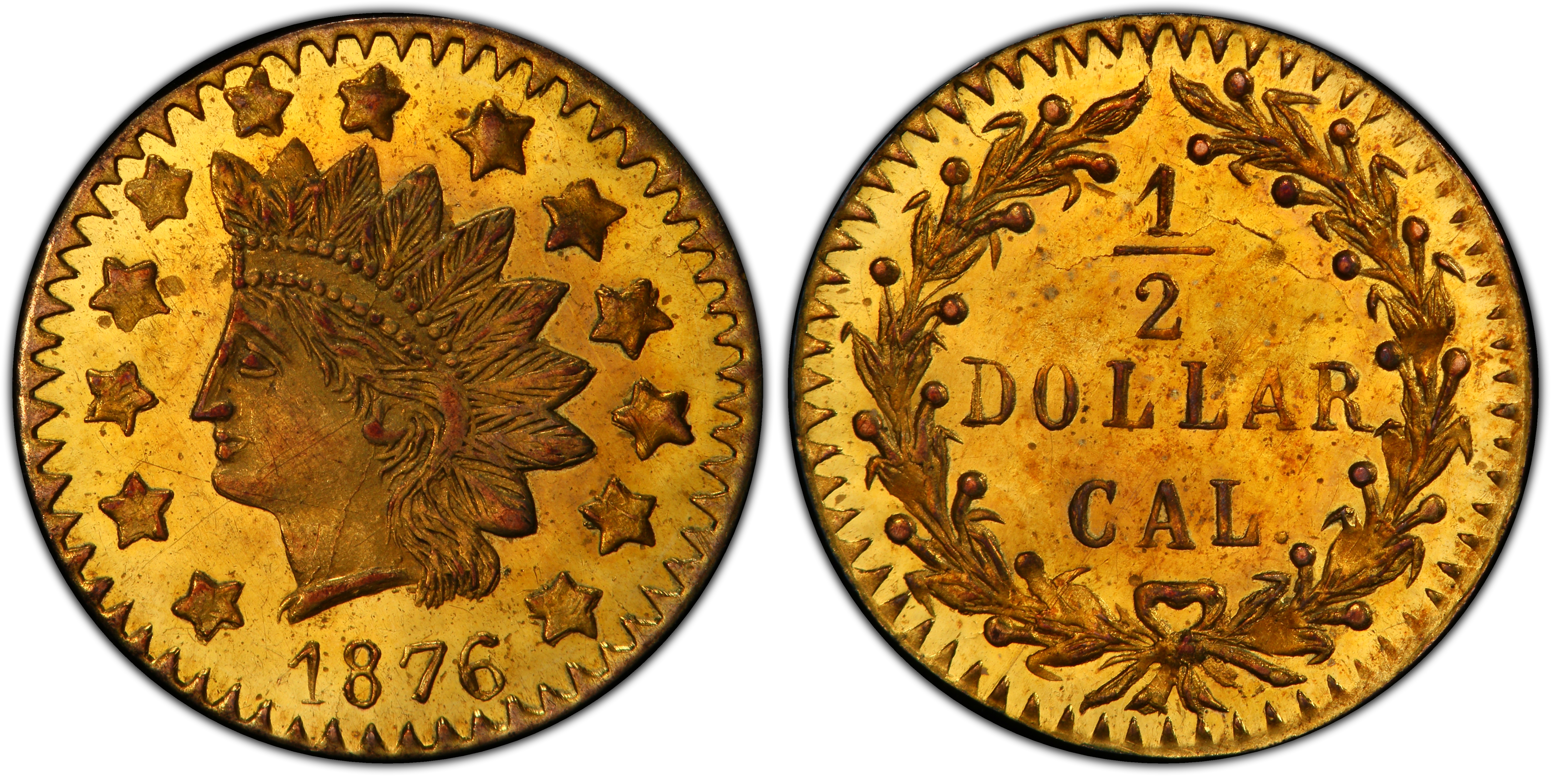
Obverse & Reverse
The 1876 BG-1064 fifty-cent piece emerges from the second major phase of California Fractional Gold production (1859-1882), a period numismatically distinct from the earlier, heavier issues of the Gold Rush proper. By the mid-1870s, the acute shortage of circulating small change that spurred the initial wave of private coinage had largely been resolved by the output of the San Francisco Mint. However, a robust market for small gold souvenirs had developed, fueled by tourism and a lingering romanticism for the Gold Rush era. These 'jeweler's issues,' as they are often called, were not intended to serve as a primary medium of exchange. Instead, they were novelty items, keepsakes, and mementos. They were typically produced by jewelers and metallurgists in San Francisco, often with a gold content significantly below their face value, functioning more as denominated tokens than true coinage. The year 1876 was particularly significant in the United States, marking the nation's Centennial. This event sparked a nationwide surge in the production of commemorative and souvenir items, and the California jewelers capitalized on this sentiment. The BG-1064, like its contemporaries, was likely sold to tourists and locals alike as a charming and affordable piece of 'pioneer gold.' These pieces were often crudely struck using manual screw presses or even the hammer method, resulting in significant variation in strike quality. The illegality of private coinage after the Act of 1864 was largely ignored in California until federal enforcement tightened in the early 1880s, bringing this fascinating chapter of American numismatics to a close. The BG-1064 is a tangible artifact from this later, more commercialized era of private gold, representing a transition from utilitarian necessity to nostalgic commerce.
Associated EventPost-Gold Rush economic activity and U.S. Centennial
Reason For MintingPrimarily produced as souvenir tokens for the tourist trade and local jewelry market rather than for general circulation.
Minter HistoryThe specific minter of BG-1064 is not definitively known, a common trait for many Period Two California fractionals. Production is generally attributed to the numerous jewelers and assayers operating in San Francisco during the 1870s. Firms like Robert B. Gray & Co. (active in the 1860s) set the precedent, and their successors and competitors continued the practice. These craftsmen possessed the requisite skills in die-sinking and metallurgy, producing small gold pieces alongside their primary business of jewelry and watchmaking. Their operations were small-scale, resulting in low mintages and numerous die varieties as old dies broke and new ones were crudely fashioned.
Historical SignificanceThe BG-1064 is significant not as a coin that facilitated commerce, but as a socio-economic artifact. It demonstrates the commodification of the Gold Rush legacy and the birth of a souvenir market in California. Its existence, more than a decade after private coinage was outlawed, highlights the lax federal enforcement on the West Coast and the persistent local demand for these miniature gold pieces. Numismatically, it is a key representative of the diverse and challenging 'jeweler's issue' period.
N/A
Denomination50 Cents
Minting Period1876
Assayer/MinterUnknown Jeweler (Possibly Robert B. Gray & Co. or successors)
Geographic OriginSan Francisco, California
Obverse DescriptionA stylized head of Liberty facing left, wearing a feathered headdress in the 'Indian Princess' motif popular in the era. Thirteen stars encircle the portrait along the rim. The date '1876' is positioned below the bust truncation.
Obverse Inscription1876
Reverse DescriptionThe denomination '50' is centered within a wreath composed of two olive branches. The wreath is open at the top and tied with a bow at the bottom. Notably, this variety lacks the 'CALIFORNIA GOLD' or 'CAL' inscription found on many other issues.
Reverse Inscription50
CompositionGold
Stated Fineness Actual FinenessVariable, typically 14-20 karats (.585 to .833 fine)
Weight0.25 grams
Diameter10.00 mm
EdgePlain
Fewer than 1,000
Survival Estimate13-30
Rarity ScaleR-6 High
This variety is highly sought after due to its high rarity (R-6) and its status as a 'No CAL' issue, making it a distinct type. The appeal lies in its connection to the romanticized post-Gold Rush era and the challenge of acquiring a well-preserved specimen. Its small size and historical context make it a fascinating and collectible piece of Americana.
Key VarietiesThe primary variety is the BG-1064 itself, defined by its specific obverse and reverse dies. There are no major sub-varieties or officially sanctioned restrikes. Any later-dated pieces or those with significantly different die characteristics would be considered contemporary counterfeits or modern replicas, which are common in the California Fractional Gold series. No patterns or trial pieces are known for this specific Breen-Gillio number.
Authentication TipsGenuine examples exhibit sharp, albeit sometimes unevenly impressed, details from dies, not the soft, soapy look of castings. Look for a natural, slightly reddish-gold luster; modern copies are often brassy yellow and overly bright. The die characteristics are key: the specific shape of the numbers in the date and the details of the wreath are diagnostic. This is a 'No CAL' variety; pieces with 'CAL' are a different BG number. Weight can be a good indicator; genuine pieces are typically around 0.25 grams, while brass copies are often lighter or heavier. Authentication by a major grading service (PCGS or NGC) is highly recommended.
Shopping ConsiderationsA premium quality example for this issue is defined by a sharp strike, especially on Liberty's headdress and the digits '50' on the reverse. Given the crude manufacturing process, perfectly centered and fully struck coins are rare and command significant premiums. Look for original, uncleaned surfaces with some remaining luster; many have been harshly cleaned or used as jewelry, showing evidence of soldering or rim damage. Attractive, original reddish or deep gold toning adds to the eye appeal. Avoid examples with excessive contact marks, planchet flaws, or evidence of tooling or repairs. A CAC sticker on a certified holder indicates superior quality for the assigned grade and is highly desirable.
A coin's grade is its condition, rated on a 1-70 scale. For rare coins, this is the most critical factor in determining value, as a tiny difference in preservation can mean a huge difference in price.
Relevant Grade TypesOriginal 1876 issues were all business strikes intended for sale as souvenirs, not circulation, though some may have seen minor handling. They are found in Circulated (1-58) grades, though this is less common, and more frequently in Mint State (MS, 60-70) grades. No true Proofs were struck during the original period of issue. The 'PL' (Prooflike) designation seen in the user input and on certified holders refers to business strikes that were made using polished dies, resulting in mirror-like fields. These are not true Proofs but are a distinct and desirable manufacturing variance.
Mint State CharacteristicsUncirculated examples of BG-1064 often show weakness in strike, particularly on the highest points of the design such as the tips of the feathers and the center of the wreath's bow. Luster is typically satiny to semi-prooflike; fully prooflike (PL) examples are scarce and command a premium. The fields can show die polish lines or minor planchet imperfections, which are characteristic of the manufacturing process and not necessarily considered defects unless severe. Small, light contact marks are common due to the softness of the gold and the way these pieces were handled in bulk by their makers.
Circulated Wear PatternsWear first appears on the high points of Liberty's cheek, hair, and the feathers in the headdress. On the reverse, the highest points of the wreath and the digits '50' will show initial friction and loss of detail. On lower-grade circulated examples, the stars and date will become soft and can merge with the fields. The rim is often the first area to show bumps or bruises from handling.
Key Factors For ValueFor the BG-1064, value is driven primarily by rarity and grade. A sharply struck coin with minimal marks and original, attractive surfaces will always be prized. The distinction between a regular Mint State coin and one designated Prooflike (PL) or Deep Prooflike (DPL) can add a substantial premium. Originality is paramount; coins that have been cleaned, polished, or removed from jewelry will trade at a significant discount. Eye appeal, which incorporates toning, luster, and strike, is a critical, albeit subjective, factor. A CAC sticker confirms the quality for the grade and often results in a higher market value.
PCGS Price Guide
| Grade | Price | Population |
|---|---|---|
| 63 | N/A | N/A |
| 64 | $2,800.00 | 3 |