1881 G50C BG-1069, PL (Regular Strike)
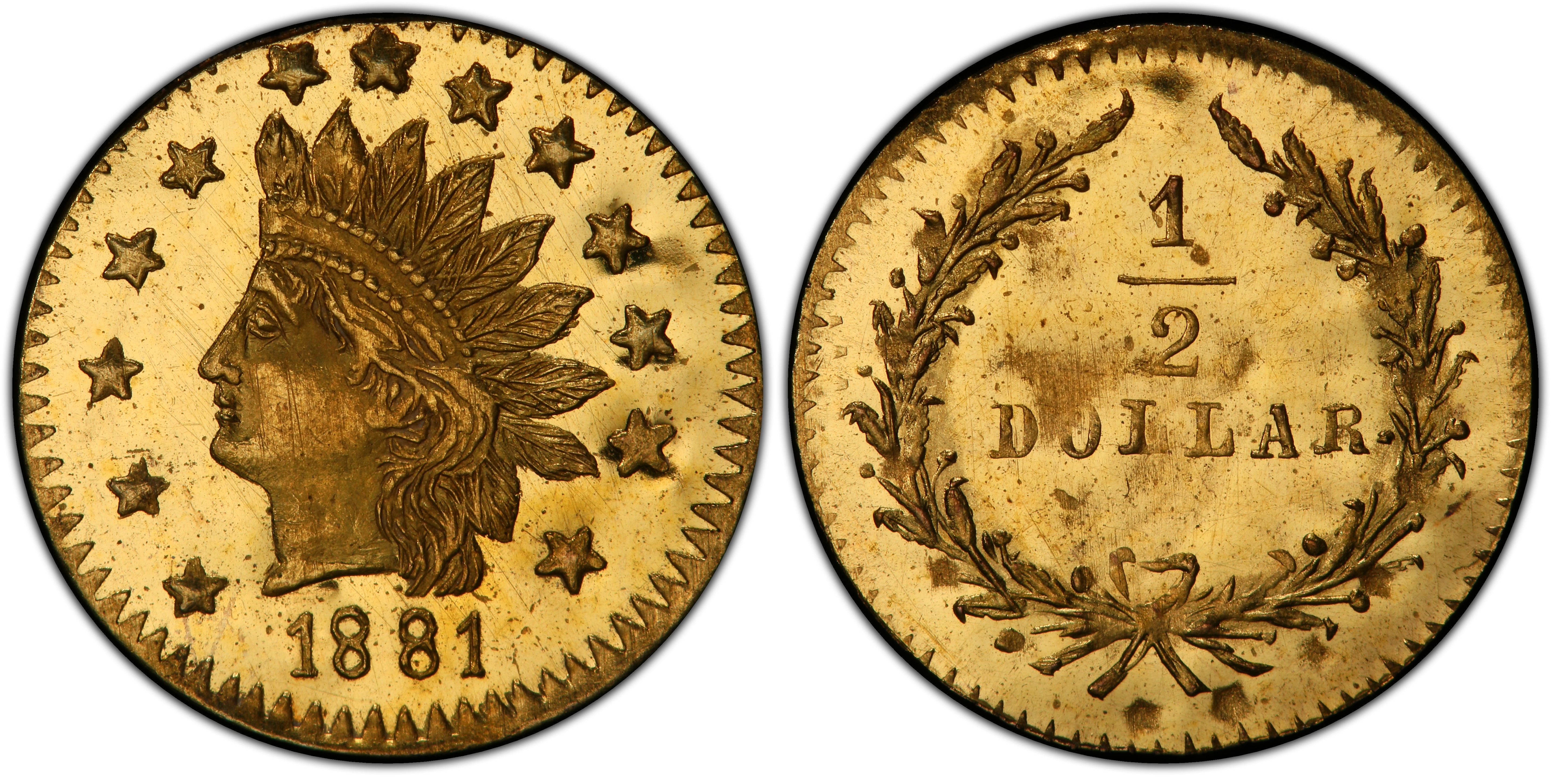
Obverse & Reverse
The 1881 BG-1069 50 Cents piece is a quintessential example of a 'Period Two' California Fractional Gold coin, a series born from a peculiar evolution in California's post-Gold Rush economy. The initial fractional gold pieces of 1852-1857 ('Period One') were a direct response to a severe shortage of small-denomination coinage, a critical impediment to daily commerce in the gold fields. Miners paid in gold dust or large private ingots struggled with simple transactions. Jewelers and metalworkers stepped into this void, creating quarter, half-dollar, and dollar pieces from native gold. By the late 1850s, the San Francisco Mint was in full operation, alleviating the acute need for circulating small change. However, the tiny gold coins had found a new and enduring market as popular souvenirs and keepsakes. Easterners and Europeans were captivated by the romance of the California Gold Rush, and these miniature gold pieces were affordable and easily mailable mementos. This second wave of production, from 1859 to 1882, is known as the 'jeweler's issues' period. These pieces, including the BG-1069, were not primarily intended to circulate, which explains their often underweight nature and the frequent use of non-Liberty Head designs, such as the popular Indian Head motif. Production was centered in San Francisco, with jewelers like Robert B. Gray & Co. and Christopher Ferdinand Mohrig being key figures. The Coinage Act of 1864 technically forbade private coinage, but enforcement was lax until the early 1880s. As the Secret Service began to crack down, production of denominated pieces ceased around 1883. The BG-1069, dated just before this final suppression, represents the twilight of this fascinating and quasi-legal chapter in American numismatics.
Associated EventPost-California Gold Rush Souvenir Market
Reason For MintingPrimarily created to satisfy a growing demand for souvenirs and jewelry items related to the California Gold Rush.
Minter HistoryThe specific minter of the BG-1069 is unconfirmed. However, the style and period are consistent with the work of several San Francisco jewelers. Christopher Ferdinand Mohrig is a notable producer of fractional gold in this era, known for varieties BG-790 through BG-799. He was famously arrested by the Secret Service in August 1876 for violating private coinage laws, and his dies were confiscated. While this specific variety falls outside his confirmed BG numbers, the manufacturing techniques are similar, making him or another contemporary San Francisco jeweler the likely source.
Historical SignificanceThe BG-1069 is significant not as a coin that facilitated commerce, but as a tangible artifact of the enduring national fascination with the California Gold Rush. It represents a mature souvenir market and the final years of a uniquely American series of private issues before federal laws were strictly enforced, ending the era of private U.S. gold coinage.
N/A
Denomination50 Cents
Minting Period1881
Assayer/MinterUnknown, possibly Christopher Ferdinand Mohrig
Geographic OriginSan Francisco, California
Obverse DescriptionFeatures a small, somewhat crude rendering of an Indian Head facing left. The portrait is adorned with a feathered headdress. The date '1881' is positioned below the bust, and the entire design is encircled by thirteen stars representing the original colonies.
Obverse Inscription1881
Reverse DescriptionThe central device is the denomination '1/2' contained within a continuous wreath of leaves and berries. The wreath is tied with a bow at the bottom. The legend 'CALIFORNIA GOLD' appears outside the wreath, curving along the upper portion of the rim.
Reverse InscriptionCALIFORNIA GOLD 1/2
CompositionGold
Stated Fineness Actual FinenessVariable, but typically less than .900; Period Two issues were notoriously underweight and often of lower fineness than official U.S. coinage.
Weight0.25 grams
Diameter10.00 mm
EdgePlain
Unknown
Survival Estimate76-200 (The range for R-4)
Rarity ScaleR-4+
This variety appeals to collectors of California Fractional Gold for its classic Indian Head design and its status as a late-period, pre-suppression issue. Its small size and affordability relative to Period One issues make it an accessible piece of Gold Rush-era history.
Key VarietiesNo major die varieties are widely recognized for BG-1069 itself. The primary distinction for this coin is its unique Breen-Gillio die pairing. No special collector issues, such as proofs or restrikes, are known to have been created for this specific variety.
Authentication TipsGenuine pieces are very small and thin, and often exhibit a somewhat crude, hand-finished appearance. The strike can be uneven, with weakness in the center of the reverse opposite the high relief of the obverse portrait. Replicas are common; many are gold-plated brass and feel greasy or have incorrect luster. Genuine pieces lack a bear in the design, a common feature on modern copies. Any piece that appears perfectly struck or has a soapy, uniform surface should be viewed with suspicion. Third-party authentication is highly recommended.
Shopping ConsiderationsA premium quality example for its grade will show a sharp strike on the Indian's headdress and the date. On the reverse, the numerals and letters should be as complete as possible, though some central weakness is typical. Original, lustrous surfaces are highly desirable; many surviving examples are prooflike (PL), exhibiting mirrored fields from polished dies, and these command a premium. Avoid examples that have been harshly cleaned, which strips the original patina and imparts hairline scratches. Also, check carefully for evidence of having been mounted in jewelry, such as solder marks or rim damage, which significantly reduce value.
A coin's grade is its condition, rated on a 1-70 scale. For rare coins, this is the most critical factor in determining value, as a tiny difference in preservation can mean a huge difference in price.
Relevant Grade TypesOriginal issues of BG-1069 were business strikes, though many were made with polished dies and sold as souvenirs, not intended for circulation. They are found in Circulated grades (AU-58 and below, though heavy circulation is unusual) and, more commonly, Mint State (MS, 60-70). The souvenir nature of their striking means that many high-grade examples exhibit prooflike (PL) or deep prooflike (DPL) surfaces, which are designations added to the MS grade, not a separate striking method like true Proofs. No true Proofs from the original minting period are known.
Mint State CharacteristicsUncirculated examples are defined by their luster. A typical piece has bright, satiny luster, while premium examples have deeply mirrored, prooflike fields. Due to the manufacturing process, the strike can be inconsistent; it is common to see weakness in the center of the wreath on the reverse, opposite the Indian's portrait. High-grade examples will have minimal contact marks, though the softness of the gold makes even pristine pieces susceptible to tiny imperfections.
Circulated Wear PatternsWear first appears on the highest points of the design: the cheek and the feathers of the headdress on the obverse. On the reverse, the leaves and the fractional numbers '1/2' will show the first signs of friction. In lower grades (VF and below), the stars on the obverse and the letters in 'CALIFORNIA GOLD' will begin to lose their sharpness and merge towards the rim.
Key Factors For ValueFor the BG-1069, the primary value drivers are grade and surface quality. A high Mint State grade (MS-63 or better) is the foundation. Beyond that, a strong 'PL' (Prooflike) or 'DPL' (Deep Prooflike) designation from a major grading service can add a significant premium. Eye appeal is paramount: coins with original, vibrant orange-gold toning and clean, mark-free surfaces are prized above hazy or spotted examples. A sharp strike, particularly on the reverse, will also command a higher price. A CAC sticker indicating premium quality for the grade provides an additional layer of value and confidence for buyers.
PCGS Price Guide
| Grade | Price | Population |
|---|---|---|
| 64 | N/A | N/A |
| 65 | $1,250.00 | 1 |
| 65+ | $1,550.00 | N/A |
| 66 | $2,250.00 | 1 |