1873/2 G$1 BG-1121, PL (Regular Strike)
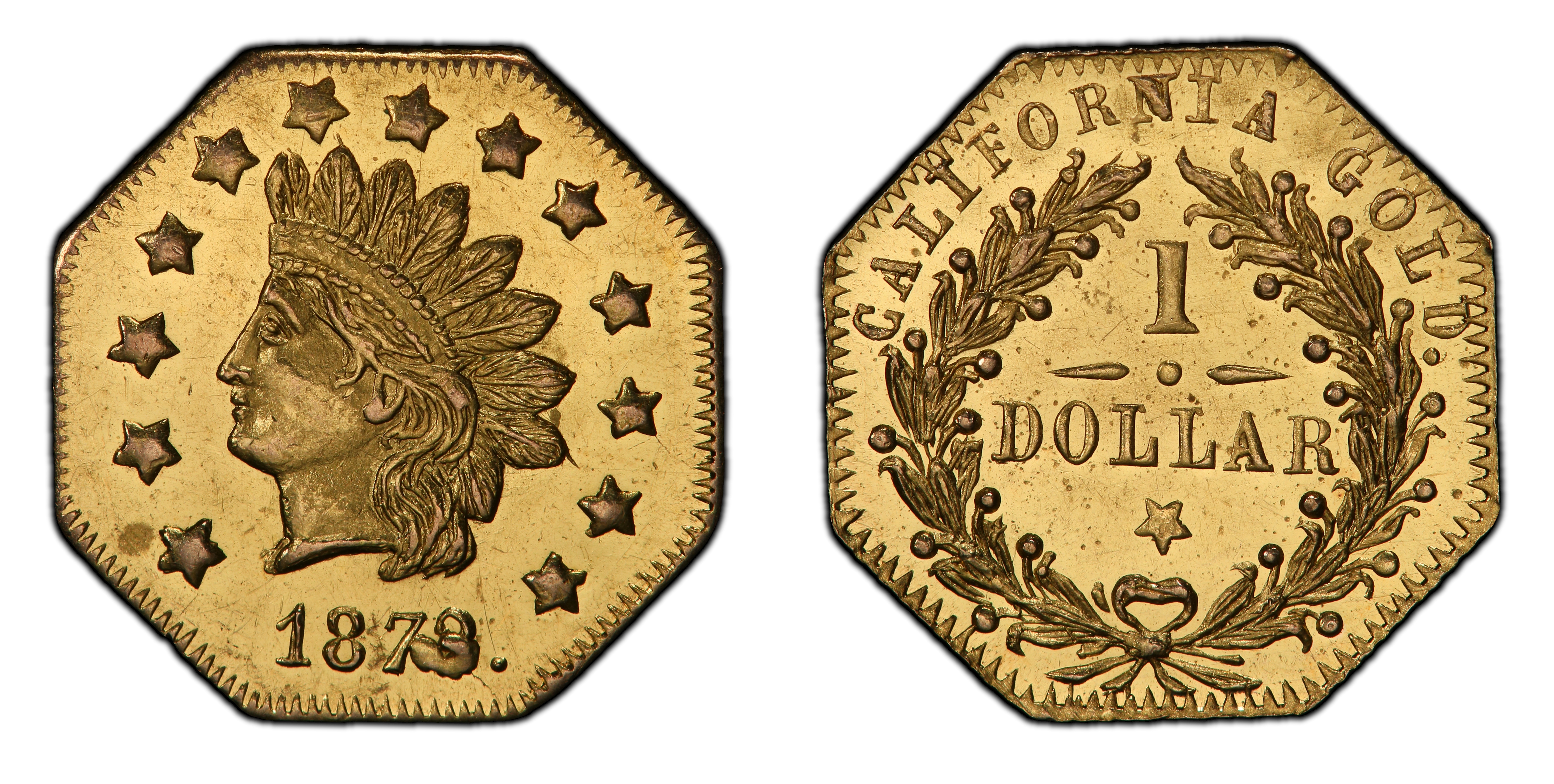
Obverse & Reverse
The 1873/2 G$1, cataloged as Breen-Gillio 1121, is a quintessential example of a 'Period Two' California Fractional Gold piece. By the 1870s, the initial, desperate need for circulating small-denomination coinage that characterized the Gold Rush of the early 1850s had largely subsided. The establishment of the San Francisco Mint in 1854 and a more stable supply of federal coinage had altered the economic landscape. However, private jewelers and minters continued to produce these diminutive gold tokens, shifting their business model from fulfilling a transactional necessity to catering to a burgeoning souvenir and jewelry market. These later issues, struck from 1858 to 1882, were often viewed with suspicion by the government, which saw them as illicitly competing with official coinage, leading to their characterization by numismatists as 'Suppressed Jewelers' Issues.' The BG-1121 was struck by Christopher Ferdinand Mohrig, a prominent San Francisco jeweler and die-sinker active in this period. Its creation is a fascinating numismatic story: the dies for the 1872 dollar (BG-1120) were repurposed for 1873 by punching a '3' over the '2' in the date. This practical, cost-saving measure resulted in a distinct and highly sought-after overdate variety. These pieces were not intended for grueling daily commerce but were instead sold as keepsakes of the Golden State, souvenirs for travelers, and novelties for collectors back East. Their often prooflike or semi-prooflike surfaces, a result of polished dies and careful striking, attest to their status as special presentation pieces rather than workhorse coins. Despite their unofficial status, they represent the final chapter of a uniquely American private coinage tradition born from the chaos and opportunity of the California Gold Rush.
Associated EventCalifornia Gold Rush (Later Period)
Reason For MintingPrimarily produced as souvenirs and for the jewelry trade rather than to fill a circulating coinage void, which was characteristic of earlier issues.
Minter HistoryChristopher Ferdinand Mohrig was a German immigrant who became one of the most prolific and skilled manufacturers of California Fractional Gold during the 'Period Two' era. Operating as a jeweler, watchmaker, and die-sinker in San Francisco from the 1860s through the 1880s, he produced a wide array of small denomination gold pieces. Unlike the emergency issues of the early 1850s, Mohrig's pieces were known for their quality craftsmanship and were marketed as keepsakes. He created both Liberty Head and Indian Head designs, often striking them with a medal alignment. The BG-1121 is a direct product of his workshop, showcasing his practice of modifying and reusing dies to create new varieties for the souvenir market.
Historical SignificanceThe BG-1121 is significant as a prime example of the evolution of California Fractional Gold from necessity-driven currency to commercial souvenir. It demonstrates the die-sinking practices of the era, specifically the creation of an overdate, and represents the work of a key private minter, C.F. Mohrig. Its immense rarity ensures its status as a landmark issue within the broader series of U.S. private and territorial coinage.
BG-1121
Denomination$1
Minting Period1873
Assayer/MinterChristopher Ferdinand Mohrig
Geographic OriginSan Francisco, California
Obverse DescriptionAn Indian Head motif, facing left, styled after the contemporary U.S. Indian Head cents. The portrait is surrounded by thirteen stars, representing the original colonies.
Obverse Inscription(No lettering)
Reverse DescriptionThe reverse features the denomination '1' and the word 'DOLLAR' within a continuous wreath of leaves and berries. The date, with the clear 3-over-2 overdate, is positioned below the wreath.
Reverse Inscription1 DOLLAR 1873/2
CompositionGold
Stated Fineness Actual Fineness EdgePlain
Extremely Low
Survival Estimate12-14 known examples
Rarity ScaleR-7-
This coin is a celebrated rarity in the California Fractional Gold series, appealing to specialists for its dramatic 1873/2 overdate, octagonal shape, and connection to the well-documented minter C.F. Mohrig. Its R-7- rarity places it among the most difficult pieces in the series to acquire, making any appearance a significant numismatic event.
Key VarietiesThe BG-1121 is itself a key variety, created by modifying the die for the BG-1120 (1872 $1). There are no other major varieties of the BG-1121 from the original minting period. No special collector restrikes or patterns are known to exist.
Authentication TipsThe primary diagnostic is the clear overdate, which resulted in a prominent die lump over and around the base of the digit '3' in the date. This feature should be sharp and distinct. Genuine examples often exhibit semi-prooflike or prooflike fields. Be wary of cast counterfeits which will show a soft, indistinct lump and may have tooling marks or a porous texture. Comparison with high-resolution images of certified examples is essential.
Shopping ConsiderationsFor a premium quality example, a buyer should seek a sharp strike, particularly on the details of the Indian's headdress and the wreath on the reverse. The semi-prooflike fields are a hallmark of this issue; look for examples with reflective, well-preserved surfaces that have not been harshly cleaned or polished, which would diminish this effect. Minor, honest marks on the cheek or in the fields are common, but severe or distracting abrasions should be avoided. The attractiveness of the 'olive-orange' or 'sun-gold' toning can add significantly to eye appeal and value. Given the rarity, even details-graded coins (e.g., for a minor bend) are highly coveted.
A coin's grade is its condition, rated on a 1-70 scale. For rare coins, this is the most critical factor in determining value, as a tiny difference in preservation can mean a huge difference in price.
Relevant Grade TypesOriginal period issues were business strikes, although produced with special care, and are found in Circulated (1-58) and Mint State (MS, 60-70) grades. Due to their status as souvenirs, a higher proportion than usual survive in uncirculated condition. No true Proofs were struck during the original period. The 'PL' (Prooflike) or 'DMPL' (Deep Mirror Prooflike) designations are sometimes used by grading services to denote examples with highly reflective, mirror-like surfaces, but these are still considered business strikes.
Mint State CharacteristicsUncirculated examples of BG-1121 are characterized by a semi-prooflike to prooflike finish, a direct result of being struck from polished dies. Luster is typically flashy and reflective rather than satiny. The strike is usually sharp, though minor weakness on the highest points is not uncommon. Because they were handled as keepsakes rather than circulated money, marks tend to be light hairlines or minor contact points rather than heavy, circulation-induced abrasions.
Circulated Wear PatternsOn circulated examples, wear first appears on the high points of the Indian's cheek, the details of the headdress feathers, and the highest leaves and bow of the wreath on the reverse. As wear progresses, the stars on the obverse will begin to lose their sharp points, and the finer details of the wreath will merge. In lower grades, the date and legends will show significant flattening.
Key Factors For ValueThe primary value driver for a BG-1121 is its grade and surface quality. An example with original, undisturbed prooflike surfaces commands a significant premium over one that has been cleaned or polished. Sharpness of the strike is crucial, as is superior eye appeal, which is often defined by attractive, original toning. The clarity and prominence of the overdate feature itself can also be a factor. A CAC sticker, indicating premium quality for the grade, adds a substantial premium for an elite-level rarity like this.
PCGS Price Guide
| Grade | Price | Population |
|---|---|---|
| 63 | $4,750.00 | 1 |