1870 G$1 BG-1107, PL (Regular Strike)
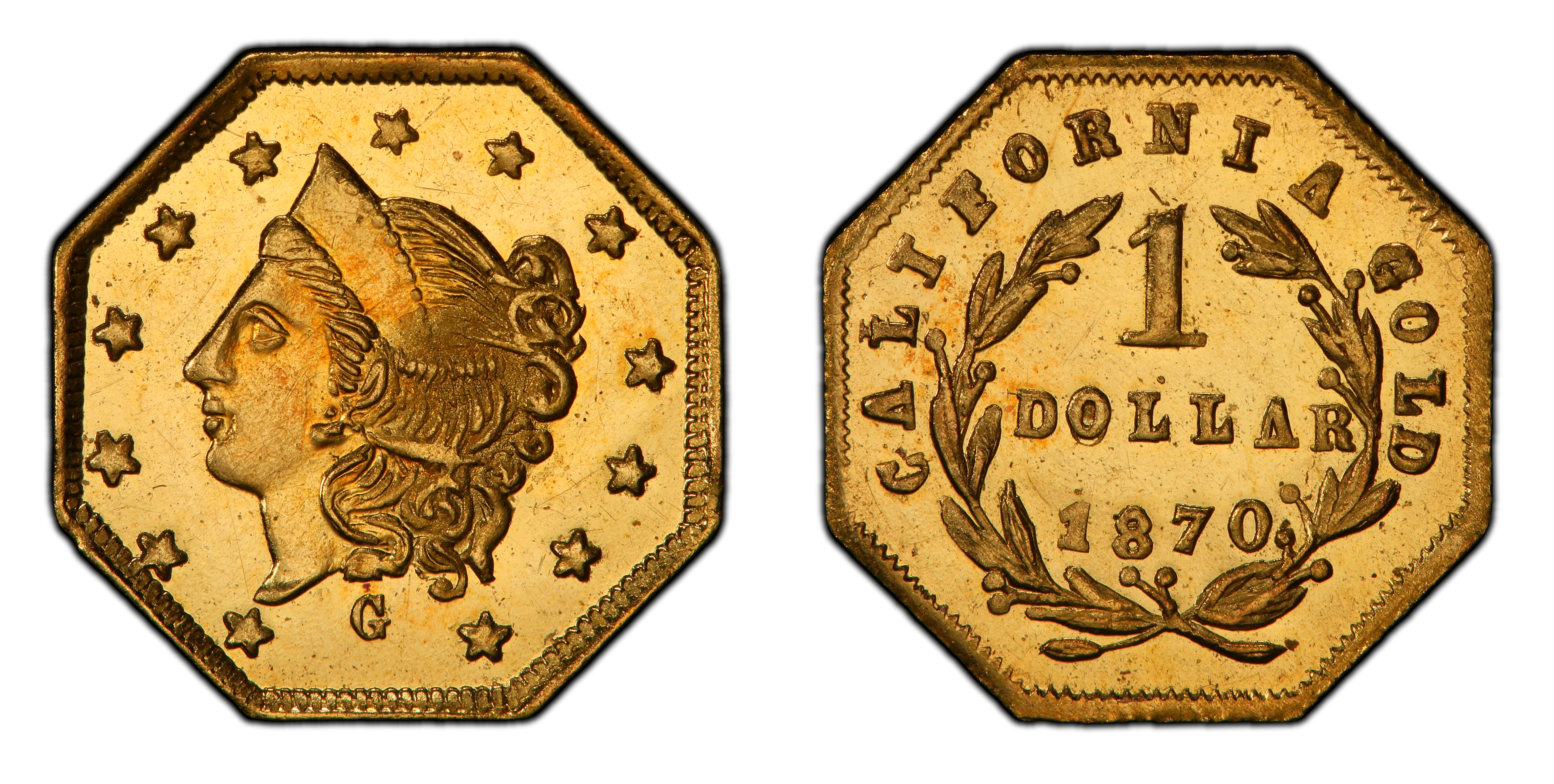
Obverse & Reverse
The 1870 BG-1107 one dollar piece emerges from the second major phase of California's private gold coinage, a period numismatists designate as 'Period Two' (1858-1882). Unlike the 'Period One' issues (1852-1857), which were struck out of genuine commercial necessity to alleviate a severe shortage of small change during the initial Gold Rush boom, these later pieces served a different purpose. By 1870, the San Francisco Mint was in full operation, supplying the region with ample federal coinage. The impetus for private minting had shifted from commerce to curiosities. Enterprising jewelers, capitalizing on the national fascination with the California Gold Rush, began producing miniature gold coins primarily as souvenirs and keepsakes. Robert B. Gray & Co. was a prominent San Francisco jewelry firm that entered this market. In late 1858 or 1859, Gray acquired the business of another established jeweler and fractional gold producer, Antoine Louis Nouzillet, inheriting his dies and equipment. After a period of using Nouzillet's old materials, Gray introduced his own distinctive issues in 1870, hallmarked with a tell-tale 'G' on the obverse. The BG-1107 is a prime example of these 'jeweler's issues.' Struck in the popular octagonal shape reminiscent of the larger fifty-dollar 'slugs' of the Assay Office, it was designed to be an attractive memento of the Golden State. These pieces were often sold to tourists or mailed back East as tangible, yet affordable, pieces of California gold. Despite their souvenir status, the Private Coinage Act of 1864 made their production illegal. However, the law was not strictly enforced by the Secret Service in California until the early 1880s, allowing firms like Gray's to continue production throughout the 1870s. This specific variety, dated 1870, represents the inaugural year of Gray's own branded production, making it a historically significant type within the Period Two series. Its existence highlights a fascinating transition in private minting, from utilitarian necessity to commercial nostalgia.
Associated EventCalifornia Gold Rush (Post-Rush Souvenir Period)
Reason For MintingPrimarily struck for sale as a souvenir or keepsake for tourists and those fascinated by the California Gold Rush.
Minter HistoryRobert B. Gray & Co. was a San Francisco jewelry firm active in the mid-to-late 19th century. The company entered the fractional gold business in earnest around 1859-60 by purchasing the dies and equipment of Antoine Louis Nouzillet, a prolific Period One minter. For about a decade, Gray likely used Nouzillet's old dies. In 1870, Gray introduced new obverse dies that included his initial, 'G', as a maker's mark, thereby creating a distinct series of coins. The firm's issues are generally noted for being of higher weight and intrinsic value than many other contemporary 'jeweler's issues,' suggesting a commitment to a higher quality product. The company produced octagonal quarter dollars, half dollars, and dollars until at least 1871. Robert B. Gray sold his interests to the California Jewelry Co. in 1871, bringing an end to the 'G' marked coinage.
Historical SignificanceThe BG-1107 is significant as a primary example of a 'Period Two' California Fractional Gold piece, illustrating the shift from circulating coinage of necessity to souvenir issues. As an inaugural dated issue from Robert B. Gray & Co. bearing his 'G' hallmark, it marks a key transition in the private production of these popular gold tokens.
K-N/A
Denomination$1
Minting Period1870
Assayer/MinterRobert B. Gray & Co.
Geographic OriginSan Francisco, California
Obverse DescriptionA well-proportioned Liberty Head faces left, her hair tied in a bun at the back. She is surrounded by thirteen six-pointed stars. A small, capitalized letter 'G' (for Gray) is located in the field below the bust, centered above the date.
Obverse Inscription1870
Reverse DescriptionThe reverse features the denomination '1 / DOLLAR' on two lines within a wreath. The wreath is composed of two stylized branches tied together at the bottom with a bow. The legend 'CALIFORNIA GOLD' appears outside and above the wreath.
Reverse InscriptionCALIFORNIA GOLD / 1 / DOLLAR
CompositionGold
Stated Fineness Actual FinenessVariable, but generally higher than other Period Two issues.
Weight0.51 grams
Diameter12.70 mm
EdgePlain
Unknown
Survival Estimate31-75
Rarity ScaleR-5/R-6
The BG-1107 is highly sought after by specialists for several reasons: it is an attractive octagonal dollar, a key first-year issue from the identified minter Robert B. Gray & Co., and it bears the clear 'G' hallmark. Its status as a relatively high-quality Period Two issue adds to its desirability.
Key VarietiesNo major varieties from the original minting period are widely recognized for BG-1107 itself. Collector issues such as Proofs or restrikes are not known to exist for this variety; all known examples are business strikes. The primary distinction for collectors is the quality of the strike and the planchet, with some examples exhibiting prooflike (PL) surfaces, which command a significant premium.
Authentication TipsGenuine examples must have the small 'G' below the bust, a key diagnostic for Robert B. Gray's issues. The strike is often sharp on the central devices but may show some softness at the borders. The planchets are typically thin but of reasonably good quality for the era. Be wary of modern replicas, which often have a soapy, cast-like appearance, incorrect weight, and a different gold color. Replicas also tend to lack the fine die polish lines and sharp detail of genuine, struck pieces. Any piece with a bear on the reverse is a 20th-century fantasy piece.
Shopping ConsiderationsA premium quality example for its grade will exhibit a sharp strike on Liberty's hair details and the lettering. Look for clean, original surfaces with minimal distracting marks; these tiny coins are easily damaged. Coins with prooflike or semi-prooflike fields are particularly desirable and rare. Avoid examples that have been harshly cleaned, which strips the original surface and luster. Evidence of tooling in the fields to hide marks or repairs to the edge from jewelry use are common problems and should be carefully checked for under magnification. A CAC sticker on this issue carries a strong premium, confirming both the grade and the quality of the surfaces.
A coin's grade is its condition, rated on a 1-70 scale. For rare coins, this is the most critical factor in determining value, as a tiny difference in preservation can mean a huge difference in price.
Relevant Grade TypesOriginal period examples of BG-1107 were produced as business strikes, intended for sale as souvenirs rather than circulation, though some may have seen minor handling. They are found in both Circulated grades (AU and below, though heavy wear is atypical) and Mint State (MS, 60-70) grades. No true Proofs were struck during the original period of issue. The 'PL' designation refers to 'Prooflike' business strikes, which are struck on highly polished planchets and are not a separate type of issue but rather a desirable manufacturing variance.
Mint State CharacteristicsUncirculated examples are defined by their luster, which is typically bright and reflective; some specimens were struck on polished planchets and exhibit deeply prooflike (PL) or even deep mirror prooflike (DMPL) fields. The strike can be uneven, with the central devices (Liberty's head, the wreath) often being sharper than the peripheral legends and stars. Small, planchet-related flaws or striations are not uncommon. Contact marks, even small ones, can be very noticeable on the smooth fields and are a primary determinant of the numerical grade.
Circulated Wear PatternsFor examples that saw handling, wear first appears on the highest points: the hair above Liberty's eye and ear, and the leaves and bow of the wreath on the reverse. As wear progresses, the stars will begin to lose their sharpness, and the fine details of the hair will merge. On lower-grade examples, the 'G' below the bust and the date may show significant weakness.
Key Factors For ValueSurface quality is paramount for this issue. An example with original, undisturbed luster and minimal marks will command a significant premium over a cleaned or heavily marked coin of the same numerical grade. Strike sharpness is also key; collectors pay more for well-defined stars and hair detail. Eye appeal is crucial, with coins showing attractive, reflective surfaces—especially those designated PL or DMPL by grading services—being the most valuable. A CAC sticker indicating premium quality for the grade will add substantially to the coin's value.
PCGS Price Guide
| Grade | Price | Population |
|---|---|---|
| 62 | $2,500.00 | N/A |
| 62+ | $2,850.00 | N/A |
| 63 | $3,500.00 | N/A |
| 63+ | $4,000.00 | N/A |
| 64 | $4,500.00 | 1 |