1869 G$1 BG-1106, PL (Regular Strike)
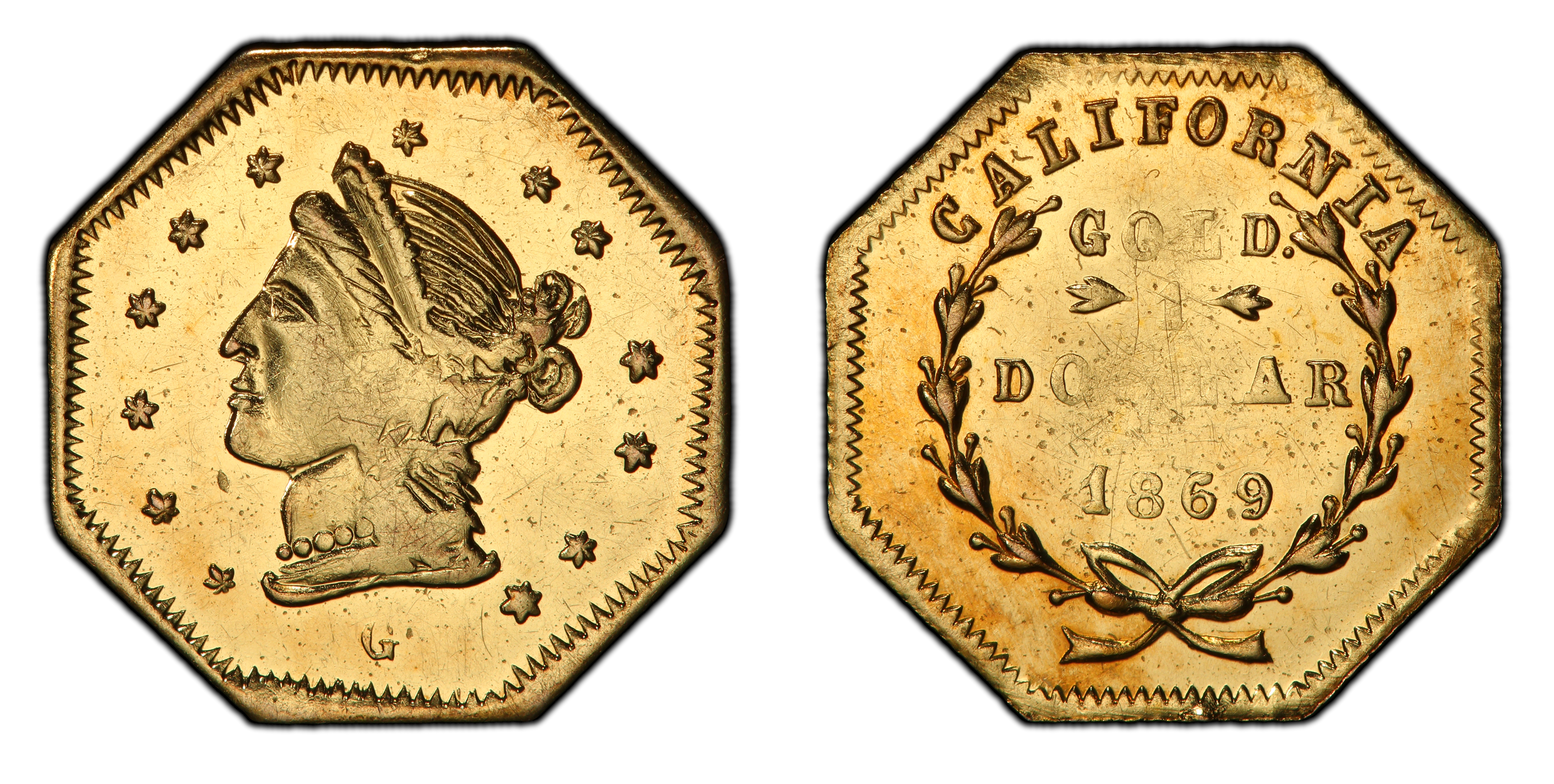
Obverse & Reverse
The 1869 BG-1106 gold dollar emerges from the second major phase of California's private gold coining era, often dubbed 'Period Two' (1858-1882) by numismatists. Unlike the 'Period One' issues, which were struck out of dire necessity to alleviate a severe shortage of small-denomination currency during the initial Gold Rush boom, the Period Two pieces were created in a more stable economic environment. By 1869, the San Francisco Mint had been in operation for fifteen years, supplying the region with federal coinage. However, the tiny, privately issued gold pieces had found a new and enduring market as souvenirs, keepsakes, and jewelry items. Their novelty and connection to the romanticism of the Gold Rush made them popular with locals and tourists alike, who often sent them back East to relatives. These 'jeweler's issues' were not intended to, and largely did not, function as a circulating medium of exchange in the same way as their predecessors. The Coinage Act of 1864 had made private coinage illegal, but the law was not strictly enforced against these small, denominated tokens until 1883, allowing jewelers like Robert B. Gray & Co. to operate for decades. The BG-1106, with its distinctive octagonal shape and Liberty Head design, is a quintessential example of this period's output. While still possessing intrinsic gold value, its primary purpose was commercial sale as a memento, a tangible piece of the California dream long after the initial fever had subsided. Its existence speaks to a mature post-Gold Rush economy where the imagery and material of the boom had become powerful marketing tools in their own right.
Associated EventCalifornia Gold Rush (Later Souvenir Period)
Reason For MintingPrimarily struck to be sold as popular souvenirs and keepsakes rather than to alleviate a currency shortage.
Minter HistoryRobert B. Gray & Co. was a prominent San Francisco manufacturing jeweler active during the 'Period Two' of fractional gold production. In late 1858 or early 1859, Gray acquired the business of another well-known jeweler and fractional gold producer, Antoine Louis Nouizillet. This purchase included Nouizillet's dies, hubs, and punches. Gray subsequently began producing his own series of fractional gold pieces, distinguishing his work by adding a hallmark 'G' to the obverse dies, as seen below the bust on the BG-1106. Numismatic research by Breen and Gillio notes that Gray's issues are generally of higher intrinsic value and weight compared to many other jeweler's issues of the same period, suggesting a higher standard of quality in his operation. The firm produced octagonal and round quarter, half, and dollar denominations from roughly 1859 through the early 1870s.
Historical SignificanceThe BG-1106 is historically significant as a prime example of a 'Period Two' or 'jeweler's issue' of California Fractional Gold. It represents the transition of these pieces from essential circulating currency to popular commercial souvenirs, reflecting the evolving economy and romantic mythology of post-Gold Rush California. The maker's mark 'G' provides a direct link to the important private minting firm of Robert B. Gray & Co.
BG-1106
Denomination$1
Minting Period1869
Assayer/MinterRobert B. Gray & Co.
Geographic OriginSan Francisco, California
Obverse DescriptionA Liberty Head, modeled after the contemporary federal gold coinage, faces left. She wears a coronet, and her hair is tied in the back. Thirteen stars encircle the portrait. A small but distinct letter 'G', for the minter Robert B. Gray, appears on the truncation of the neck, below the bust.
Obverse Inscription[None, aside from the 'G' minter's mark]
Reverse DescriptionThe denomination '1' and the word 'DOLLAR' are enclosed within a wreath of leaves and berries, tied with a bow at the bottom. The date '1869' is positioned below the wreath.
Reverse Inscription1 DOLLAR 1869
CompositionGold
Stated Fineness Actual FinenessVariable, but generally higher for Robert B. Gray issues compared to other Period Two pieces.
Weight0.50 grams
Diameter12.20 mm
EdgePlain
Unknown
Survival Estimate31-75 (per R-5 rating)
Rarity ScaleR-5
The BG-1106 is highly sought after for its attractive octagonal shape, the clear attribution to a known and respected maker (Robert B. Gray), and its status as a high-denomination dollar. As a one-year type, its appeal is further enhanced. Examples with prooflike surfaces are particularly prized.
Key VarietiesThe primary variety relates to the die state. 'State I' examples show a clear, distinct 'G' below the bust. Later die states exist where aggressive die polishing and wear began to efface the 'G', making it faint or incomplete. Coins with a bold 'G' are generally preferred. No later-date restrikes or special collector issues are known to exist.
Authentication TipsAuthentic examples often exhibit a characteristic weak strike in the centers of both the obverse and reverse, a result of the manual hammer-striking process. The 'G' below the bust should be of the correct style for Robert B. Gray's work. The numerals in the date and the lettering style should match known genuine examples cataloged in Breen-Gillio. Counterfeits may be cast, showing a porous or soapy surface texture, or may be struck with incorrect details and dimensions. Weight and diameter should be reasonably close to the established norms for the type.
Shopping ConsiderationsA premium quality example for its grade will display sharp details on the peripheral stars and wreath, even if the central portrait is soft. Look for original, undisturbed luster; many examples have been cleaned or used in jewelry. Prooflike (PL) examples, which exhibit mirrored fields, are exceptionally rare and command significant premiums. Avoid coins with significant rim bumps, scratches, or evidence of tooling. The overall eye appeal, meaning the combination of strike, surface quality, and luster, is paramount for this issue.
A coin's grade is its condition, rated on a 1-70 scale. For rare coins, this is the most critical factor in determining value, as a tiny difference in preservation can mean a huge difference in price.
Relevant Grade TypesOriginal period issues of BG-1106 were business strikes, although their primary purpose was for sale as souvenirs rather than circulation. They are found in Circulated (1-58) and, more commonly, Mint State (MS, 60-70) grades. No proofs were struck during the original period of issue, and no later-date Proof restrikes are known.
Mint State CharacteristicsUncirculated examples of BG-1106 are defined by their luster, which can range from satiny to semi-prooflike. A key characteristic is the strike: they are almost universally softly struck in the centers, with Liberty's cheek and the '1 DOLLAR' text often showing weakness. The peripheral devices, such as the stars and the outer wreath, should be sharper. Contact marks from handling are common due to the softness of the gold, but large, distracting marks will lower the grade.
Circulated Wear PatternsOn circulated examples, wear first appears on the highest points: Liberty's cheekbone, the hair above her ear, and the coronet. On the reverse, the numeral '1' and the bow of the wreath will show the first signs of friction and flattening. In lower grades (VF and below), the stars and letters in the legend will begin to merge with the fields.
Key Factors For ValueFor the BG-1106, value is driven by several key factors. Firstly, the grade and overall surface preservation are critical; an example with original, uncleaned surfaces and minimal marks is always preferred. Secondly, the strike sharpness plays a major role; a coin that is better-struck than average for the issue, particularly in the centers, will command a premium. Thirdly, eye appeal is crucial; coins designated 'PL' (Prooflike) are very rare and highly valuable. Finally, a CAC sticker, indicating premium quality for the grade, adds a significant premium for this and other California Fractional Gold issues.
PCGS Price Guide
| Grade | Price | Population |
|---|---|---|
| 63 | $2,250.00 | 1 |
| 63+ | $2,750.00 | N/A |
| 64 | $4,000.00 | N/A |