1868 G50C BG-1073, PL (Regular Strike)
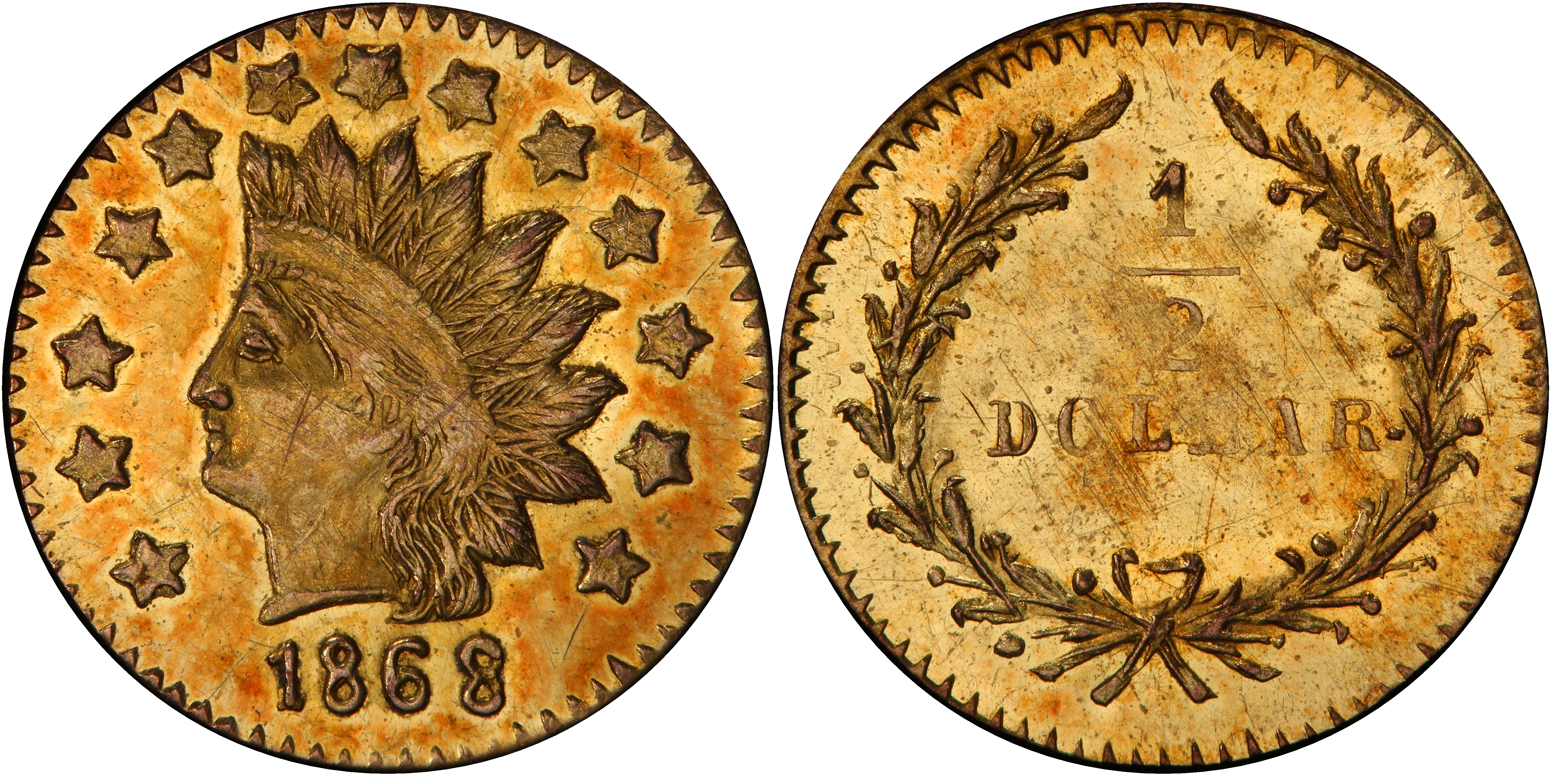
Obverse & Reverse
The 1868 50 Cents, cataloged as Breen-Gillio 1073 (BG-1073), is a quintessential example of 'Period Two' California Fractional Gold. This era, spanning from 1858 to 1882, saw the production of small-denomination gold tokens shift from a necessity-driven enterprise to a commercial venture primarily aimed at the souvenir and jewelry trade. Following the initial Gold Rush boom ('Period One,' 1852-1857), the acute shortage of circulating small change had been largely alleviated by official United States coinage. However, the romance of the Gold Rush and the desire for mementos kept the market for these miniature gold pieces alive. Jewelers and private minters, such as Robert B. Gray in San Francisco, capitalized on this demand. They produced vast quantities of beautifully crafted, yet often underweight, gold quarters, half dollars, and dollars. These were not intended to serve as a primary circulating medium in the same way their predecessors were, but rather as keepsakes for locals and tourists, and as popular items to be mounted into jewelry. The BG-1073, with its classic Liberty head design, was a product of this commercial environment. Struck in a period of significant national change following the Civil War, these pieces represent a nostalgic look back at the 'Days of '49' while simultaneously serving a new economic purpose. The widespread production and the jewelers' intent meant that many of these pieces were handled, cleaned, or soldered, making well-preserved, problem-free examples a challenge for modern collectors to locate.
Associated EventPost-Gold Rush Commercial Souvenir Trade
Reason For MintingPrimarily produced as souvenirs and for use in the jewelry trade, rather than to alleviate a shortage of circulating coinage.
Minter HistoryRobert B. Gray was one of the most prolific producers of California Fractional Gold during the second and third periods of their issuance. Operating as a jeweler in San Francisco, he was responsible for a significant number of the surviving half dollar and dollar varieties struck between the late 1850s and the early 1870s. Unlike the Period One assayers who were filling a critical economic void, Gray's business model was focused on the commercial appeal of these small gold pieces. He produced a wide array of die varieties, often using stock designs like the Liberty head, and his name is synonymous with the later souvenir-driven phase of fractional gold production. His operations were purely commercial and not sanctioned by any government authority.
Historical SignificanceThe BG-1073 is significant not as a coin of necessity, but as a tangible link to the commercialization of the Gold Rush legacy. It represents the transition from utilitarian private coinage to privately struck souvenirs, reflecting California's evolving identity and the romanticism that the gold discovery had imprinted on the national consciousness. Its widespread production also highlights the legal gray area these tokens occupied before the Comstock Act of 1873 and subsequent legislation curtailed their manufacture.
N/A
Denomination50 Cents
Minting Period1868
Assayer/MinterRobert B. Gray & Co.
Geographic OriginSan Francisco, California
Obverse DescriptionA beaded border encircles a right-facing bust of a female figure representing Liberty, her hair tied in a bun. She wears a coronet or tiara. Thirteen stars surround the portrait, representing the original colonies.
Obverse Inscription[None, only stars and portrait]
Reverse DescriptionA beaded border surrounds the denomination '1/2' and the word 'DOLLAR' within a wreath composed of two branches tied together with a ribbon at the bottom. The date '1868' is positioned below the wreath.
Reverse Inscription1/2 DOLLAR 1868
CompositionGold
Stated Fineness Actual FinenessVaries, but typically between .500 and .750 fine.
Weight0.25 grams
Diameter10.00 mm
EdgePlain
Unknown, but believed to be in the low thousands.
Survival Estimate200-300
Rarity ScaleR-5
This variety is highly popular with collectors due to its affordability, classic design, and status as a representative example of the widely produced Period Two fractionals. It is often one of the first pieces a new collector in the series will acquire. The 'PL' (Plain Liberty) designation distinguishes it from other varieties with different obverse features.
Key VarietiesThe primary variety is the Regular Strike (Business Strike) as described (BG-1073). While Period Two fractionals were not typically struck as Proofs in the modern sense, some examples exhibit prooflike (PL) surfaces from freshly polished dies. No official restrikes or patterns are known for this specific variety. The main variations in the broader series relate to different die pairings, resulting in over 500 Breen-Gillio numbers for the entire Fractional Gold series.
Authentication TipsAuthentic examples often have a slightly soft or 'mushy' strike, particularly on the highest points of Liberty's hair and the wreath leaves. The planchets are typically thin. Counterfeits from the era and modern fakes exist. Many fakes are cast, showing pitting or a soapy surface texture under magnification. Others are struck but have incorrect weights, diameters, or design details that do not match known die states of BG-1073. Compare the style of the numerals and letters to high-resolution images of certified examples.
Shopping ConsiderationsA premium quality example for its grade will possess a sharp strike for the issue, with clear details on Liberty's hair and the wreath. Look for original, uncleaned surfaces with some remaining luster; many examples have been harshly cleaned or polished over the years, which significantly impairs value. Avoid specimens that show evidence of being mounted in jewelry (solder marks, rim damage, excessive wear on one side). Eye appeal is paramount; a coin with attractive, original reddish-gold toning will command a significant premium over a bright, dipped-out example. Check carefully for scratches, rim nicks, and planchet flaws.
A coin's grade is its condition, rated on a 1-70 scale. For rare coins, this is the most critical factor in determining value, as a tiny difference in preservation can mean a huge difference in price.
Relevant Grade TypesOriginal period issues of BG-1073 were business strikes intended for commercial sale, and are found in Circulated (AU-58 and below) and Mint State (MS, 60-70) grades. No true Proofs were struck during the original period of issue. The term 'Prooflike' (PL) may be used by grading services to denote business strikes that have mirror-like fields from being struck with freshly polished dies, but these are not a separate striking and should not be confused with true Proof coinage.
Mint State CharacteristicsAn uncirculated BG-1073 typically exhibits a soft, satiny luster rather than a deeply frosty one. The strike is often somewhat weak, with Liberty's hair bun and the bow on the reverse wreath being the last areas to fill. Contact marks are common due to the softness of the low-karat gold and the way these pieces were handled in bulk by jewelers. A premium MS example would be well-struck for the variety with minimal distracting marks and vibrant original luster.
Circulated Wear PatternsWear first appears on the high points of Liberty's cheek, hair above the ear, and the coronet. On the reverse, the highest points of the wreath leaves and the bow of the ribbon will show initial friction and flatness. In lower grades (VF and below), the finer details of the hair and wreath become indistinct, and the stars on the obverse may begin to merge with the fields.
Key Factors For ValueThe primary value drivers for an 1868 G50C BG-1073 are grade and surface preservation. An example with original, uncleaned surfaces will always be worth more than a cleaned one of the same grade. Strike quality is also critical; a sharply struck coin is more desirable than a weakly struck one. Eye appeal, which includes luster and toning, plays a significant role. Finally, certification by a top-tier grading service (PCGS or NGC) is essential for market acceptance, and a CAC sticker indicating premium quality for the grade will add a substantial premium.
PCGS Price Guide
| Grade | Price | Population |
|---|---|---|
| 63 | $3,250.00 | 1 |
| 63+ | $4,000.00 | N/A |
| 64 | $5,250.00 | N/A |
| 66 | N/A | N/A |