1875 G50C BG-1057, PL (Regular Strike)
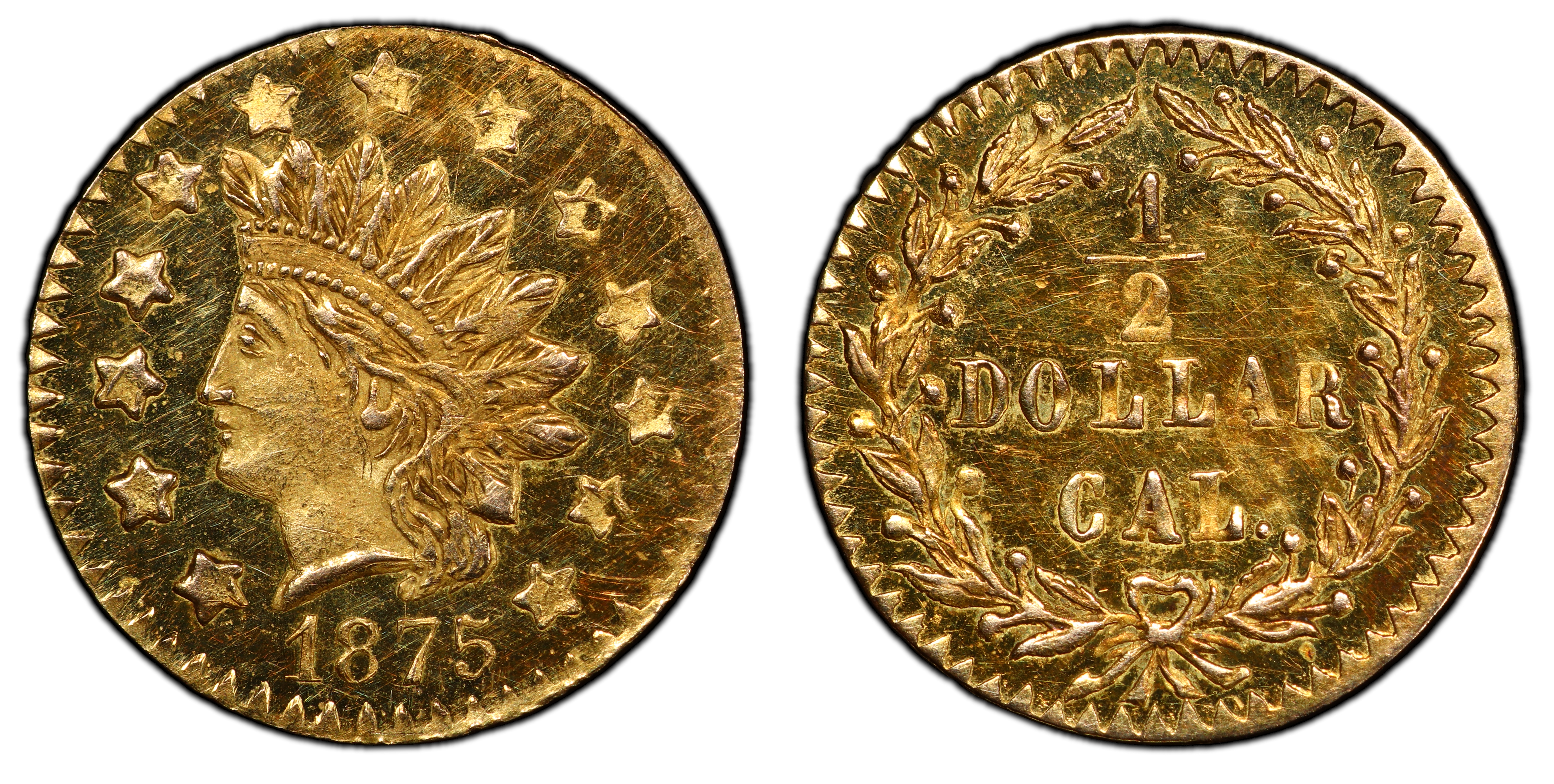
Obverse & Reverse
The 1875 BG-1057 half dollar emerges from the second major period of California Fractional Gold production (1859-1882), an era starkly different from the initial issue of 1852-1857. By the mid-1870s, the acute shortage of small change that plagued California during the Gold Rush had been largely resolved by the prodigious output of the United States Mint in San Francisco. The transcontinental railroad, completed in 1869, had ended California's economic isolation, but also brought challenges, including the Panic of 1873 which triggered a national depression and significant unemployment in the state. In this environment, the economic necessity for privately minted fractional gold had vanished. Instead, these miniature gold pieces transitioned into a new role as popular souvenirs, jewelry items, and keepsakes. Jewelers and private minters in San Francisco, many of whom remain anonymous, catered to a burgeoning tourist trade and a local appetite for novelties that recalled the heady days of the Gold Rush. These 'jeweler's issues' were not intended for robust circulation; they were typically underweight and often of a lower fineness than their stated value would imply. The Coinage Act of 1864 had already outlawed private coinage, but enforcement was lax in the West until the early 1880s, allowing this souvenir trade to flourish. The BG-1057, therefore, is not a product of a frontier economy starved for change, but rather a memento from a rapidly maturing California grappling with new economic realities, industrialization, and social tensions.
Associated EventPost-Gold Rush Economic Transition & Souvenir Coinage Era
Reason For MintingPrimarily struck to be sold as souvenirs, charms, or keepsakes, not to alleviate a shortage of circulating currency.
Minter HistoryThe specific minter of BG-1057 is unknown, which is characteristic of many 'Period Two' California fractional gold pieces. Production was decentralized among various San Francisco jewelers who capitalized on the souvenir market. Unlike the earlier, more functional issues, these later pieces were often made anonymously. While firms like Robert B. Gray & Co. and individuals like Herman J. Brand were active in this period, a definitive attribution for the BG-1057 dies has not been established. These craftsmen used techniques like the 'hammer method'—striking a planchet between two dies with a sledgehammer—resulting in variable strike quality.
Historical SignificanceThe BG-1057 is significant not as a coin of necessity, but as a numismatic artifact that reflects California's economic and cultural shift. It marks the transformation of private gold coinage from a vital medium of exchange in the 1850s to a commercial novelty item by the 1870s, capturing the romanticism of the Gold Rush for a new generation of tourists and residents.
BG-1057
Denomination50 Cents
Minting Period1875
Assayer/MinterUnknown San Francisco Jeweler(s)
Geographic OriginSan Francisco, California
Obverse DescriptionFeatures a small, stylized female head facing left, intended to be a representation of an Indian princess. The portrait is somewhat crude, typical of the era's private issues. She wears a feathered headdress, and the portrait is surrounded by thirteen five-pointed stars along the periphery.
Obverse Inscription Reverse DescriptionA simple wreath composed of two branches tied with a bow at the bottom encircles the central inscriptions. The design is open at the top.
Reverse Inscription1/2 / CALIFORNIA / GOLD
CompositionGold
Stated Fineness Actual FinenessVariable, often between .500 and .800 fine gold, and generally underweight for their stated value.
Weight0.25 grams
Diameter10.50 mm
EdgePlain
Unknown
Survival Estimate31-75 coins
Rarity ScaleR-5+
This variety is sought after by specialists in the extensive California Fractional Gold series. Its appeal lies in its high rarity (R-5+), the attractive Indian Head design, and the frequency with which it is found with desirable prooflike surfaces. As a 'Period Two' issue, it tells the story of the souvenir-era of private gold.
Key VarietiesThe primary issue is the business strike, often found with prooflike (PL) or deep prooflike (DPL) surfaces due to the polishing of the dies by their jeweler-minters. No contemporary Proofs, patterns, or official later-date restrikes are known to exist for the BG-1057 die pair. One known diagnostic is the existence of examples with the reverse die rotated significantly (e.g., 45 degrees counterclockwise), which can be considered a minor but collectible variety.
Authentication TipsAuthenticity is paramount. Genuine pieces exhibit sharp, albeit sometimes uneven, strikes from dies, not the soft, mushy details of common cast counterfeits. The style of the lettering and the specific shape of the stars are key diagnostics; compare with high-resolution images of certified examples. The surfaces should have natural luster, not a modern polished look. Many fakes are gold-plated brass and will feel light or have incorrect toning. Edges should be plain and show no signs of a casting seam.
Shopping ConsiderationsA premium quality example for this variety is defined by a sharp strike, particularly on the details of the headdress and the wreath. Given their souvenir nature, many high-grade survivors were well-preserved. Seek out specimens with clean, original prooflike surfaces that have not been harshly cleaned or polished, as this is a key part of their appeal. Attractive, original reddish-gold toning commands a premium. Avoid examples that have been holed or mounted for jewelry, a common fate for these pieces. Scrutinize surfaces for evidence of tooling or repairs, especially in the fields.
A coin's grade is its condition, rated on a 1-70 scale. For rare coins, this is the most critical factor in determining value, as a tiny difference in preservation can mean a huge difference in price.
Relevant Grade TypesAll original period issues of BG-1057 were business strikes intended for sale as souvenirs, not circulation. They are found in Circulated grades (e.g., AU-55, AU-58) and, more commonly, in Mint State grades (MS, 60-70). Because the dies were often highly polished by their jeweler-makers to enhance eye appeal, many Mint State examples qualify for Prooflike (PL) or Deep Prooflike (DPL) designations. No true Proof (PR/PF) examples were struck during the original period of issue, and no official restrikes exist.
Mint State CharacteristicsIn uncirculated condition, the BG-1057 often exhibits a bright, reflective finish, hence the frequent PL designation. The quality of the strike can be inconsistent due to the manual hammering process; some may be weakly struck on the stars or the highest points of the wreath. Luster is typically flashy and reflective rather than satiny. Contact marks can be present, as the small coins were often handled in groups, but top-grade examples will be remarkably clean.
Circulated Wear PatternsAlthough not intended for heavy circulation, some examples show light wear. Friction first appears on the highest points of the design: the cheek and feathers of the Indian princess on the obverse, and the leaves and bow of the wreath on the reverse. In lower grades (VF and below, though rare), the stars would begin to merge with the fields and the finer details of the wreath would be lost.
Key Factors For ValueThe primary value driver is the quality of the surfaces. A coin with deep, original prooflike fields free of distracting marks or hairlines is most desirable. Sharpness of strike is critical; a fully struck-up example will command a significant premium over a weakly struck one. Eye appeal, including any attractive original toning, is a major factor. Given the prevalence of counterfeits, certification by a top-tier grading service (PCGS or NGC) is virtually mandatory for a significant transaction. A CAC sticker for this issue denotes premium quality for the grade and adds considerable value.
PCGS Price Guide
| Grade | Price | Population |
|---|---|---|
| 62 | N/A | N/A |
| 63 | N/A | N/A |
| 64 | $1,150.00 | 2 |
| 65 | N/A | N/A |
| 69 | N/A | N/A |