1874 G50C BG-1072, PL (Regular Strike)
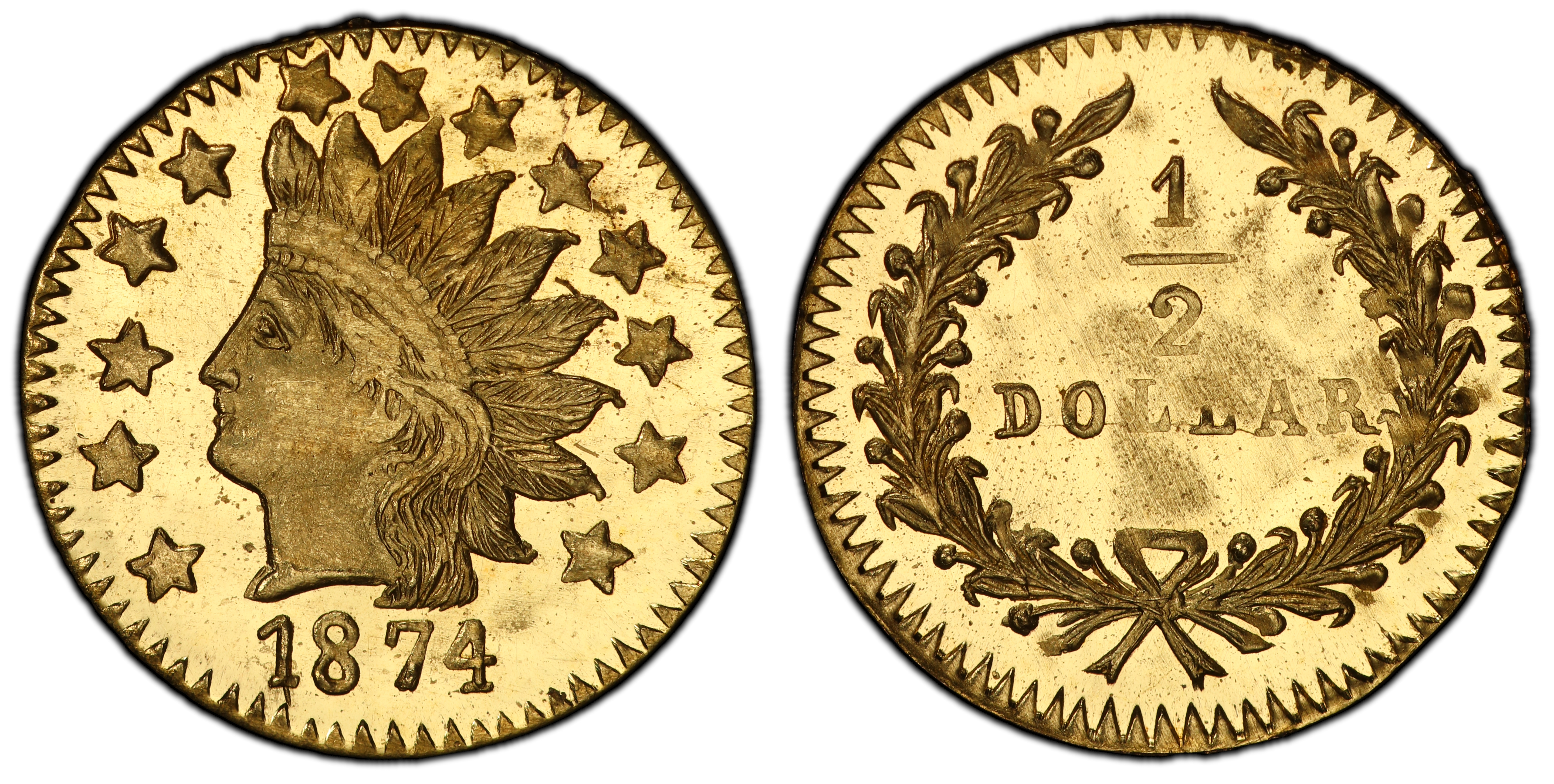
Obverse & Reverse
The 1874 BG-1072 50 Cents is a product of the second period of California Fractional Gold production (1859-1882). Following the initial frenzy of the Gold Rush, California's economy matured, but a chronic shortage of small-denomination coinage persisted. The U.S. Mint in San Francisco, established in 1854, focused on larger denominations, leaving a void for everyday transactions. This void was filled by private minters, often jewelers by trade, who began striking fractional gold pieces in quarter dollar, half dollar, and dollar denominations. These 'Period Two' issues were distinct from their earlier 'Period One' counterparts (1852-1856). While the first issues were generally of good weight and intended to circulate as true money substitutes, the Period Two pieces, including this 1874 variety, were often underweight for their stated value, functioning more as privately issued tokens accepted by local merchants out of necessity and convenience. The Coinage Act of 1864 officially made private coinage illegal, yet enforcement by the Secret Service was lax in California until 1883. This legal gray area allowed jewelers and artisans in San Francisco to continue producing these miniature gold coins for nearly two more decades. These pieces were typically manufactured using hand-operated screw presses or even by the hammer method, resulting in coins of varying strike quality. Their designs often mimicked federal coinage, with Liberty and Indian Head motifs being popular choices to inspire public confidence. The BG-1072 is a quintessential example of this later period—a tiny, functional piece of commercial necessity that captures the enduring spirit of the Gold Rush long after its peak.
Associated EventCalifornia Gold Rush Aftermath
Reason For MintingTo alleviate a persistent shortage of small change for daily commerce in California.
Minter HistoryThe specific minter or jeweler responsible for the BG-1072 variety is unknown, a common trait for many Period Two California Fractional Gold pieces. Production was decentralized among various San Francisco jewelers who typically did not apply identifiable mintmarks to their work. These craftsmen used their skills in metalworking to meet a local market demand, creating the dies and striking the coins in their own shops.
Historical SignificanceCalifornia Fractional Gold represents a unique chapter in American monetary history, demonstrating how private enterprise stepped in to solve a government-created currency shortage. The BG-1072, as a Period Two issue, illustrates the evolution of these pieces from quasi-official coins to accepted trade tokens. Their existence is a tangible link to the daily economic life of post-Gold Rush California.
N/A
Denomination50 Cents
Minting Period1874
Assayer/MinterUnknown Private Minter
Geographic OriginSan Francisco, California
Obverse DescriptionAn Indian Head motif, facing left, surrounded by thirteen stars. The portrait style is typical of the era's interpretations of Native American figures on coinage, featuring a feathered headdress.
Obverse InscriptionNo inscriptions are present on the obverse.
Reverse DescriptionThe denomination '1/2 DOLLAR' is enclosed within a wreath of leaves and berries. The date '1874' appears below the wreath. Some examples may exhibit a small 'G' below the wreath, though its significance is not definitively known.
Reverse Inscription1/2 DOLLAR 1874
CompositionGold
Stated Fineness Actual FinenessVaries, but Period Two issues were typically less than face value, ranging from 14 to 22 karats.
Weight0.25 grams
Diameter10.00 mm
EdgePlain
Unknown, but very small.
Survival EstimateFewer than 30 known.
Rarity ScaleR-6 (13 to 30 known)
This variety is highly sought after due to its R-6 rarity, classic Indian Head design, and its direct connection to the economic history of San Francisco. The tiny size and intricate detail make it a fascinating and challenging piece to collect.
Key VarietiesThe primary catalog number is BG-1072. Research in the Breen-Gillio reference, 'California Pioneer Fractional Gold,' is essential, as minor die states or variations can exist. No official restrikes or patterns are known for this specific variety.
Authentication TipsGenuine pieces will have the word 'DOLLAR' and a denomination. Beware of modern replicas, which are extremely common; many fakes feature a bear on the reverse, a design never used on genuine 19th-century issues. Authentic pieces often exhibit weak or uneven strikes due to the crude manufacturing process. Unusually sharp, perfectly centered strikes should be viewed with suspicion. Weight and specific gravity can also be indicators, though they vary. Professional authentication by PCGS or NGC, who attribute by Breen-Gillio (BG) number, is highly recommended.
Shopping ConsiderationsA premium quality BG-1072 will exhibit a relatively sharp strike for the issue, especially on the high points of the Indian's headdress and the details of the wreath. Look for original, uncleaned surfaces with some remaining mint luster; many survivors are found in circulated grades. Prooflike (PL) or Deep Prooflike (DPL) examples are exceptionally rare and command significant premiums. Avoid examples that have been holed, bent, or harshly cleaned, as this is common for the series. Eye appeal is paramount for these tiny coins, with attractive toning and mark-free surfaces being highly desirable.
A coin's grade is its condition, rated on a 1-70 scale. For rare coins, this is the most critical factor in determining value, as a tiny difference in preservation can mean a huge difference in price.
Relevant Grade TypesOriginal issues were business strikes intended for circulation and are found in Circulated (1-58) and Mint State (MS, 60-70) grades. Due to their practical use, most examples are circulated. No original Proofs were struck. Some business strikes were produced with such exceptional, reflective surfaces that they are designated Prooflike (PL) or Deep Prooflike (DPL) by grading services; these are not a different type of issue but rather a special quality of the strike.
Mint State CharacteristicsUncirculated examples of BG-1072 are rare. Luster is typically satiny and can be somewhat subdued. The strike is a key factor; many were softly struck, especially in the center of the obverse (the cheek) and the corresponding area on the reverse. Planchet quality can be irregular, with minor striations or 'unstruck' areas being common and not necessarily detrimental if they are as-made.
Circulated Wear PatternsWear first appears on the highest points: the cheek and the feathers of the headdress on the obverse, and the bow and high points of the leaves in the wreath on the reverse. In lower grades (VF and below), the stars on the obverse and the letters in the denomination will begin to lose their sharpness and merge with the fields.
Key Factors For ValueRarity is the primary driver, but for a given grade, value is determined by surface quality and strike. An example with original, undisturbed luster will be worth significantly more than a cleaned or polished one. A sharp, well-centered strike is highly prized and adds a substantial premium. The presence of a PL or DPL designation significantly increases value. A CAC sticker for this issue indicates superior quality for the grade and will also command a strong premium.
PCGS Price Guide
| Grade | Price | Population |
|---|---|---|
| 65 | $2,750.00 | 1 |
| 66 | N/A | N/A |
| 67 | N/A | N/A |