1866 G25C BG-824 (Regular Strike)
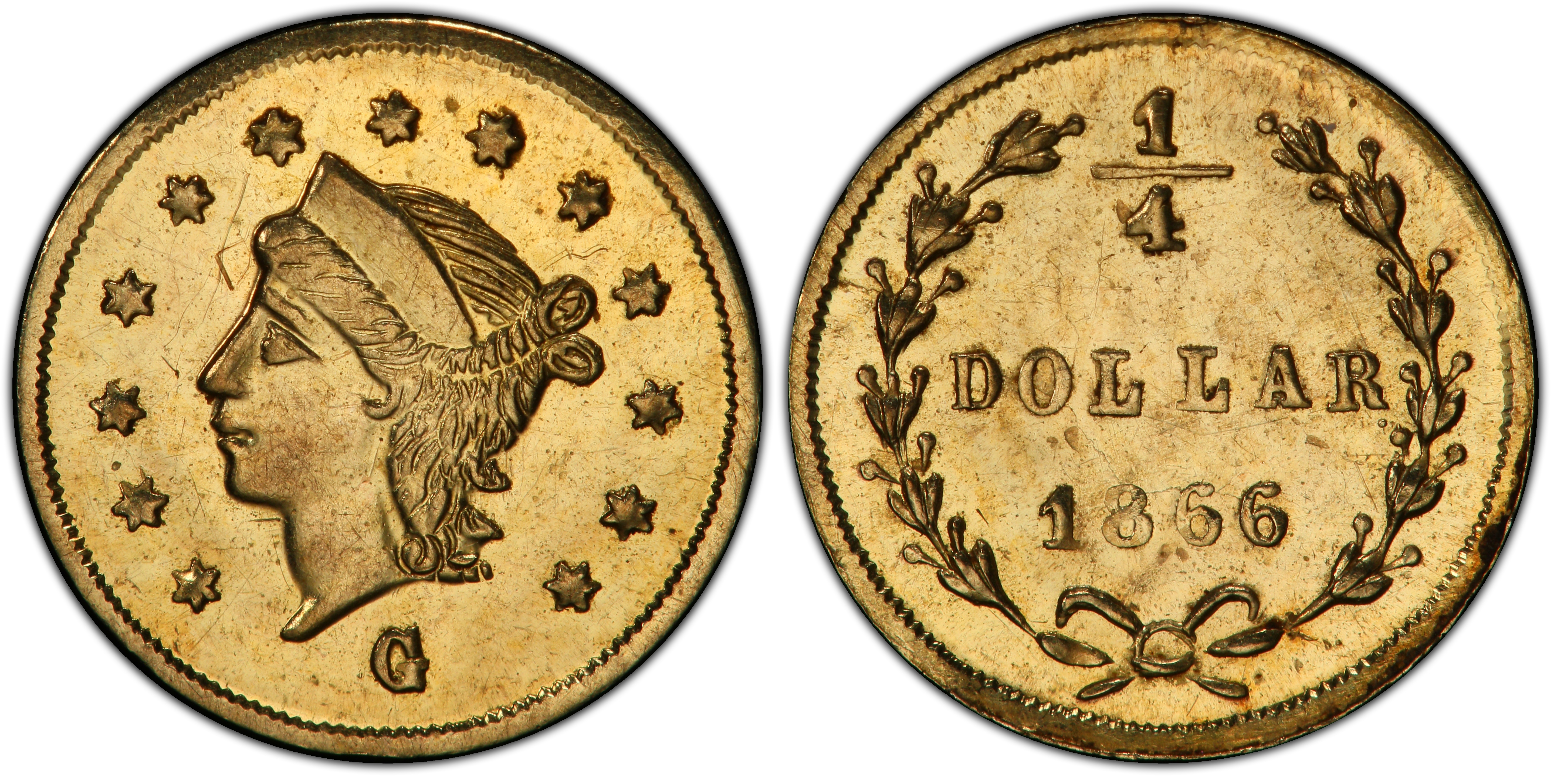
Obverse & Reverse
The 1866 BG-824 25 Cents represents a fascinating chapter in the story of California's private currency, belonging to what numismatists classify as 'Period Two' (1858-1882) of California Fractional Gold production. Unlike the earlier issues of Period One, which were struck to meet an urgent need for circulating coinage in the chaotic Gold Rush economy, Period Two pieces emerged in a more mature economic environment. By the mid-1860s, U.S. silver coinage was more prevalent, yet the allure and utility of small-denomination gold pieces persisted, particularly as souvenirs and for small-scale transactions where specie was preferred over paper money. These tokens, often called 'charms' or 'souvenirs' even in their own time, were produced by jewelers and private minters, capitalizing on the romanticism of the Gold Rush and the state's identity as the 'Golden State.' The Act of April 22, 1864, which prohibited private coinage, was largely ignored by these producers, who continued to issue pieces discreetly. The BG-824, attributed to the prolific firm of Robert B. Gray & Co. in San Francisco, is a prime example of this era's output. It features a standard 'Liberty Head' design, common to U.S. federal coinage, which lent it an air of legitimacy, though it was not legal tender. These pieces circulated to some degree but were primarily treasured as keepsakes, gifts, and mementos of a visit to California. Their diminutive size and delicate nature meant many were lost or damaged, making well-preserved examples scarce today. The history of the BG-824 is not just that of a coin, but of California's evolving identity, the transition from a frontier economy to a more established state, and the enduring legacy of gold in the American West.
Associated EventPost-Civil War Economic Expansion in California
Reason For MintingPrimarily created to be sold as souvenirs and keepsakes to tourists and locals, capitalizing on California's Gold Rush fame.
Minter HistoryRobert B. Gray & Co. was a prominent San Francisco firm of manufacturing jewelers and engravers active during this period. While not a formal mint, they were one of the most significant producers of California Fractional Gold, particularly during Period Two. Their establishment on the famous Montgomery Street was well-known for producing a wide variety of gold and silver items, including these small denomination tokens. Their work is characterized by competent, if not always high-art, engraving that often mimicked federal designs to enhance consumer acceptance. Their prolific output makes them central to the study of this numismatic specialty.
Historical SignificanceThe BG-824 is a tangible artifact of the commercialization of the Gold Rush legend and the persistence of private minting in defiance of federal law. It represents the second generation of California gold coinage, created not out of necessity but for commercial and novelty purposes, reflecting a shift in California's economy and culture. Its existence speaks to the unique monetary landscape of the American West in the latter half of the 19th century.
N/A
DenominationG25C (Gold 25 Cents)
Minting Period1866
Assayer/MinterRobert B. Gray & Co. (presumed)
Geographic OriginSan Francisco, California
Obverse DescriptionA classic Liberty Head design facing left, reminiscent of the federal gold dollar. The hair is tied in a bun with a beaded ribbon. Thirteen stars surround the portrait, representing the original colonies.
Obverse Inscription(Thirteen stars surrounding the Liberty head)
Reverse DescriptionThe denomination '1/4 DOLLAR' is prominently displayed within a wreath composed of two olive branches tied together at the bottom with a ribbon. The date '1866' is positioned below the wreath.
Reverse Inscription1/4 DOLLAR 1866
CompositionGold
Stated FinenessNot explicitly stated on the piece.
Actual FinenessTypically varied, often ranging from .450 to .650 fine gold, significantly below the standard for federal coinage.
Weight0.25 grams
Diameter9.60 mm
EdgePlain
Unknown
Survival Estimate75-125
Rarity ScaleR-5 (Very Scarce)
The BG-824 is popular among collectors for its classic, federally-inspired design, its status as a representative 'Period Two' issue, and its relative affordability compared to rarer varieties. Its defined date and clear denomination make it a satisfying piece to own for those building a type set of California Fractionals.
Key VarietiesThe primary variety is the Regular Strike business issue. There are no known major die varieties for BG-824 from the period of issue. Unlike some other California Fractional Gold issues, there are no known contemporary Proof strikings or later-date (e.g., Chapman) restrikes associated with this specific Breen-Gillio number.
Authentication TipsAuthentic pieces exhibit sharp, well-defined details, particularly in Liberty's hair and the leaves of the wreath. The numerals in the date should be evenly spaced and properly formed. Counterfeits are common and often have a soapy, indistinct appearance, incorrect weight, or a brassy color. Many fakes are cast rather than struck, leaving behind pitting or a granular surface visible under magnification. A key diagnostic for the BG-824 is the specific shape of the wreath and the positioning of the date relative to the bow. Compare any prospective purchase to high-resolution images of certified examples.
Shopping ConsiderationsA premium quality example for its grade will display a sharp strike, especially on the stars, Liberty's hair details, and the wreath leaves. Original, uncleaned surfaces with some remaining mint luster are highly desirable and command significant premiums. Look for pieces with a pleasing, original reddish-gold or yellow-gold patina. Avoid examples that are harshly cleaned, polished, or show evidence of being mounted in jewelry (solder marks, rim damage). Pay close attention to the delicate area around the denomination, as this is often a location for hidden scratches or tooling.
A coin's grade is its condition, rated on a 1-70 scale. For rare coins, this is the most critical factor in determining value, as a tiny difference in preservation can mean a huge difference in price.
Relevant Grade TypesOriginal period issues like the BG-824 were business strikes intended for commercial use, though many were saved as souvenirs. They are found in Circulated grades (AG-3 to AU-58) and Mint State grades (MS-60 to MS-70). No Proof (PR/PF) examples were struck during the original minting period for this variety, and there are no known later-date Proof restrikes. Any piece described as a 'Proof' should be regarded with extreme skepticism and is likely a prooflike business strike or an altered coin.
Mint State CharacteristicsAn uncirculated BG-824 typically displays a soft, satiny luster rather than a deeply prooflike or frosty one. The strike can be variable; a sharp strike across all elements (stars, hair, wreath) is rare and desirable. Central weakness on the highest points of the design is common. Due to the softness of the low-karat gold alloy, even high-grade Mint State examples will often show small, scattered contact marks from handling and storage over the past 150+ years.
Circulated Wear PatternsWear first appears on the highest points of the design. On the obverse, friction will first dull the luster on Liberty's cheek, the hair above the eye, and the ear. On the reverse, the highest points of the wreath leaves and the bow of the ribbon will show initial wear. In lower grades (VF and below), the individual hair strands will merge, the stars will become faint, and the finer details of the wreath will be lost.
Key Factors For ValueBeyond the numerical grade, value is driven by three main factors. First is surface quality: an example with original, uncleaned 'skin' is far more valuable than a brighter, cleaned coin in the same grade. Second is the sharpness of the strike; a well-struck coin with full details is always preferred. Third is eye appeal, which is a combination of attractive, original color and mark-free surfaces. A CAC sticker on a certified coin provides third-party verification of quality for the grade and often results in a significant price premium for this series.
PCGS Price Guide
| Grade | Price | Population |
|---|---|---|
| 50 | N/A | N/A |
| 53 | $500.00 | 1 |
| 53+ | $525.00 | N/A |
| 55 | $600.00 | 4 |
| 55+ | $625.00 | N/A |
| 58 | $650.00 | 4 |
| 58+ | $674.00 | N/A |
| 60 | $700.00 | 1 |
| 61 | $750.00 | 3 |
| 62 | $825.00 | 7 |
| 62+ | $1,000.00 | N/A |
| 63 | $1,450.00 | 1 |
| 63+ | $1,575.00 | N/A |
| 64 | $1,950.00 | 1 |