1880/70 25C BG-799H, PL (Regular Strike)
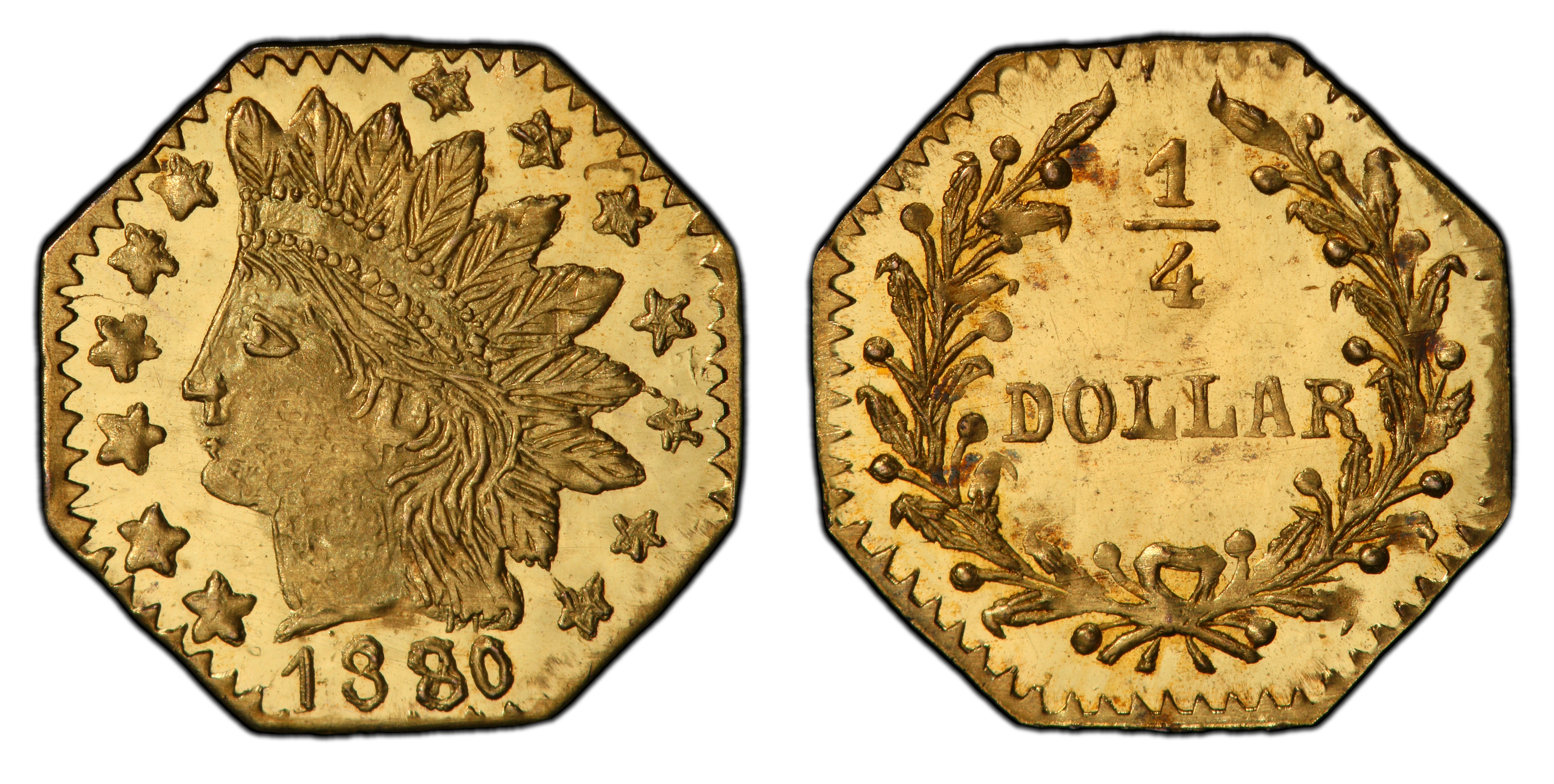
Obverse & Reverse
The BG-799H variety is a quintessential example of a 'Period Two' California Fractional Gold piece, a series born from the unique economic landscape of the American West. Following the initial California Gold Rush, the United States Mint established a branch in San Francisco in 1854, which soon produced enough federal silver and gold coinage to alleviate the acute shortage of small change that had plagued the region. The initial 'Period One' (1852-1857) fractional gold coins, struck by jewelers and assayers, were a direct response to this shortage and were intended to circulate. However, by the late 1850s, their necessity had waned. The pieces struck thereafter, from 1859 to 1882, are categorized as 'Period Two' issues. These were not primarily created to function as money but rather as souvenirs, keepsakes, and jewelry items for a burgeoning tourist trade and for locals who romanticized the Gold Rush era. These pieces were often deliberately underweight and of lower fineness compared to their Period One predecessors, as their value was in their novelty, not their intrinsic worth. Production was centered in San Francisco, with many makers being French jewelers who had settled in the city. The Coinage Act of 1864 technically prohibited private coinage, but it was not strictly enforced by the Secret Service in California until 1883. This legal gray area allowed for the continued production of these denominated 'coins' for nearly two decades. The BG-799H, dated 1880 but featuring a clear 80/70 overdate, reflects the common practice of reusing and re-punching dies to save on production costs. The existence of Prooflike (PL) examples, like the one specified, underscores their non-circulating, souvenir nature, as they were struck with polished dies and planchets to create a more brilliant and appealing product for collectors and tourists.
Associated EventPost-Gold Rush California Economy & Tourism
Reason For MintingPrimarily produced as souvenirs and jewelry items for tourists and locals, not for general circulation.
Minter HistoryWhile definitive minting records for many Period Two fractionals are lost, numismatic scholarship, primarily through die state analysis by Walter Breen and Ronald J. Gillio, attributes this and related varieties to the firm of Robert B. Gray & Co. of San Francisco. Unlike the more documented Period One minters who often placed their initials on their work, many Period Two makers operated with less public-facing branding. They were typically jewelers and engravers who capitalized on the demand for Gold Rush memorabilia. Their operations were small-scale, often using hand-operated presses, which resulted in coins with inconsistent strike quality and frequent die imperfections, such as the overdate seen on this variety.
Historical SignificanceThe BG-799H represents the evolution of California Fractional Gold from a necessary circulating medium to a commercial souvenir. It is a tangible artifact of how the Gold Rush was memorialized and commercialized in the decades following the initial boom. The series as a whole demonstrates the independent and entrepreneurial spirit of the West, operating in the space between federal monetary policy and local economic demand. For numismatists, Period Two pieces are a rich field of study in die varieties, overdates, and the history of private minting in the United States.
N/A
Denomination25 Cents
Minting Period1880
Assayer/MinterRobert B. Gray & Co. (attributed)
Geographic OriginSan Francisco, California
Obverse DescriptionFeatures a stylized Indian Head facing left, with 13 stars surrounding the portrait in a circle. The overdate '1880/70' is prominent below the truncation of the neck. The '80' is clearly punched over an underlying '70'.
Obverse Inscription1880/70
Reverse DescriptionThe central device is the denomination '1/4' enclosed within a wreath of two olive branches tied with a bow at the bottom. The legend 'CALIFORNIA GOLD' appears above the wreath along the upper periphery. The piece is octagonal in shape.
Reverse Inscription1/4 CALIFORNIA GOLD
CompositionGold
Stated Fineness Actual FinenessVariable, often between .500 and .750 fine, but lower than circulating coinage.
Weight0.25 grams
Diameter9.80 mm
EdgePlain
Unknown
Survival EstimateFewer than 75
Rarity ScaleR-5
The 1880/70 BG-799H is highly sought after for several reasons: it has a dramatic and clear overdate, it is an affordable entry point into the popular Indian Head motif of the series, and the Prooflike designation adds significant eye appeal and rarity. As a Period Two piece, it tells the story of California's souvenir coin trade.
Key VarietiesThe primary variety is the 1880/70 overdate itself. Within the BG-799 designation, various die states exist (BG-799H, BG-799I, etc.) showing progressive die wear or cracks. The major distinction for collectors is between the 'Regular Strike' and the 'Prooflike (PL)' strike. No true Proofs were made during this period; the 'PL' designation is given by third-party grading services to business strikes that exhibit deeply mirrored fields and frosted devices, resulting from polished dies and planchets. No later-date restrikes are known for this specific BG number.
Authentication TipsAuthentic Period Two pieces are typically very thin and lightweight. Counterfeits are often thicker, heavier, and have a 'soapy' or cast-like appearance rather than a sharp strike. The details on genuine pieces, while sometimes weakly struck, will be sharp in protected areas. Look for crisp edges on the octagonal planchet. Many fakes are gold-plated base metal. The Breen-Gillio reference is essential for die characteristic comparison. Unlisted varieties should be viewed with extreme skepticism.
Shopping ConsiderationsFor a premium quality BG-799H PL, a buyer should seek out sharply struck examples with deep, clean mirrors and noticeable frost on the devices. The overdate should be bold and unmistakable. Common issues include weak strikes, particularly on the stars or the wreath, and handling marks or hairlines that impair the mirrored fields. 'Original skin' with undisturbed luster is paramount. Avoid examples that have been cleaned, polished, or mounted in jewelry, as this is common for these souvenir pieces and drastically reduces their numismatic value. A CAC sticker on a PL-designated holder would confirm premium quality for the assigned grade.
A coin's grade is its condition, rated on a 1-70 scale. For rare coins, this is the most critical factor in determining value, as a tiny difference in preservation can mean a huge difference in price.
Relevant Grade TypesOriginal issues of BG-799H were business strikes intended for the souvenir market, not circulation. They are found in both Circulated (1-58) and, more commonly, Mint State (MS, 60-70) grades. No true Proofs were struck during the original period. The 'PL' (Prooflike) designation is applied to exceptional business strikes from polished dies that exhibit mirrored surfaces. These are not a separate issue but represent the highest quality of the original production run and are highly prized by collectors.
Mint State CharacteristicsAn uncirculated BG-799H typically displays a soft, satiny luster. Strike quality varies significantly due to hand-press operation; many show weakness on the high points like the Indian's cheek, the details of the wreath, and some of the peripheral stars. A 'PL' example will have reflective, mirror-like fields, often with a frosted texture on the portrait and lettering. Small planchet flaws or die polishing lines are common and not always considered detrimental if they don't detract from the overall eye appeal.
Circulated Wear PatternsAlthough not intended for circulation, some pieces did see handling. Wear first appears on the high points: the cheek and feathers of the Indian Head, and the leaves and bow of the wreath on the reverse. In lower grades (VF and below), the date and stars will begin to lose their sharpness.
Key Factors For ValueFor a PL example, the primary value driver is the quality and depth of the mirrored fields. A coin with 'deep mirror' (DMPL or DPL) characteristics commands a significant premium. Beyond that, a sharp strike that brings out the full detail of the portrait and wreath is critical. Eye appeal is paramount; coins with original, attractive golden-orange toning are preferred over those that are bright and dipped. Surface preservation is key—any hairline, scuff, or mark that disrupts the mirrored fields will substantially lower the value. A CAC sticker is particularly valuable for this issue, as it confirms the quality of the PL surfaces and the overall eye appeal.
PCGS Price Guide
| Grade | Price | Population |
|---|---|---|
| 64 | N/A | 1 |
| 65 | $2,000.00 | 1 |
| 65+ | $2,150.00 | N/A |
| 66 | $2,500.00 | N/A |
| 66+ | $3,000.00 | N/A |
| 67 | $3,750.00 | 1 |