1872 G50C BG-939, PL (Regular Strike)
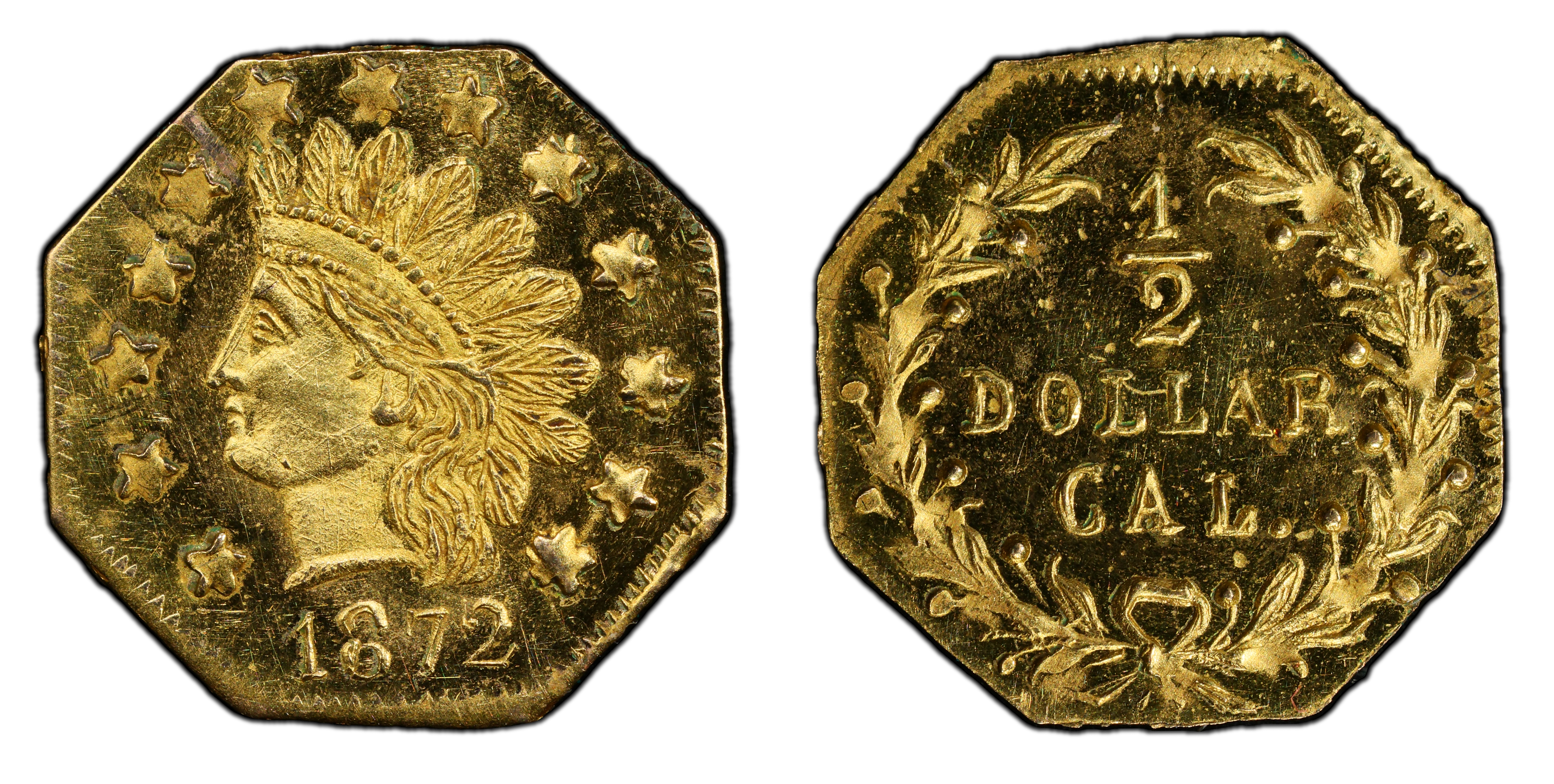
Obverse & Reverse
The 1872 BG-939 50-cent piece emerges from the second major phase of California Fractional Gold production, often termed 'Period Two' or the 'Jewelers' Issues' (1859-1882). Unlike the earlier 'Period One' coins (1852-1857) which were struck to alleviate a critical shortage of small change during the initial Gold Rush boom, these later issues served a different purpose. By the 1870s, the San Francisco Mint was in full operation, and the acute need for circulating private coinage had subsided. Instead, these miniature gold pieces became popular as souvenirs, keepsakes, and novelty items for tourists and locals alike, tangible mementos of the Gold Rush that had transformed the state. Despite their intended purpose as novelties, they were still produced by skilled private minters and jewelers. The Coinage Act of 1864 had officially outlawed private coinage, but enforcement was lax in the West until the early 1880s. This legal gray area allowed producers like Christopher Ferdinand Mohrig to continue their work, often backdating coins to pre-1864 dates to avoid scrutiny, although this 1872-dated piece is contemporary to its production. These 'jewelers' issues' were typically lighter and contained less gold than their face value would imply, a fact well understood by the public who purchased them primarily for their charm, not their intrinsic value. The BG-939, with its crisp Indian Head design, is a prime example of the artistry and commercial savvy of San Francisco's private minters who capitalized on the enduring romanticism of the Gold Rush era.
Associated EventCalifornia Gold Rush (Later Souvenir Period)
Reason For MintingPrimarily minted as souvenirs and novelty items for a public fascinated with the Gold Rush, rather than for circulation.
Minter HistoryChristopher Ferdinand Mohrig was a prominent and prolific German-born die sinker and private minter active in San Francisco from the 1860s through the 1870s. He was a key figure in the production of 'Period Two' California Fractional Gold. Operating as a jeweler and engraver, he created a wide variety of dies for these small denomination pieces, known for their high-quality engraving and consistent craftsmanship. His work is often characterized by specific design elements and punches that allow numismatists to attribute many different Breen-Gillio varieties to his hand. Mohrig's enterprise successfully navigated the ambiguous legal landscape following the 1864 private coinage prohibition, producing a significant portion of the souvenir gold pieces that are avidly collected today. The BG-939 is a recognized product of his dies.
Historical SignificanceThe BG-939 is significant as a representative of the commercial evolution of the Gold Rush legacy, shifting from necessity-driven private coinage to nostalgic souvenir production. It encapsulates the transition of private minting in California and stands as an artifact of the jewelers and die sinkers, like C.F. Mohrig, who continued a unique numismatic tradition long after its original purpose had ceased.
BG-939
Denomination50 Cents
Minting Period1872
Assayer/MinterChristopher Ferdinand Mohrig
Geographic OriginSan Francisco, California
Obverse DescriptionAn Indian Head portrait facing left, reminiscent of the contemporary U.S. Indian Head cent, but with distinct features characteristic of the private minter's style. The portrait is surrounded by 13 six-pointed stars.
Obverse Inscription[None, design only]
Reverse DescriptionThe denomination '1/2' is enclosed within a wreath of two olive branches tied with a ribbon at the bottom. The date '1872' is positioned below the wreath.
Reverse Inscription1/2
CompositionGold
Stated Fineness Actual FinenessVaries, but typically lower than the U.S. Mint standard of .900 fine.
Weight0.25 grams
Diameter10.00 mm
EdgePlain
Unknown
Survival Estimate31-75
Rarity ScaleR-5
This variety is sought after for its attractive Indian Head design, specific BG-939 attribution, and its status as a product of the notable minter C.F. Mohrig. The availability of Proof-like (PL) and Deep Prooflike (DPL) examples adds a significant layer of appeal for collectors who prize exceptional surface quality and eye appeal.
Key VarietiesThe primary variety is the regular business strike. However, this die pairing (BG-939) is known to have produced specimens with special surface characteristics. These are not true proofs but are designated by third-party graders as Proof-like (PL) or Deep Prooflike / Deep Mirror Prooflike (DMPL) when exhibiting highly reflective, mirror-like fields. These are not restrikes but are early strikes from fresh, polished dies. A known die state exhibits a radial die crack from the chin to the rim on the obverse.
Authentication TipsAuthentic pieces should have sharp, albeit sometimes uneven, strikes characteristic of manual press operation. The style of the engraving, particularly the shape of the portrait and the wreath, must match known genuine examples of Mohrig's work. Counterfeits are common in the Cal Gold series; many are gold-plated base metal and will feel light or have incorrect luster. Look for mushy details, incorrect style, or tool marks from modern production. Genuine pieces are very thin. Be wary of any specimen that does not have a denominated value (e.g., '1/2 DOLLAR' or '50 CENTS' or, in this case, '1/2' within the wreath), as post-1882 pieces were legally required to omit such markings and are considered tokens.
Shopping ConsiderationsFor a premium quality example, seek out a sharp, well-centered strike. The user's query specifies 'PL,' so a buyer should look for coins with deeply reflective, mirror-like fields that contrast with frosted devices, a feature found on early strikes from polished dies. Check for the later die state with the chin-to-rim die crack, which can be an interesting feature for variety collectors. Surfaces should be clean and free of distracting marks, although tiny planchet flaws or adjustment marks are not uncommon for this series. Avoid examples that have been harshly cleaned, which strips the original skin and luster, or those that are bent or holed, which significantly impairs value unless it is an extreme rarity.
A coin's grade is its condition, rated on a 1-70 scale. For rare coins, this is the most critical factor in determining value, as a tiny difference in preservation can mean a huge difference in price.
Relevant Grade TypesOriginal period issues were business strikes intended for the souvenir market, found in Circulated (1-58) and, more commonly, Mint State (MS, 60-70) grades. No true Proofs were struck during the original period. However, this die pair is noted for producing specimens with highly reflective surfaces from polished dies. These are not a separate issue but a condition rarity, designated as Proof-like (PL) or Deep Prooflike (DPL) by grading services when the reflectivity is pronounced. These PL/DPL business strikes are highly coveted and carry a significant premium over regular Mint State examples.
Mint State CharacteristicsUncirculated examples of BG-939 often exhibit a reasonably sharp strike, though weakness on the highest points of the Indian's hair or the wreath is common due to the manual striking process. Luster can range from soft and satiny to the highly desirable deep, mirror-like fields of PL/DPL examples. The contrast between the fields and devices on PL specimens is a key value driver. As these are tiny gold coins, even high-grade examples can show minor planchet irregularities or small, scattered contact marks that do not significantly detract from the grade.
Circulated Wear PatternsOn circulated examples, wear first appears on the high points of the Indian's cheek, hair feathers, and the ribbon bow on the reverse wreath. As wear progresses, the stars on the obverse will become faint, and the details of the wreath will soften. In lower grades (VF and below), the date and legends may become difficult to read.
Key Factors For ValueFor the BG-939, the single most important factor beyond the numerical grade is the surface designation. A coin graded MS65 is valuable, but an MS65PL is significantly more so, and an MS65DPL is in the highest tier. Sharpness of strike is critical; a well-struck coin with full details will always command a premium. Eye appeal is paramount: coins with clean, original surfaces and a strong contrast between mirrored fields and frosted devices (on PL/DPL examples) are the most desirable. A CAC sticker for this issue indicates superior quality for the grade and will add a substantial premium.
PCGS Price Guide
| Grade | Price | Population |
|---|---|---|
| 63 | N/A | 1 |
| 65 | N/A | 1 |