1871 G50C BG-1044 (Regular Strike)
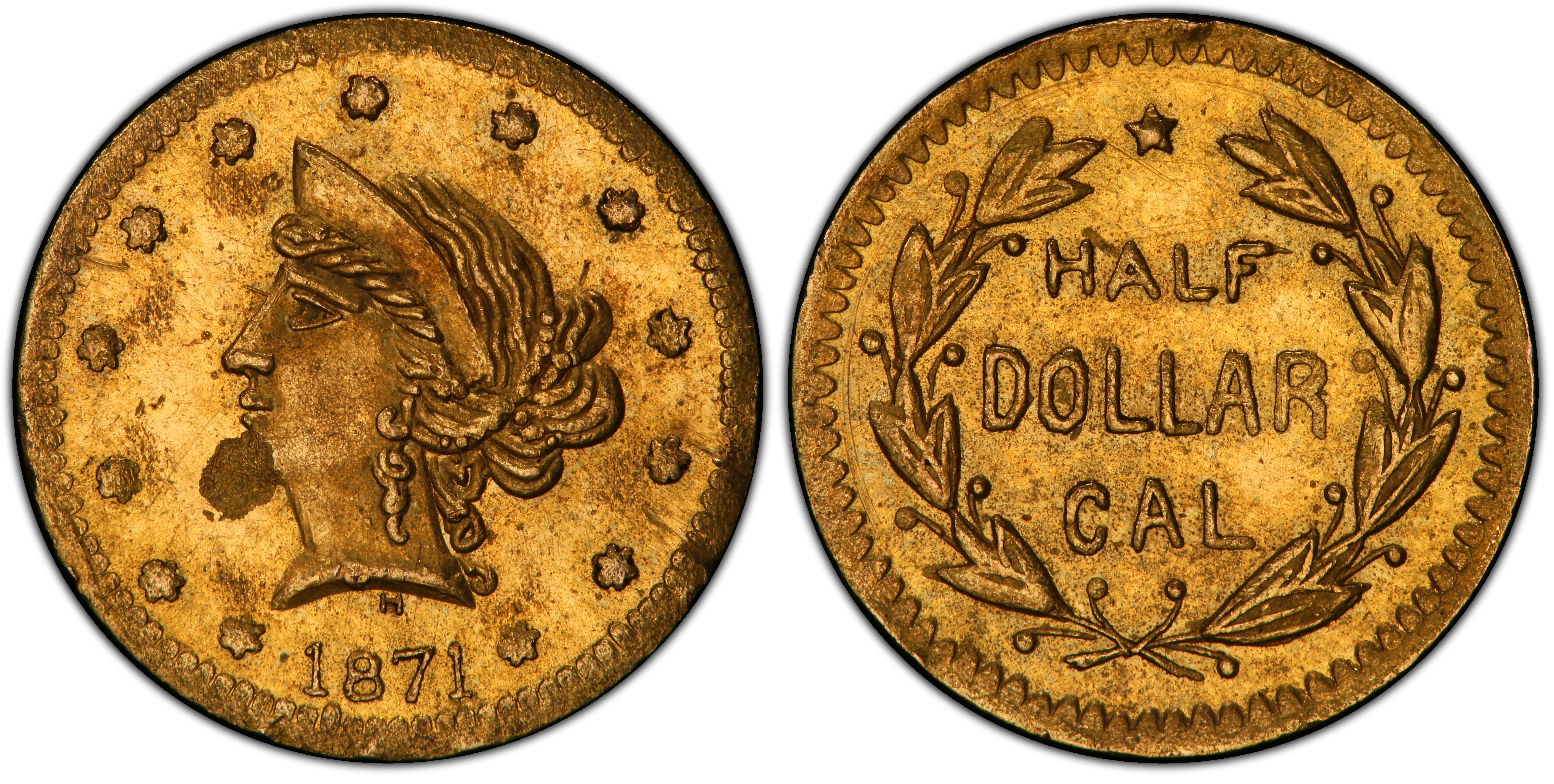
Obverse & Reverse
The 1871 G50C BG-1044 is a quintessential example of a 'Period Two' California Fractional Gold piece. This era, spanning from 1858 to 1882, is distinct from the earlier 'Period One' (1852-1857) issues. While the Period One coins were struck out of a genuine commercial need to alleviate a severe shortage of small change during the initial frenzy of the California Gold Rush, the Period Two pieces were created for a different purpose. By the 1870s, the San Francisco Mint was in full operation, and the acute need for private coinage had subsided. Instead, local jewelers and artisans recognized a burgeoning market for gold rush souvenirs. The transcontinental railroad, completed in 1869, brought a wave of tourism and commerce to California, and these tiny gold pieces served as perfect, affordable keepsakes of a visit to the Golden State. These 'jeweler's issues' were not intended to and did not circulate as money. Their production was a direct response to commercial demand for novelties and mementos. The Coinage Act of 1864 had prohibited private coinage, but enforcement by the Secret Service was lax in California until the early 1880s, allowing this cottage industry to flourish for over two decades. The BG-1044, like its contemporaries, was likely struck using the 'hammer method,' where a planchet was placed between two dies and struck with a sledgehammer, a process that accounts for the frequent imperfections, such as wavy planchets or uneven strikes, seen on these pieces. Their intrinsic value was typically far less than their face value, a fact that was unimportant to a buyer seeking a souvenir rather than a circulating coin. The eventual crackdown by the Secret Service in 1883 brought an end to this fascinating chapter of private minting in the United States, cementing the status of the Period Two issues as historical curiosities.
Associated EventPost-Gold Rush California Tourism
Reason For MintingPrimarily struck to be sold as souvenirs and curiosities to tourists and collectors, not for monetary circulation.
Minter HistoryThe specific minter or jeweler who produced the BG-1044 dies and coins is unknown, which is common for Period Two issues. These pieces were often the work of various San Francisco-based jewelers who created them for the robust souvenir trade. Unlike the more organized private mints of the 1849-1855 period, these later minters rarely, if ever, marked their products with identifiable insignia.
Historical SignificanceThe BG-1044 is historically significant not as a coin, but as a cultural and economic artifact. It represents the commercialization of the Gold Rush narrative and the transition of California from a raw frontier to a tourist destination. It is a tangible link to the robust souvenir and jewelry trade of 1870s San Francisco and the lax enforcement of federal coinage laws on the West Coast during that era.
BG-1044
Denomination50 Cents
Minting Period1871
Assayer/MinterUnknown private minter
Geographic OriginSan Francisco, California
Obverse DescriptionFeatures a Liberty Head motif, facing left, with 'LIBERTY' inscribed on her coronet. The head is surrounded by 13 six-pointed stars arranged along the perimeter. The date, 1871, appears below the bust. This obverse die is known to be shared with the BG-1045 variety.
Obverse InscriptionLIBERTY 1871
Reverse DescriptionA wreath composed of two branches tied together with a bow at the bottom encircles the denomination. The denomination is distinctive for this variety, spelled out as 'HALF DOLLAR CAL'. The BG-1044 reverse die is distinguished from the BG-1045 by the presence of additional berries near the ends of the wreath.
Reverse InscriptionHALF DOLLAR CAL
CompositionGold
Stated Fineness Actual Fineness EdgePlain
Unknown
Survival EstimateFewer than 15 known
Rarity ScaleHigh R-6
The BG-1044 is highly sought after by specialists in California Fractional Gold due to its high rarity (High R-6) and distinctive reverse legend. Its status as a Period Two 'jeweler's issue' appeals to those interested in the souvenir and cultural aspects of the Gold Rush era. The very low surviving population ensures constant demand.
Key VarietiesThe primary variety is the regular strike BG-1044. It is defined by its shared obverse with BG-1045 and its unique reverse die with 'HALF DOLLAR CAL' and extra berries in the wreath. There are no known patterns, restrikes, or proof issues associated with this variety.
Authentication TipsAuthentic examples are struck on very thin gold planchets, which often results in a slightly wavy or bent appearance; a perfectly flat, thick coin should be viewed with suspicion. The strike is often uneven, with some elements appearing sharper than others. The style of the Liberty head and the reverse wreath should be compared to known genuine examples. Modern counterfeits often have a soapy or cast appearance, lacking the sharp detail of a struck original. Any piece with a bear on the reverse is a modern fantasy item.
Shopping ConsiderationsA premium quality example of BG-1044 will exhibit a sharp strike, particularly on the date and the lettering of 'HALF DOLLAR CAL'. Given their nature as souvenirs, most surviving examples are in Mint State condition. Luster is a key factor; look for pieces with frosty or moderately reflective (prooflike) surfaces, as described in major auction listings. A slight waviness to the planchet is acceptable and characteristic of the issue. Avoid coins that have been abrasively cleaned, which will show as hairlines under magnification and destroy the original surface. Small patches of natural surface roughness are sometimes noted on genuine examples and are not necessarily a major detriment.
A coin's grade is its condition, rated on a 1-70 scale. For rare coins, this is the most critical factor in determining value, as a tiny difference in preservation can mean a huge difference in price.
Relevant Grade TypesOriginal issues of BG-1044 were business strikes, although they were not intended for circulation. Therefore, they are found in Mint State (MS, 60-70) grades. It is exceptionally rare to find a circulated example. No Proof (PR/PF) examples were struck during the original period of issue, and no later-date restrikes are known to exist.
Mint State CharacteristicsUncirculated examples of BG-1044 are defined by their luster, which can range from satiny to moderately prooflike. As these were struck on thin, often poorly prepared planchets, it is common to see some minor surface imperfections or slight waviness that is inherent to the manufacturing process. The strike can be variable, but high-end examples will show sharp details on Liberty's hair and the leaves of the wreath. Contact marks, while affecting the grade, are common due to the softness of the gold.
Circulated Wear PatternsWhile almost never seen circulated, wear would first appear on the highest points: the hair above Liberty's eye, her cheekbone, and the ribbon in the wreath's bow. The fine letters of the reverse inscription would then begin to fade into the fields. Any wear on a piece of this nature would be unusual and drastically affect its value.
Key Factors For ValueFor the BG-1044, value is overwhelmingly driven by its rarity and grade. Surface quality is paramount; an example with original, undisturbed frosty or prooflike luster will command a significant premium over one that is hairlined or cleaned. Strike sharpness is also key, with well-defined details on both sides being highly desirable. Finally, overall eye appeal, including attractive original gold toning (often appearing as apricot or khaki-gold hues), contributes significantly to the coin's market value. A CAC sticker would provide further confirmation of quality for the assigned grade.
PCGS Price Guide
| Grade | Price | Population |
|---|---|---|
| 58 | $550.00 | 1 |
| 58+ | $600.00 | N/A |
| 60 | $700.00 | N/A |
| 61 | $800.00 | N/A |
| 62 | $1,200.00 | 4 |
| 62+ | $1,400.00 | N/A |
| 63 | $2,250.00 | 2 |
| 63+ | $2,650.00 | N/A |
| 64 | $2,750.00 | 3 |