1874 G50C BG-1071, PL (Regular Strike)
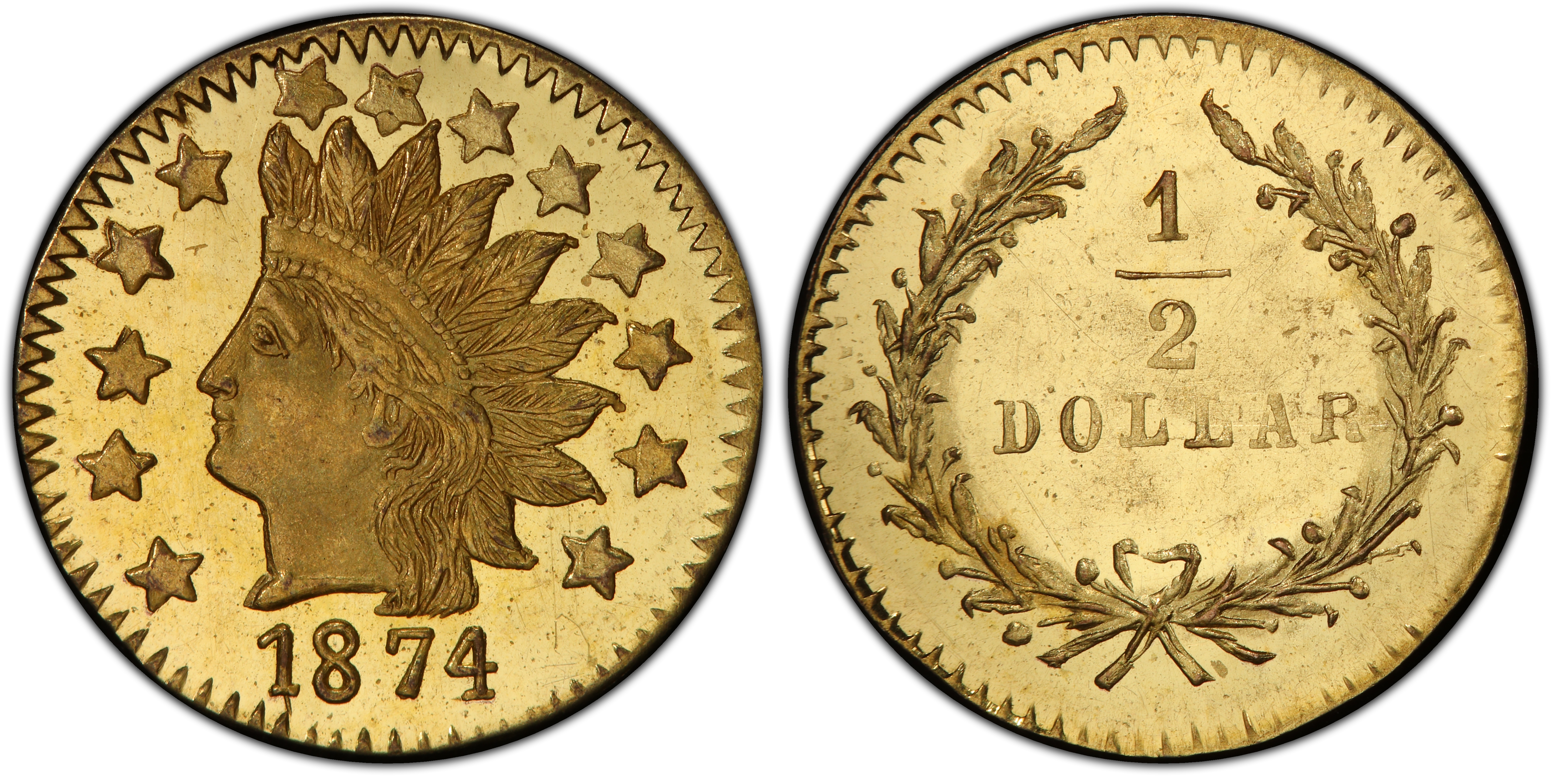
Obverse & Reverse
The 1874 BG-1071 50 Cents is a quintessential example of a 'Period Two' California Fractional Gold piece. The era of these small-denomination coins was born from the initial chaos of the California Gold Rush. In the early 1850s, the flood of gold dust and nuggets created a paradox: an economy rich in value but poor in circulating small change for daily transactions. This void was filled by private minters, often jewelers, who began striking 25-cent, 50-cent, and one-dollar gold pieces starting in 1852. These 'Period One' (1852-1857) issues were utilitarian and met a genuine commercial need. However, by the time the BG-1071 was struck in 1874, the landscape had changed dramatically. The San Francisco Mint, opened in 1854, had largely resolved the coin shortage. The Coinage Act of 1864 officially outlawed private coinage, yet enforcement was lax in distant California. The purpose of fractional gold shifted from commerce to souvenir and novelty. These 'Period Two' (1858-1882) pieces, often called 'jeweler's issues,' were primarily made for tourists, merchants, and others as mementos of the romanticized Gold Rush era. They were typically thinner, lighter, and of more variable fineness than their Period One predecessors, representing their face value only nominally. The BG-1071, with its Indian Head motif—a popular design choice intended to evoke a uniquely American feel—perfectly fits this context. Its extreme rarity today (R-7) suggests a very small original production, likely struck by a jeweler in a small workshop using hand-operated presses. These pieces were not intended for widespread circulation and their survival in any condition, particularly high grade, is remarkable. They are a tangible link to the post-Gold Rush economy of San Francisco, where the memory of the '49ers was already a powerful marketing tool.
Associated EventCalifornia Gold Rush Aftermath
Reason For MintingPrimarily created as a souvenir or charm for the tourist and jewelry trade, not to fill a circulating coinage need.
Minter HistoryThe specific minter of BG-1071 is unknown, a common trait for many Period Two fractional gold varieties. The work is attributed to the many jewelers operating in San Francisco during the 1870s who produced these small gold pieces as a profitable sideline. Prominent jewelers of the era known to have produced fractional gold include Frontier, Deviercy & Co., Deriberpe & Nouizillet, and Robert B. Gray & Co., among others. Without a specific maker's mark, attribution is impossible, but the style is consistent with other 'jeweler's issues' of the period.
Historical SignificanceThis coin represents the transition of fractional gold from a necessary form of currency to a commercial souvenir. It is a numismatic artifact of California's evolving identity in the late 19th century, symbolizing how the raw, utilitarian spirit of the Gold Rush was being packaged and sold as romantic history. Its high rarity makes it a key variety for specialists.
BG-1071
Denomination50 Cents
Minting Period1874
Assayer/MinterUnknown
Geographic OriginSan Francisco, California
Obverse DescriptionA head of a Native American (Indian Head) facing left, wearing a feathered war bonnet. The portrait is surrounded by thirteen six-pointed stars, which are characteristically unevenly spaced for this variety. The date '1874' is below the bust.
Obverse Inscription1874
Reverse DescriptionThe denomination '1/2' and the word 'DOLLAR' are enclosed within a simple wreath of leaves. A characteristic of the BG-1071 variety is an incomplete or weak strike on the word 'DOLLAR'.
Reverse Inscription1/2 DOLLAR
CompositionGold
Stated Fineness Actual FinenessVariable, typical for Period Two issues, often between .500 and .800 fine.
Weight0.25 grams
Diameter10.00 mm
EdgePlain
Unknown, but extremely small.
Survival EstimateFewer than 10 known specimens. NGC and PCGS population reports combined show approximately 6-8 unique coins graded.
Rarity ScaleR-7 (4 to 12 known)
BG-1071 is a highly coveted rarity for the advanced specialist in California Fractional Gold. Its appeal lies in its extreme scarcity (R-7), its distinct die characteristics, and its status as a Period Two Indian Head type. The existence of high-grade, prooflike specimens adds to its allure.
Key VarietiesThe primary variety is the regular business strike. However, specimens with deeply mirrored fields and frosted devices are designated as Prooflike (PL) or Deep Prooflike (DPL/DMPL) by grading services. These are not true Proofs but are special presentation strikings from polished dies and command a significant premium. There are no known major sub-varieties from the original minting period.
Authentication TipsAuthenticity should be confirmed by a major grading service. Key die diagnostics for BG-1071 include: 1) The uneven and somewhat crude spacing of the 13 obverse stars. 2) The date is often weakly struck, particularly the final digit. 3) A consistently weak or incomplete strike across the word DOLLAR on the reverse is characteristic. Counterfeits of this era are common, but they often lack the sharp, albeit crude, details of genuine pieces and may have incorrect weight, diameter, or a soapy, cast-like appearance. Genuine pieces have a distinct 'feel' from being struck, not cast.
Shopping ConsiderationsFor a potential buyer, any authenticated example is a major acquisition. A premium quality coin for its grade will show minimal distracting marks; this is crucial on prooflike examples where marks are highly visible in the mirrored fields. Look for a sharp strike on the Indian's portrait and the wreath, though weakness on the date and 'DOLLAR' is expected and confirmatory. Original, uncleaned surfaces with a hint of reddish-gold or greenish-gold toning are highly desirable. Avoid examples that have been used as jewelry, evidenced by solder marks, harsh cleaning, or excessive smoothing. Given the rarity, even a problem-free AU example is a significant prize, while a Mint State specimen is a landmark piece.
A coin's grade is its condition, rated on a 1-70 scale. For rare coins, this is the most critical factor in determining value, as a tiny difference in preservation can mean a huge difference in price.
Relevant Grade TypesAll original BG-1071 examples were struck as business strikes, intended for sale as souvenirs. They are found in Circulated (AU-50 to AU-58, though rarely seen) and Mint State (MS, 60-70) grades. No true Proofs were struck in 1874. However, some specimens were struck using highly polished dies, resulting in coins with mirrored fields designated Prooflike (PL) or Deep Prooflike (DPL). These are a distinct category from regular Mint State strikes and are not later-date restrikes; they are special strikings from the original period of manufacture.
Mint State CharacteristicsAn uncirculated BG-1071 is defined by its luster. A typical Mint State example has a soft, satiny luster. High-end examples, particularly those designated PL or DPL, exhibit deep, watery mirrors in the fields, contrasting with frosted devices. Strike is a key issue; central softness on the highest points of the Indian's bonnet and the wreath is common and should not be confused with wear. Bag marks are less common than handling marks due to their non-commercial use, but the soft gold is susceptible to tiny nicks and hairlines.
Circulated Wear PatternsOn circulated examples, wear first appears on the high points of the design: the cheek and feathers of the Indian Head, and the highest leaves and bow of the wreath on the reverse. As wear progresses, the finer details of the feathers will merge, and the legend and stars will begin to lose their sharpness. The weakly struck date and 'DOLLAR' are often the first parts of the inscription to become indistinct.
Key Factors For ValueFor the BG-1071, value is driven by three main factors. First and foremost is rarity; its R-7 status makes any example valuable. Second is grade; the jump in value from AU to low Mint State, and again to Gem (MS-65+) is exponential. Third is surface quality and eye appeal. A specimen with original, undisturbed luster and attractive toning will command a massive premium over a cleaned or heavily marked coin of the same grade. The presence of a PL or DPL designation significantly increases value, as does verification by CAC for superior quality within the assigned grade.
PCGS Price Guide
| Grade | Price | Population |
|---|---|---|
| 65 | $5,500.00 | 1 |
| 65+ | $6,000.00 | N/A |
| 66 | $6,750.00 | 1 |