1875 G$1 BG-1112, PL (Regular Strike)
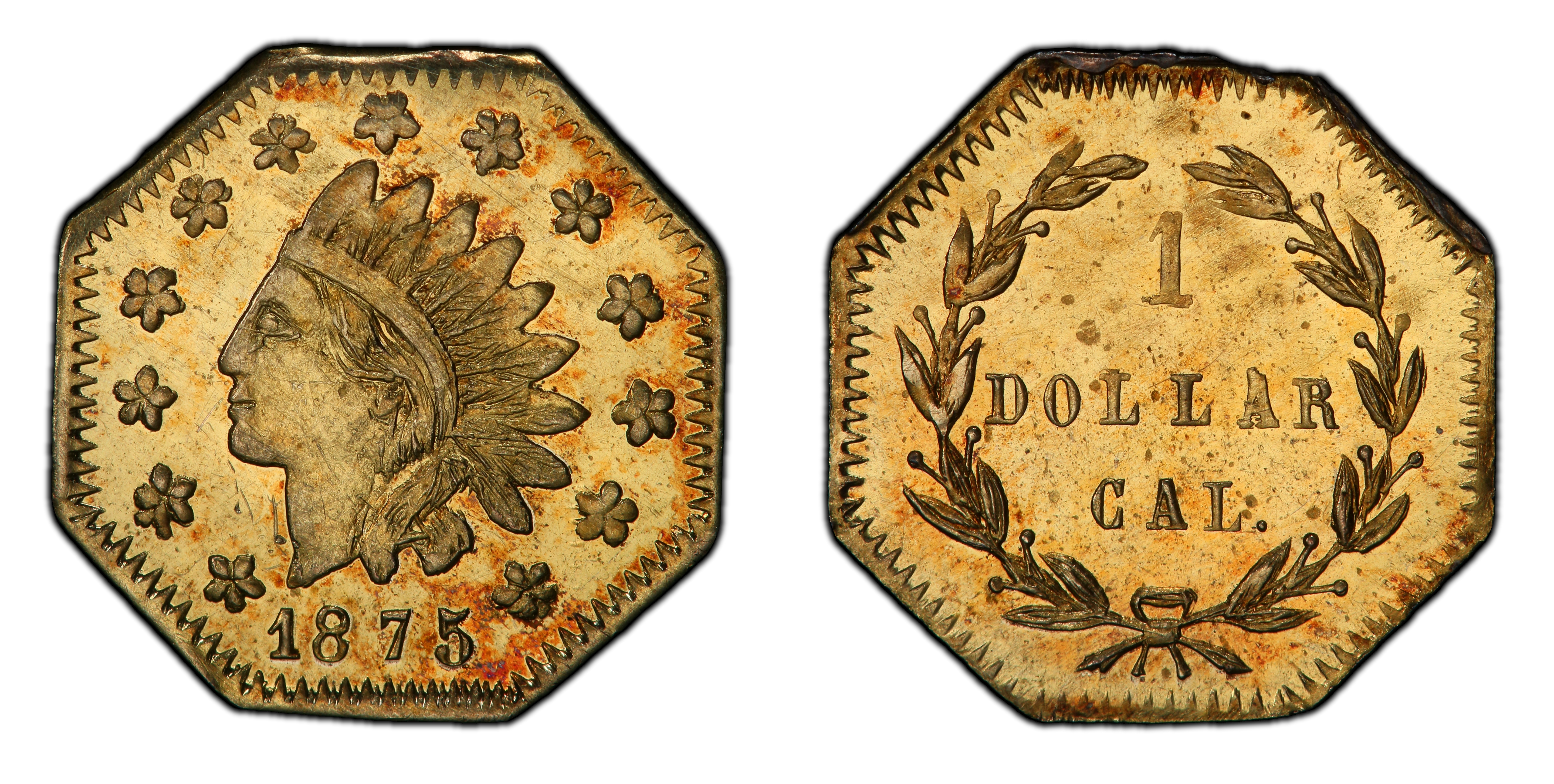
Obverse & Reverse
The 1875 Octagonal Gold Dollar, cataloged as Breen-Gillio 1112, emerged from the second major phase of California's private gold coinage. Unlike the 'Period One' issues (1852-1857), which were struck out of genuine necessity to alleviate a severe shortage of small-denomination circulating coinage during the initial gold rush fervor, the 'Period Two' pieces (1858-1882) served a different purpose. By 1875, the United States Mint in San Francisco was in full operation, and federal silver and minor coinage had largely saturated the commercial channels of the West. The acute need for private fractional gold had waned. Instead, these later pieces were primarily produced by San Francisco jewelers and artisans as souvenirs and novelty items. They catered to a burgeoning tourist trade and a local population still captivated by the romance of the Gold Rush. These miniature gold pieces were charming mementos of California's unique economic history. The Coinage Act of 1864 had explicitly forbidden private coinage, but enforcement against these small, low-value tokens was lax until the early 1880s. Minters of this era often operated anonymously to avoid scrutiny from the Secret Service. The BG-1112, with its Indian Head motif—a popular design choice echoing federal coinage but with a distinct local flair—was a product of this environment. Its production was not a response to economic desperation but rather a commercial enterprise tapping into nostalgia and the public's fascination with gold. Despite their unofficial status, they contain real gold, though often at a fineness and weight inconsistent with their stated face value, reinforcing their role as keepsakes rather than true instruments of commerce.
Associated EventPost-Gold Rush California Economy
Reason For MintingPrimarily struck as a souvenir or keepsake for tourists and locals, capitalizing on the nostalgia of the California Gold Rush.
Minter HistoryThe specific minter of BG-1112 is unknown, a common characteristic of many 'Period Two' California fractional gold issues. The producers were typically jewelers and metalworkers located in San Francisco who created these pieces as a profitable sideline. They operated without explicit mintmarks or identifying insignia, likely to avoid legal complications stemming from the 1864 federal prohibition on private coinage. These artisans used hand-operated presses, resulting in significant variation in strike quality among surviving examples.
Historical SignificanceThe BG-1112 is significant not as a circulating coin, but as a numismatic artifact representing the transition of California fractional gold from a necessary medium of exchange to a commercial souvenir. It embodies the enduring legacy of the Gold Rush in California's culture and economy, decades after the initial frenzy had subsided. Its high rarity today underscores the small scale and ephemeral nature of these late-period private minting operations.
BG-1112
DenominationG$1
Minting Period1875
Assayer/MinterUnknown Private Minter
Geographic OriginSan Francisco, California
Obverse DescriptionFeatures a small, stylized Indian Head portrait facing left, adorned with a feathered headdress. The portrait is simple in its execution. The date '1875' is located below the bust. Thirteen five-pointed stars encircle the central design, close to the octagonal border.
Obverse Inscription1875
Reverse DescriptionThe central design is a simple wreath composed of two branches tied with a ribbon at the bottom. Within the wreath, the denomination '1' is prominently displayed, followed by 'DOLLAR' below it, and the abbreviation 'CAL' for California at the bottom. The design elements are often simply rendered.
Reverse Inscription1 DOLLAR CAL
CompositionGold
Stated Fineness Actual FinenessVariable, typically between .500 and .750 fine, consistent with Period Two souvenir issues being underweight for their face value.
Weight0.50 grams
Diameter11.50 mm
EdgePlain
Extremely low, likely less than 500.
Survival EstimateFewer than 30 known.
Rarity ScaleR-6 (13-30 known)
BG-1112 is highly sought after for its extreme rarity and its classic Indian Head design. As a 'Period Two' issue, it is a key representative of the souvenir phase of this fascinating series. The challenge of acquiring any example, particularly in high grade, makes it a prize for the advanced specialist.
Key VarietiesNo major die varieties are widely recognized for BG-1112. The entire issue is considered a single variety. No known patterns, trial pieces, or official restrikes exist.
Authentication TipsGenuine examples typically exhibit heavily striated, prooflike fields from polished dies. The strike is often weak on the high points, particularly the tips of the headdress feathers. Counterfeits may appear mushy or cast, lacking the crisp, albeit sometimes weak, detail of a genuine strike. Look for the precise die markers and style of the numerals in the date as depicted in the Breen-Gillio reference. Tool marks around the letters or stars are a major red flag. Weight and specific gravity tests are crucial, as many fakes are gold-plated brass.
Shopping ConsiderationsA premium quality example for this issue is defined by a combination of a sharp strike, minimal contact marks, and original, undisturbed surfaces. Look for specimens with as much detail as possible in the Indian's hair and the wreath on the reverse. Given that most are prooflike, the quality of the fields is paramount; avoid pieces with excessive hairlines, signs of cleaning, or harsh polishing. The Indian's cheek and the fields within the reverse wreath are common locations for distracting contact marks. Any remaining original luster, often frosty on the devices, adds significantly to eye appeal and value.
A coin's grade is its condition, rated on a 1-70 scale. For rare coins, this is the most critical factor in determining value, as a tiny difference in preservation can mean a huge difference in price.
Relevant Grade TypesOriginal issues of BG-1112 were all business strikes, though they were struck from polished dies, giving them a Prooflike (PL) or Deep Mirror Prooflike (DMPL) appearance. They are found in Circulated grades (AG-3 to AU-58) and Mint State (MS-60 to MS-70). No true Proofs were struck during the original minting period, and there are no known later-date restrikes.
Mint State CharacteristicsUncirculated examples of BG-1112 are characterized by their prooflike, often heavily striated or die-polished, surfaces. The quality of the luster is reflective and mirror-like rather than satiny. The strike is a key differentiator; many are softly struck, especially on the tips of the feathers and the details of the wreath. Contact marks are common due to the small size and soft gold, and they are particularly noticeable in the mirrored fields. A premium MS example will have a bold strike for the issue and relatively clean fields.
Circulated Wear PatternsWear first appears on the highest points of the design: the cheek, ear, and the highest feathers of the headdress on the obverse. On the reverse, the high points of the wreath leaves and the numeral '1' will show friction first. In lower grades (VF and below), the date and stars will begin to lose their sharpness, and the legends on the reverse will become faint.
Key Factors For ValueFor the BG-1112, value is driven first by rarity, then by grade. Surface preservation is paramount; a coin with original, uncleaned prooflike surfaces will command a massive premium over a cleaned or polished specimen of the same technical grade. Strike quality is the next major factor; a sharply struck example is a rarity and is highly prized. Eye appeal, including the absence of distracting carbon spots or significant marks, is also critical. A CAC sticker is highly desirable for this issue, as it confirms both the grade and the quality of the surfaces for the assigned grade.
PCGS Price Guide
| Grade | Price | Population |
|---|---|---|
| 62 | $1,550.00 | N/A |
| 62+ | $1,650.00 | N/A |
| 63 | $1,850.00 | 1 |
| 63+ | $2,150.00 | N/A |
| 64 | $2,750.00 | N/A |