1871 G50C BG-1026, PL (Regular Strike)
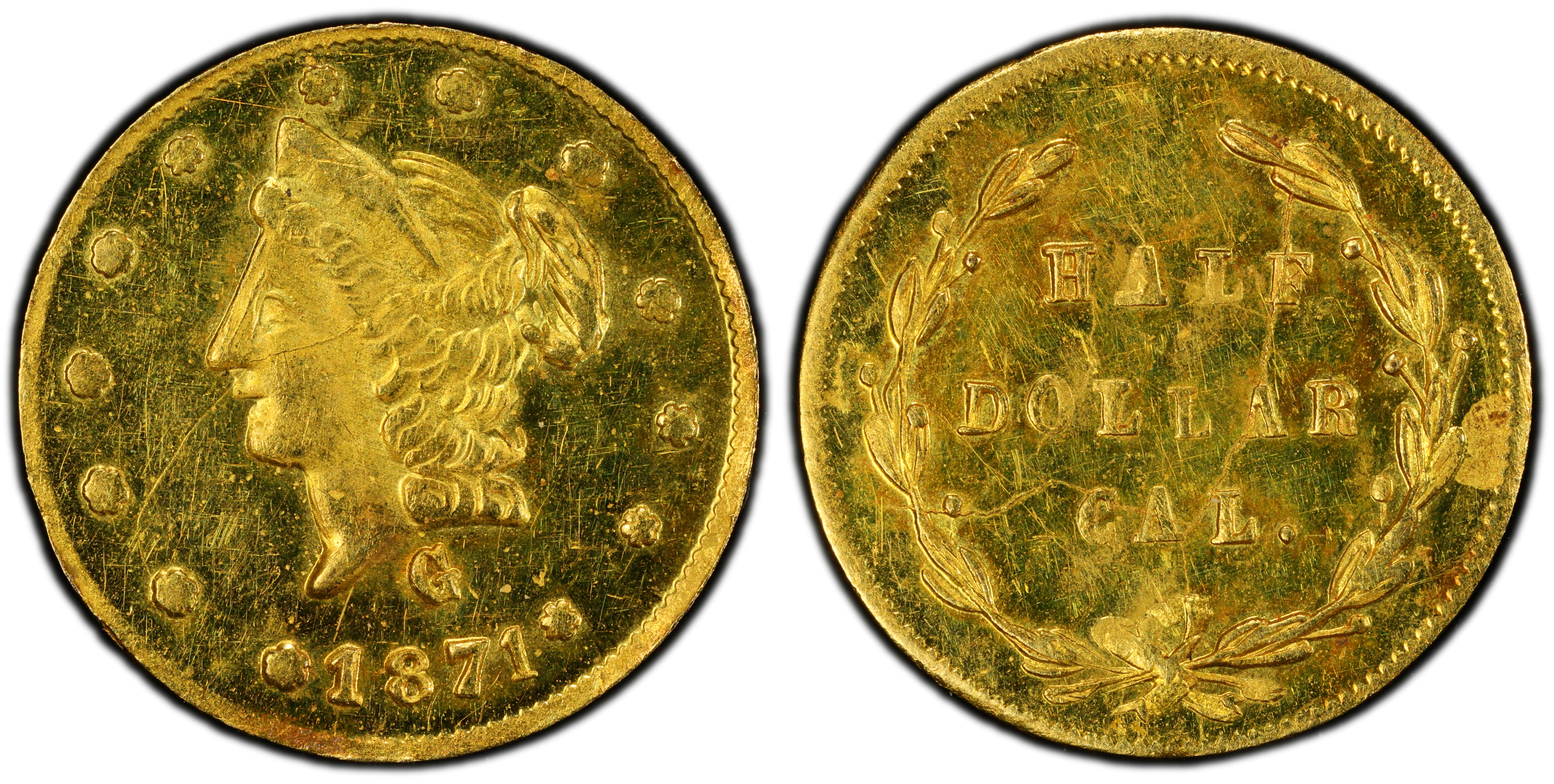
Obverse & Reverse
The 1871 BG-1026 50 Cents piece is a fascinating artifact from the second period (1859-1882) of California's fractional gold coinage. This era, often termed the 'jeweler's period,' stands in contrast to the earlier 'Period One' (1852-1856) issues which were struck with a genuine, if limited, commercial intent to alleviate the chronic shortage of small change during the initial Gold Rush boom. By the 1870s, the San Francisco Mint was in full operation, supplying ample federal silver and minor coinage, thus negating the original purpose of these tiny gold pieces. The motivation for minting fractional gold shifted from necessity to novelty. San Francisco jewelers and private minters recognized a burgeoning market for these miniature gold coins as souvenirs and keepsakes for tourists, merchants, and those wanting a small, tangible piece of the California dream. These Period Two issues, including the BG-1026, were typically lighter and often of a lower fineness than their stated face value would imply, functioning more as tokens than true circulating currency. The Coinage Act of 1864 had explicitly forbidden private coinage, but enforcement was lax, allowing this lively trade in 'Cal Gold' to persist until federal authorities finally clamped down in the early 1880s. The BG-1026, with its classic Liberty Head motif mimicking federal designs, was an affordable and attractive memento, encapsulating the romantic legacy of the Gold Rush long after its frantic peak had passed. Its existence speaks to a mature California economy where gold was not just a raw commodity but a cultural symbol, commercially packaged for a wide audience.
Associated EventPost-Gold Rush California Economy & Tourism
Reason For MintingPrimarily created to serve the growing demand for gold souvenirs and keepsakes in California rather than to function as circulating currency.
Minter HistoryThe specific minter or jeweler responsible for the BG-1026 variety is not definitively known, a common trait for many Period Two fractional gold pieces. The work is attributed to one of the numerous private jewelers operating in San Francisco during the period who produced these pieces for commercial sale. Unlike Period One minters who sometimes hallmarked their work, Period Two makers were often anonymous, likely due to the legally dubious nature of their enterprise following the Private Coinage Act of 1864. These minters were skilled artisans, capable of producing intricate dies for these minuscule coins, which were then often struck by hand.
Historical SignificanceThe BG-1026 is significant not as a coin of necessity, but as a representation of the commercialization of the Gold Rush legacy. It marks the transition of fractional gold from a practical monetary substitute to a popular souvenir item, reflecting California's evolving identity and the burgeoning tourist trade of the late 19th century. As a 'jeweler's issue,' it is a key component of the extensive and complex California fractional gold series.
N/A
DenominationG50C (50 Cents)
Minting Period1871
Assayer/MinterUnknown Private Minter
Geographic OriginSan Francisco, California
Obverse DescriptionA head of Liberty facing left, styled after the contemporary federal gold coinage. She wears a coronet, and her hair is tied in the back. The field is typically plain, surrounded by thirteen stars representing the original colonies.
Obverse Inscription Reverse DescriptionThe reverse features the denomination '1/2' and the word 'CALIFORNIA' enclosed within a wreath of leaves and berries. The date '1871' is positioned below the wreath.
Reverse Inscription1/2 CALIFORNIA 1871
CompositionGold
Stated Fineness Actual FinenessVariable, but generally lower than federal standards for the period, consistent with Period Two 'jeweler's issues.'
Weight0.24 grams
Diameter10.00 mm
EdgePlain
Unknown, but considered scarce.
Survival Estimate75-150
Rarity ScaleR-5 (Very Scarce)
The BG-1026 is popular with collectors for its classic Liberty Head design, affordability relative to Period One issues, and its status as a representative of the 'souvenir' era of Cal Gold. The challenge of finding well-struck, high-grade examples with good eye appeal adds to its allure. The 'PL' (Prooflike) designation, as noted in the user's query, indicates a specimen with reflective, mirror-like fields, a feature that is highly desirable and commands a significant premium.
Key VarietiesThe primary variety is the regular business strike. No major sub-varieties from the original minting period are widely recognized. The distinction of 'PL' (Prooflike) or 'DMPL' (Deep Mirror Prooflike) is a manufacturing characteristic rather than a separate variety, resulting from freshly polished dies. These surfaces are highly sought after by collectors. No official restrikes, patterns, or trial pieces are known for this specific BG number.
Authentication TipsGenuine BG-1026 coins have a characteristic strike style; while often sharp in the center, they can show weakness at the periphery. The lettering and stars should be stylistically correct for the period, not mushy or modern-looking. Weight and diameter should be close to the known standards. Many replicas and counterfeits exist; these are often brassy in color, have incorrect details (e.g., a bear on the reverse, which is never on genuine denominated pieces), or may feel soapy to the touch. Authentication by a major third-party grading service (PCGS or NGC) is highly recommended, as they maintain extensive databases of genuine examples.
Shopping ConsiderationsA premium quality BG-1026 will exhibit a sharp, well-centered strike, particularly on Liberty's hair details and the numerals and letters on the reverse. Seek out examples with clean surfaces free of distracting marks, rim bumps, or evidence of cleaning or tooling. Original, lustrous surfaces are paramount; many examples are found with impaired luster from harsh cleaning. The presence of prooflike ('PL') or deep mirror prooflike ('DMPL') fields, while rare, dramatically increases the coin's value and eye appeal. Avoid coins that have been holed or mounted for jewelry, as this damage is considered severe and significantly reduces numismatic value.
A coin's grade is its condition, rated on a 1-70 scale. For rare coins, this is the most critical factor in determining value, as a tiny difference in preservation can mean a huge difference in price.
Relevant Grade TypesOriginal period issues were business strikes intended for commercial sale as souvenirs, not circulation. They are found in Circulated (1-58) grades, though this is less common, and more frequently in Mint State (MS, 60-70) grades. No true Proofs were struck during the original period of issue. The 'PL' designation on a Mint State coin refers to Prooflike surfaces from polished dies and is not a separate grade type, but a desirable attribute. Later-date restrikes or special collector issues are not known for this variety.
Mint State CharacteristicsUncirculated examples of BG-1026 often exhibit a soft, satiny luster. Strike quality varies, but high-end examples will show full detail in the wreath and Liberty's hair strands. Due to vigorous die polishing on some specimens, details like Liberty's lower lip may appear weak or missing. The fields can be reflective, earning a 'Prooflike' (PL) designation. Due to their small size and handling over the years, even Mint State examples can have minor ticks and contact marks; a coin with exceptionally clean surfaces is a true rarity.
Circulated Wear PatternsWear first appears on the highest points: Liberty's cheek, the hair above her eye and ear, and the coronet. On the reverse, the highest points of the wreath and the fraction '1/2' will show the first signs of friction. On lower-grade circulated examples, the stars on the obverse and the date on the reverse will begin to lose their sharpness and merge with the fields.
Key Factors For ValueThe primary drivers of value for an 1871 BG-1026 are its numerical grade and surface quality. A sharp strike is critical; a weakly struck coin will be discounted. The presence of original mint luster is essential, with any evidence of cleaning or polishing severely depressing the value. Eye appeal is a major factor, with coins having attractive, original reddish-gold toning being highly prized. The premium for a Prooflike (PL) or Deep Mirror Prooflike (DMPL) designation is substantial. Finally, certification by PCGS or NGC is standard, and a CAC sticker for this issue indicates superior quality for the grade, adding a significant premium.
PCGS Price Guide
| Grade | Price | Population |
|---|---|---|
| 61 | $450.00 | N/A |
| 62 | $600.00 | N/A |
| 62+ | $750.00 | N/A |
| 63 | $1,000.00 | 1 |
| 63+ | $1,150.00 | N/A |
| 64 | $1,600.00 | N/A |
| 67 | N/A | N/A |