1876 G50C BG-1062, PL (Regular Strike)
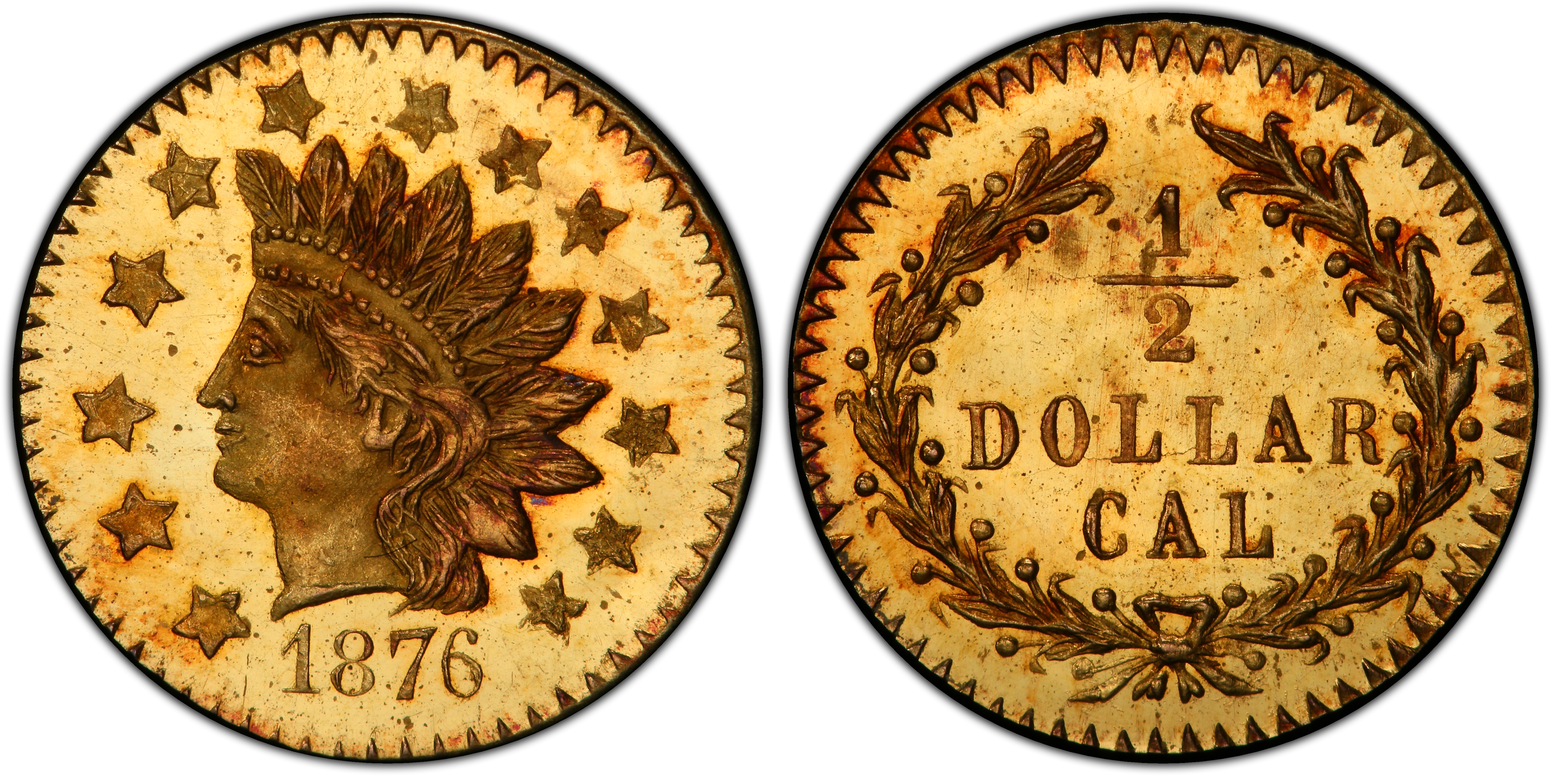
Obverse & Reverse
The 1876 G50C BG-1062 represents the second phase, or 'Period Two' (1859-1882), of California Fractional Gold production. Unlike their 'Period One' predecessors which were struck to alleviate a severe shortage of small change during the initial Gold Rush boom, these later issues served a different purpose. By the 1870s, the United States Mint in San Francisco was producing ample quantities of official silver and minor coinage, rendering private fractional gold redundant for commerce. Instead, these miniature gold pieces were created by manufacturing jewelers as souvenirs and novelty items for the burgeoning tourist trade and for sale back East. The Philadelphia Centennial Exposition of 1876, a massive celebration of America's 100th birthday, created a nationwide appetite for historical souvenirs and mementos, and it is highly probable that pieces like the BG-1062 were produced to capitalize on this patriotic and commercial fervor. These 'jeweler's issues' were not intended for circulation, a fact reflected in their physical characteristics. They were often struck with a lower gold content than their face value would imply and were manufactured with an eye towards aesthetic appeal rather than utilitarian function. Production was often crude, utilizing the hammer method, but many were struck on polished planchets to create a prooflike or mirror finish, enhancing their appeal as keepsakes. The Private Coinage Act of 1864 had made such private issues illegal, but enforcement was lax for many years. It wasn't until the early 1880s that the Secret Service, concerned about potential fraud, finally cracked down and permanently halted the production of these fascinating private issues. The BG-1062 is a tangible link to this later, more commercialized era of the California Gold Rush legacy, a time when the memory of the '49ers was being packaged and sold as a charming, miniature gold souvenir.
Associated EventPhiladelphia Centennial Exposition / Late Gold Rush Souvenir Era
Reason For MintingPrimarily created as a souvenir or novelty item for the tourist trade and collectors, not for general circulation.
Minter HistoryThe specific minter of the BG-1062 variety is unknown, a common trait for most Period Two fractional gold pieces. Production was dominated by a number of manufacturing jewelers in San Francisco, many of French origin, who created a wide variety of dies. While some earlier issues bear identifiable initials (e.g., 'FD' for Frontier & Deviercy or 'DN' for Deriberpe & Nouizillet), many later pieces from the 1870s are anonymous. These craftsmen operated in a quasi-legal space, producing items that skirted the line between tokens and illegal coinage, and thus had little incentive to prominently mark their work.
Historical SignificanceThis coin is significant not as a circulating medium of exchange, but as a numismatic artifact of the post-Gold Rush souvenir industry. It demonstrates the continued romantic allure of California gold decades after the initial rush and represents the final chapter of privately issued gold pieces in the state before federal enforcement ended the practice.
N/A
Denomination50 Cents
Minting Period1876
Assayer/MinterAnonymous Jeweler
Geographic OriginSan Francisco, California
Obverse DescriptionFeatures a stylized Indian Head facing left, a popular motif for this period. The portrait is typically rendered with simple, somewhat crude features, surrounded by thirteen stars representing the original colonies. The date '1876' appears below the bust.
Obverse Inscription1876
Reverse DescriptionA wreath of leaves and berries, open at the top, encircles the denomination. The denomination is expressed as '1/2' in the center. The overall design is characteristic of the 'jeweler's issues' of the era.
Reverse Inscription1/2
CompositionGold
Stated Fineness Actual FinenessVariable, often lower than official U.S. coinage, typically in the 14-22 karat range.
Weight0.25 grams
Diameter10.00 mm
EdgePlain
Unknown
Survival EstimateFewer than 5 known
Rarity ScaleR-7 (Very Rare)
The 1876 BG-1062 is a highly sought-after collectible due to its extreme rarity and status as a Centennial-year issue. Its appeal lies in the charm of miniature gold coinage and its connection to the romantic history of the California Gold Rush era. The prooflike surfaces often found on this variety add significant eye appeal.
Key VarietiesThe primary catalog designation is Breen-Gillio 1062 (BG-1062). No major varieties from the original minting period are known or recognized. The designation 'PL' (Prooflike) is a descriptor of the surface quality of an individual coin and not a separate variety. As these were made as souvenirs, no patterns or later restrikes are known to exist for this specific variety.
Authentication TipsAuthentic Period Two pieces are very thin and lightweight. Counterfeits and modern replicas are often thicker and heavier. Examine the strike details; genuine pieces, while sometimes crudely engraved, have a distinct character, whereas fakes may appear 'mushy' or have modern tool marks. The surfaces should have the correct luster for a hammered gold coin of the period; many fakes are brassy or have incorrect color. Any piece with a bear on the reverse is a modern replica. Authentication by a major third-party grading service (PCGS or NGC) is strongly recommended.
Shopping ConsiderationsFor a premium quality example, seek a specimen graded by PCGS or NGC, which guarantees authenticity. Look for sharp strike details, particularly on the highest points of the Indian's headdress and the details within the wreath. Original, lustrous surfaces are paramount; many of these pieces were cleaned or used as jewelry, so examples with undisturbed 'skin' command a significant premium. The 'PL' (Prooflike) or 'DMPL' (Deep Mirror Prooflike) designations are highly desirable and add considerable value. Avoid examples that are bent, holed, or show evidence of being mounted in jewelry, unless purchased as a placeholder for this extremely rare variety.
A coin's grade is its condition, rated on a 1-70 scale. For rare coins, this is the most critical factor in determining value, as a tiny difference in preservation can mean a huge difference in price.
Relevant Grade TypesOriginal issues were business strikes, although many were struck on polished planchets to appeal to souvenir buyers. Therefore, they are found in Mint State (MS, 60-70) grades, often with a 'Prooflike' (PL) designation. No true Proofs were struck. Because they did not circulate, examples in Circulated (1-58) grades are virtually nonexistent and would likely indicate damage rather than honest wear.
Mint State CharacteristicsA high-quality uncirculated example of BG-1062 will exhibit reflective, mirror-like fields, which is the basis for the PL designation. The strike can be uneven, a hallmark of being struck by hand with a hammer. It is common to see some weakness in the stars or parts of the wreath. Luster should be bright and frosty on the devices, contrasting with the mirrored fields. Due to the softness of gold and crude manufacturing, small planchet flaws or contact marks from handling are common but should not be overly distracting.
Circulated Wear PatternsAs these coins were not intended for circulation, true wear patterns are not a primary grading concern. If a piece were to circulate, wear would first appear on the highest points: the cheek and feathers of the Indian Head, and the high points of the wreath on the reverse. Any circulation would be highly unusual and would drastically reduce the coin's value compared to a Mint State example.
Key Factors For ValueFor the BG-1062, value is driven by three main factors. First and foremost is rarity; with only a few known examples, any specimen is valuable. Second is the grade and surface quality; a high Mint State grade (e.g., MS-62 or higher) with a strong PL or DMPL designation will command a massive premium. Third is eye appeal; an example with a sharp strike, clean surfaces free of distracting marks, and attractive original gold toning is the most desirable. A CAC sticker would provide further confirmation of premium quality for the assigned grade.
PCGS Price Guide
| Grade | Price | Population |
|---|---|---|
| 61 | $1,500.00 | N/A |
| 62 | $1,850.00 | N/A |
| 62+ | $2,250.00 | N/A |
| 65 | $4,250.00 | 1 |