1872 G$1 BG-1208, PL (Regular Strike)
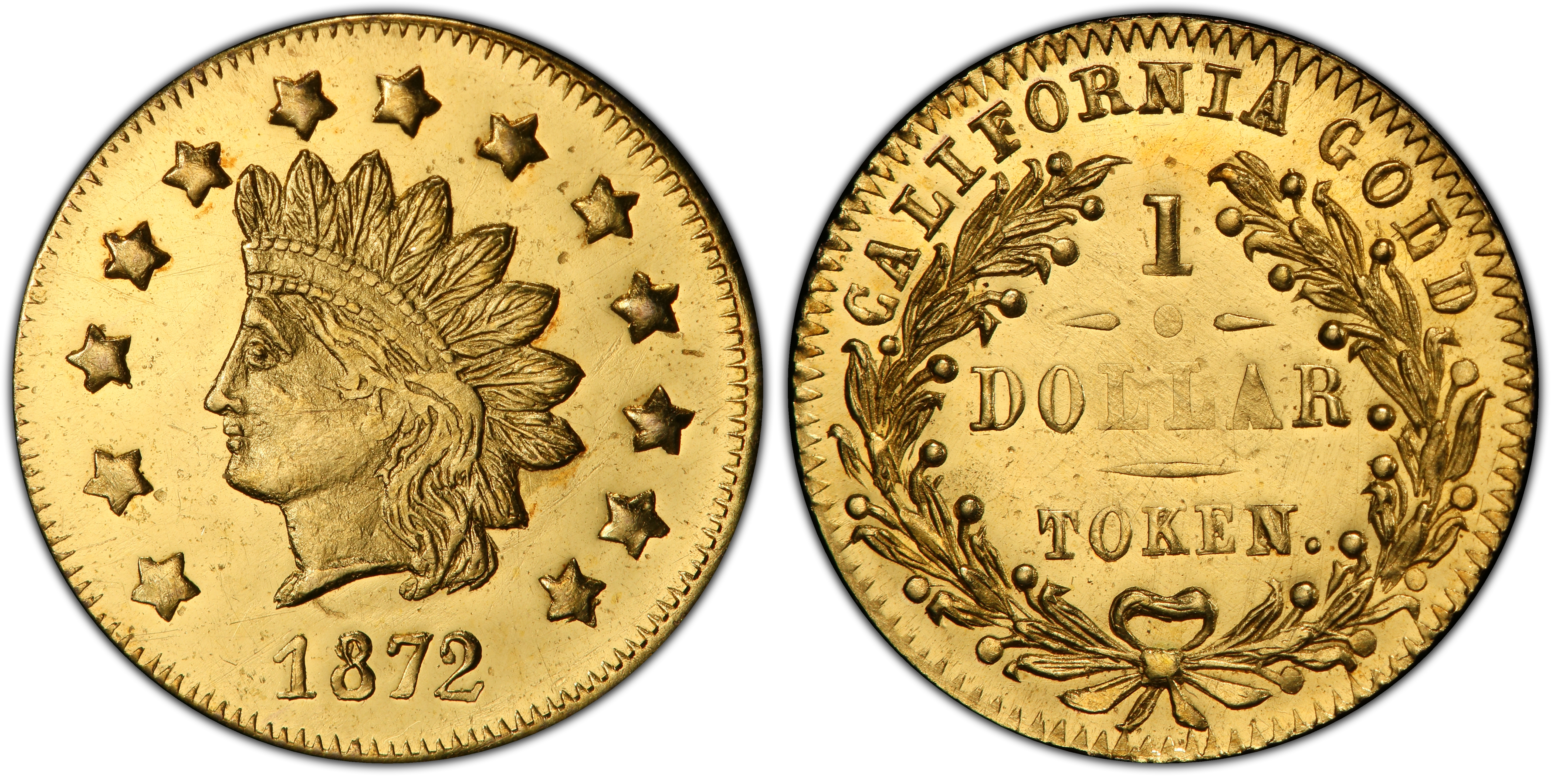
Obverse & Reverse
The 1872 BG-1208 gold dollar belongs to the second great era of California Fractional Gold production, known to numismatists as 'Period Two' (1859-1882). Unlike the 'Period One' issues (1852-1857), which were struck out of genuine commercial necessity to alleviate a severe shortage of small change during the initial Gold Rush boom, Period Two pieces were created primarily as souvenirs and for use in jewelry. By the 1870s, the United States Mint in San Francisco was in full operation, supplying the region with ample federal coinage and rendering private fractional gold obsolete for circulation. Despite this, a robust market persisted for these miniature gold pieces, fueled by tourists, merchants, and Californians who wished to send a tangible piece of the 'Golden State' to relatives back East. These later issues, often called 'jeweler's pieces,' were produced by various private manufacturers in San Francisco. The Coinage Act of 1864 had technically outlawed private currency, but enforcement by the Secret Service was lax until the early 1880s, allowing this cottage industry to flourish. The BG-1208, with its Indian Head design aping the popular federal coinage of the day, was a quintessential example of this phenomenon. It was designed to be attractive and nostalgic, evoking the spirit of the fading frontier even as California was becoming an established state. These pieces were not intended to circulate widely and their gold content was often less than their face value, a fact that was of little concern to buyers who prized them for their novelty and charm rather than their intrinsic worth. The relative crudeness of the edge reeding and the frequent appearance of prooflike surfaces suggest they were produced with an eye towards visual appeal rather than the durability required for commerce. Today, the BG-1208 is recognized as a scarce and historically significant artifact of this unique transitional period in California's economic and cultural history.
Associated EventPost-Gold Rush California economic development
Reason For MintingPrimarily created to satisfy the demand for souvenirs and jewelry items, rather than for general circulation.
Minter HistoryThe specific minter of BG-1208 is unrecorded, a common trait for Period Two California Fractional Gold. Production was typically handled by San Francisco jewelers and artisans who struck a wide variety of designs to cater to the robust souvenir market. These operations were small-scale and often ephemeral, leaving behind little to no documentation of their specific activities or identities.
Historical SignificanceThis coin is a prime example of a 'Period Two' or 'Jeweler's Issue' of California Fractional Gold. Its existence illustrates the shift in the purpose of these pieces from necessary circulating currency in the 1850s to popular souvenirs by the 1870s, reflecting California's maturation from a raw frontier to a more settled and romanticized state.
BG-1208
Denomination$1
Minting Period1872
Assayer/MinterUnknown private minter
Geographic OriginSan Francisco, California
Obverse DescriptionA portrait of a Native American chief facing left, wearing a feathered headdress. The portrait is encircled by thirteen six-pointed stars, with the date 1872 below.
Obverse Inscription1872
Reverse DescriptionThe denomination '1' and the word 'DOLLAR' are enclosed within a wreath of leaves and berries. The wreath is open at the top.
Reverse Inscription1 DOLLAR
CompositionGold
Stated Fineness Actual Fineness EdgeCrudely Reeded
Unknown
Survival Estimate15-30 pieces
Rarity ScaleR-6
The BG-1208 is sought after for its classic Indian Head design, its status as a scarce Period Two dollar, and its frequent prooflike or semi-prooflike surfaces which give it exceptional eye appeal. Its rarity ensures consistent demand among specialists in the extensive California Fractional Gold series.
Key VarietiesNo major varieties from the original minting period are known for BG-1208. The series of California Fractional Gold is not known to have collector-oriented restrikes in the traditional sense (like Chapman restrikes for federal coinage). Later, 20th-century reproductions and fantasy pieces exist in abundance, but these are not considered part of the original series and are typically uniface or bear fantasy designs like bears, and lack a proper denomination.
Authentication TipsGenuine BG-1208 examples will be denominated '1 DOLLAR' on the reverse; many common replicas are undenominated or use phrases like 'CAL GOLD CHARM'. The edge should be crudely reeded, not plain or perfectly executed. The strike may be uneven, with some weakness in the details, which is characteristic of genuine pieces. Modern fakes are often sharply struck, have a soapy or unnatural luster, and may be made of brass or low-purity gold. One known diagnostic is a planchet crack that can appear on the obverse, running diagonally across the Indian's chin and neckline. All uncertified examples should be regarded with extreme suspicion.
Shopping ConsiderationsA premium quality BG-1208 is defined by its surface preservation and strike. Look for examples with deeply mirrored, prooflike (PL) fields and frosted devices, creating a strong cameo contrast. A sharp strike on the headdress feathers and the details within the wreath is highly desirable, though some central weakness is common and acceptable. Luster is paramount; avoid cleaned, polished, or harshly whizzed examples that have been stripped of their original skin. Attractive, original toning, often a rich apricot or greenish-gold, adds significantly to eye appeal. Given the coin's tiny size, distracting marks in prime focal areas like the chief's cheek are particularly detrimental to the grade and value.
A coin's grade is its condition, rated on a 1-70 scale. For rare coins, this is the most critical factor in determining value, as a tiny difference in preservation can mean a huge difference in price.
Relevant Grade TypesOriginal examples of BG-1208 were business strikes, although many were struck on polished planchets to enhance their appeal as souvenirs. They are found in Circulated (AU-58 and below) and Mint State (MS, 60-70) grades. The term 'Prooflike' (PL) is a designation added to business strikes with mirrored surfaces and is very relevant to this issue. No true Proofs were struck during the original period of issue, and later-date restrikes are not a factor for this series.
Mint State CharacteristicsUncirculated examples are judged on the quality of their strike, luster, and marks. The BG-1208 is known for often having prooflike or semi-prooflike surfaces, characterized by a flashy, mirrored finish in the fields. A strong cameo contrast between the frosted devices (the Indian Head, wreath) and the mirrored fields is highly desirable. Strike can be variable, with weakness sometimes seen on the highest points of the headdress or the bow of the wreath. Contact marks, even small ones, are magnified by the coin's tiny size and can be very distracting, especially on the delicate prooflike surfaces.
Circulated Wear PatternsWear first appears on the high points of the design. On the obverse, check the cheek, jawline, and the tips of the feathers in the headdress. On the reverse, the highest points of the wreath's leaves and the knot of the bow will show the first traces of friction. In lower grades (VF and below), the finer details of the feathers will merge and the legends will begin to soften.
Key Factors For ValueFor the BG-1208, the primary value driver is the quality and preservation of the surfaces. A high-grade Mint State coin with deep, clean, prooflike fields will command a significant premium over a typical uncirculated piece. A strong cameo contrast adds another layer of desirability. Eye appeal is critical; coins with original, attractive reddish or greenish-gold toning are prized. Conversely, coins that have been cleaned, polished, or show significant distracting marks will be heavily discounted. Given the prevalence of forgeries, certification by a top-tier grading service (PCGS or NGC) is virtually required for any significant transaction, with a CAC sticker adding a further premium for exceptional quality within the grade.
PCGS Price Guide
| Grade | Price | Population |
|---|---|---|
| 64 | N/A | 1 |