1872 G$1 BG-1119, PL (Regular Strike)
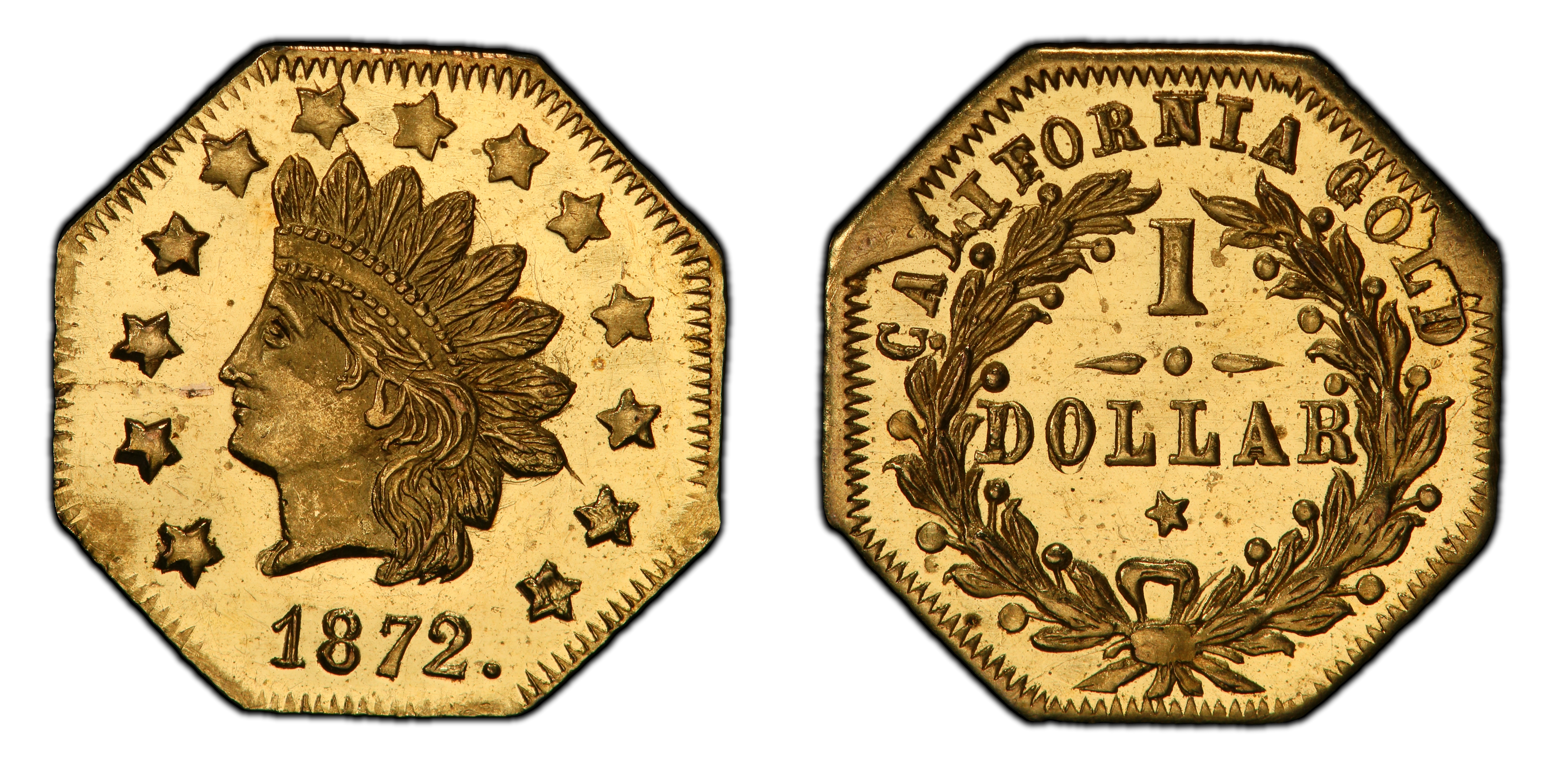
Obverse & Reverse
The California Fractional Gold series, produced from 1852 to 1882, represents a fascinating and complex chapter in American numismatics. Born from the acute shortage of small-denomination coinage in the post-Gold Rush West, these miniature gold pieces served as a practical solution for daily commerce. By the 1870s, the initial frenzy had subsided, but the regional economy still relied heavily on gold, and the federal government's supply of silver coinage remained inconsistent on the West Coast. This environment allowed private minters, often operating as jewelers or assayers, to continue producing fractional gold. The year 1872 falls into the 'Period Two' (1858-1882) of fractional gold production, an era characterized by a mix of functional currency and souvenir pieces. Unlike the earlier, cruder issues, tokens from this period were generally better manufactured, with more standardized designs. The BG-1119 variety is attributed to the firm of Broderick & Gum, one of the more prolific producers of the era. These pieces, denominated as 'DOLLAR' or 'DOL.', were technically tokens, as the Act of June 8, 1864, had prohibited the private issuance of coinage. To circumvent this, manufacturers often omitted the word 'DOLLAR' or used designs that were distinct from federal coinage, though many, like this one, closely mimicked the official U.S. Gold Dollar's Liberty Head motif. Their gold content was typically worth less than their face value, making them profitable for the producers but leading to contemporary accusations of being debased currency. These tokens circulated out of necessity and convenience, filling a vital role in small transactions until a sufficient supply of federal coinage finally rendered them obsolete by the early 1880s. Today, they are cherished by collectors for their link to the romanticism of the Gold Rush era and for the challenge presented by their vast number of varieties.
Associated EventPost-California Gold Rush Economic Development
Reason For MintingTo alleviate a chronic shortage of small-denomination circulating coinage for commerce in California during the 1870s.
Minter HistoryWhile not definitively signed, the BG-1119 is attributed to the prolific San Francisco jewelry firm of Broderick & Gum based on die characteristics and planchet preparation shared with signed 'BG' pieces. Little is known about the personal lives of William Broderick and A.L. Gum, but their firm was a major force in the Period Two fractional gold market. They produced a wide variety of denominations (25 Cents, 50 Cents, and $1) and designs, often using standardized obverse and reverse dies in different combinations, known as 'muling.' Their products are noted for their generally higher quality of manufacture compared to many earlier issues, suggesting a well-equipped and professional operation.
Historical SignificanceThe BG-1119, like other Period Two fractionals, demonstrates the persistence of private currency solutions on the American frontier long after the initial Gold Rush. It serves as a tangible artifact of a regional economy struggling with inadequate federal monetary support and highlights the legal and economic gray area in which these 'coins' existed. They represent the final chapter of private gold coinage in the United States, a tradition dating back to the Bechtlers in the 1830s.
N/A
DenominationG$1 (Gold Dollar)
Minting Period1872
Assayer/MinterAttributed to Broderick & Gum (San Francisco)
Geographic OriginSan Francisco, California
Obverse DescriptionA classic Liberty Head design facing left, closely mimicking the federal gold dollar. The coronet is plain, without the 'LIBERTY' inscription. The portrait is surrounded by 13 six-pointed stars.
Obverse Inscription(None)
Reverse DescriptionThe denomination '1' and 'DOLLAR' are enclosed within a wreath of grains and leaves, open at the top. The date '1872' is positioned just below the bow of the wreath.
Reverse Inscription1 DOLLAR 1872
CompositionGold
Stated Fineness Actual FinenessVaries, but typically in the range of .450 to .600 fine.
Weight0.47 grams
Diameter11.80 mm
EdgePlain
Unknown
Survival Estimate30-50
Rarity ScaleR-6 (Very Rare)
This variety is highly sought after due to its specific Breen-Gillio catalog number, R-6 rarity, and its association with the popular California Fractional Gold series. The classic Liberty Head design and dollar denomination make it a cornerstone piece for specialists.
Key VarietiesThe primary variety is the BG-1119 as described. No major contemporary varieties are noted, and no special collector restrikes are known to exist for this specific die marriage. Collectors focus on die states and minor planchet variations.
Authentication TipsAuthentication requires expert analysis. Look for the precise die markers illustrated in the Breen-Gillio reference, including the specific positioning of the date relative to the wreath. The weight should be very close to 0.47 grams. Counterfeits are common; they often have a soapy, cast-like appearance, incorrect weight, or mushy details. Genuine pieces have sharp, wire-like rims and crisp, if sometimes lightly struck, details. The fabric of the planchet should show the parallel striations characteristic of period manufacturing.
Shopping ConsiderationsA premium quality example for its grade will exhibit a sharp strike, particularly on the stars of the obverse and the details of the wreath on the reverse. Many examples are weakly struck, so a bold strike commands a significant premium. Look for pieces with original, undisturbed surfaces and a pleasing luster; many have been harshly cleaned or used as jewelry. Avoid specimens with evidence of tooling, significant rim damage, or scratches. Eye appeal is paramount for this series, and coins with a rich, original gold color are preferred over those with a brassy, cleaned appearance.
A coin's grade is its condition, rated on a 1-70 scale. For rare coins, this is the most critical factor in determining value, as a tiny difference in preservation can mean a huge difference in price.
Relevant Grade TypesOriginal examples of BG-1119 were business strikes intended for circulation. They are found in Circulated grades (AG-3 to AU-58) and, more rarely, in Mint State (MS-60 to MS-70). No Proof (PR/PF) examples were struck during the original period of issue, and no later-date Proof restrikes are known for this variety.
Mint State CharacteristicsAn uncirculated BG-1119 is characterized by full, unbroken mint luster, which is typically frosty or slightly satiny. Strike quality varies, but a top-tier example will show strong definition in Liberty's hair details and the individual leaves of the wreath. Due to the small size and manufacturing process, even Mint State examples can show minor planchet flaws or a slight weakness in the center. Contact marks, while present, should be minimal and not be distracting to the overall eye appeal.
Circulated Wear PatternsWear first appears on the highest points of the design. On the obverse, this includes Liberty's cheek, the hair just above the ear, and the coronet. On the reverse, the high points of the bow and the leaves at the top of the wreath will show the first signs of friction. In lower grades (VF and below), the stars will begin to lose their points and the letters and numbers will become softer and less defined.
Key Factors For ValueFor the BG-1119, value is driven by several key factors. Rarity is paramount, as an R-6 coin is inherently valuable. Grade is the next critical component, with Mint State examples commanding multiples of the price of circulated pieces. Surface quality is crucial; an example with original, lustrous surfaces will always be worth more than a cleaned, scratched, or otherwise damaged coin of the same grade. Strike sharpness is a major determinant of eye appeal and value—a fully struck specimen is a rarity and highly prized. Finally, a certification from a top-tier grading service (PCGS or NGC), especially with a CAC sticker, provides confidence and often results in a significant price premium.
PCGS Price Guide
| Grade | Price | Population |
|---|---|---|
| 62 | $2,500.00 | N/A |
| 62+ | $2,600.00 | N/A |
| 63 | $3,150.00 | N/A |
| 63+ | $3,500.00 | N/A |
| 64 | $4,500.00 | 1 |
| 64+ | $5,000.00 | N/A |
| 65 | $6,000.00 | N/A |
| 65+ | $7,250.00 | N/A |
| 66 | $9,000.00 | N/A |