1875 G$1 BG-1125, PL (Regular Strike)
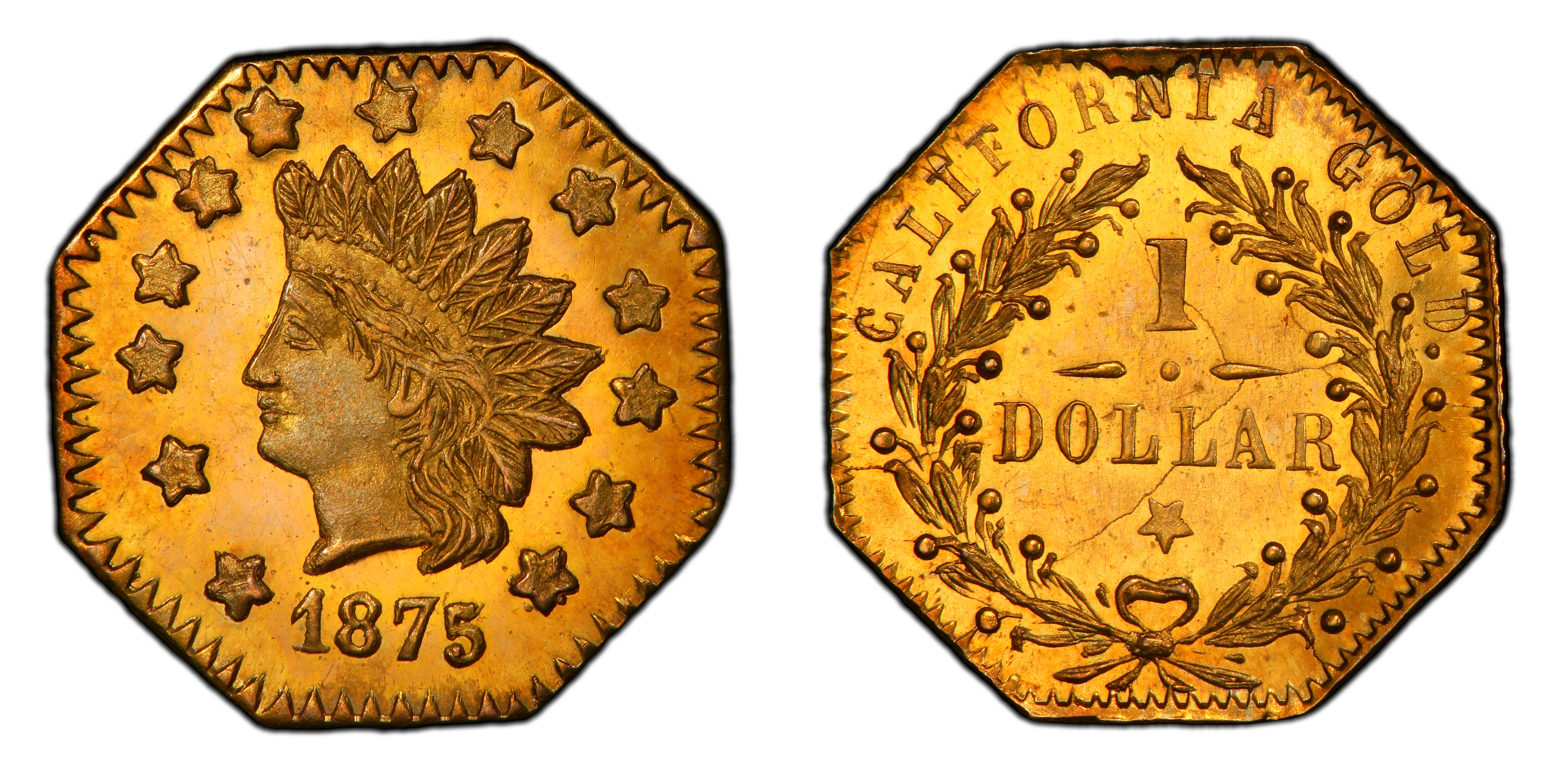
Obverse & Reverse
The 1875 G$1 BG-1125 is a quintessential example of 'Period Two' California Fractional Gold. By the mid-1870s, the acute shortage of small change that had plagued California during the initial Gold Rush years had long been resolved by the steady output of the United States Mint in San Francisco, which opened in 1854. The original impetus for private fractional gold coinage—to facilitate everyday commerce—had vanished. Instead, these small, privately-struck gold pieces transitioned into a new role as popular souvenirs and keepsakes. San Francisco, having blossomed from a chaotic boomtown into a major American city, was becoming a tourist destination. Visitors, captivated by the romanticism of the Gold Rush, sought tangible mementos of their journey to the Golden State. Manufacturing jewelers, such as Robert B. Gray & Co., astutely met this demand by producing an array of attractive, small-denomination gold 'coins.' These pieces were not intended for widespread circulation and were often sold at a premium over their minimal intrinsic value. The Coinage Act of 1864 had prohibited private coinage, but enforcement by the Secret Service was lax until 1883, allowing this souvenir trade to flourish. The BG-1125, with its classic Indian Head motif, was a popular design choice, evoking a romanticized vision of the American West. These pieces were typically struck with polished dies to create a flashy, prooflike surface that would appeal to buyers. The manufacturing process was often crude compared to the federal mint, using manually operated presses or even the hammer method, which resulted in coins of varying strike quality and frequent die failures. The extensive die cracks and cuds seen on later states of the BG-1125 reverse die are a testament to this production reality, where dies were used until they literally fell apart. Today, the BG-1125 is a prized collectible, valued not as a coin that fueled the Gold Rush economy, but as a historical artifact representing the commercial evolution of San Francisco and the enduring mythology of its golden era.
Associated EventCalifornia Gold Rush Aftermath & Tourism
Reason For MintingPrimarily struck for sale to tourists and collectors as a souvenir of the California Gold Rush era.
Minter HistoryWhile not definitively signed, the BG-1125 is attributed to the jewelers of the 1870s in San Francisco, with strong evidence pointing toward Robert B. Gray & Co. Gray was a prominent manufacturing jeweler who, around 1859, purchased the business and equipment of another fractional gold producer, Antoine Nouizillet. Gray continued to produce fractional gold pieces, often marked with a 'G', until he sold his interests to the California Jewelry Co. in 1871. The style, fabric, and period of manufacture of the BG-1125 are highly consistent with other pieces attributed to this group of interconnected San Francisco jewelers who dominated the Period Two souvenir market.
Historical SignificanceThe BG-1125 represents the shift in purpose for California Fractional Gold, from a necessary medium of exchange in the 1850s to a commercial souvenir item by the 1870s, reflecting the maturation of San Francisco's economy and the burgeoning tourism industry.
N/A
DenominationG$1
Minting Period1875
Assayer/MinterProbably Robert B. Gray & Co.
Geographic OriginSan Francisco, California
Obverse DescriptionA stylized head of Liberty facing left, wearing a Native American-style feathered headdress. The word LIBERTY is inscribed on the headband. Thirteen stars encircle the portrait along the octagonal border.
Obverse Inscription[No Inscription - Stars and Portrait]
Reverse DescriptionThe denomination '1' and the word 'DOLLAR' are enclosed within a wreath of leaves and berries. The wreath is open at the top. The inscription 'CALIFORNIA GOLD' appears above the wreath along the upper border, and the date '1875' is below.
Reverse InscriptionCALIFORNIA GOLD / 1 / DOLLAR / 1875
CompositionGold
Stated Fineness Actual FinenessTypically lower than federal issues, variable but often in the .500 to .800 range for Period Two issues.
EdgePlain
Unknown; likely a few thousand pieces originally struck.
Survival EstimateFewer than 75-150 coins are estimated to exist in all grades.
Rarity ScaleLow R-5 (Very Scarce)
This variety is highly sought after due to its attractive Indian Head design, octagonal shape, and the dramatic, easily identifiable late-state die cracks on the reverse, which offer a tangible link to the private minting process. The typically prooflike surfaces add significant eye appeal.
Key VarietiesThe primary variation is in the die state of the reverse. Early strikes show a clean die, while later examples exhibit increasingly prominent die cracks. The latest known state, considered a terminal die state, shows extensive cracking throughout the reverse periphery, a crack through the center, and a distinct cud (a retained die break) appearing above the letter 'N' in CALIFORNIA. No major die pairing varieties or later restrikes are noted for this specific catalog number.
Authentication TipsAuthentic examples are very small and thin. The most critical diagnostic is the reverse die state. Look for the distinctive pattern of die cracks on later state examples; their sharpness and location are difficult for counterfeiters to replicate. The fields should have a reflective, prooflike character, not a modern, overly brilliant shine. The strike on the stars is often flat and incomplete, even on high-grade specimens. Be wary of pieces with a soapy or cast-like appearance, incorrect weight, or a 'bear' on the reverse, as no genuine Period Two dollars feature this motif.
Shopping ConsiderationsA premium quality example for this variety is defined by sharply reflective, prooflike fields with minimal distracting abrasions. While the central strike can be sharp, expect some flatness on the peripheral stars. The presence of the dramatic late-state die cracks and cud is actually desirable for this issue, as it's a key characteristic and proof of authenticity; 'terminal state' examples are highly coveted. Avoid specimens that have been harshly cleaned, which destroys the delicate prooflike surface, or those with significant rim bumps or evidence of being mounted in jewelry. Original, reddish-gold toning over lustrous surfaces commands a significant premium.
A coin's grade is its condition, rated on a 1-70 scale. For rare coins, this is the most critical factor in determining value, as a tiny difference in preservation can mean a huge difference in price.
Relevant Grade TypesOriginal 1875 issues of BG-1125 were business strikes, although struck with polished dies to impart a special finish for collectors. They are found in Circulated (1-58) and, more commonly, Mint State (MS, 60-70) grades due to their souvenir nature. The term 'Prooflike' (PL) is often used to describe the reflective surfaces, but these are not true Proofs. No Proofs in the modern sense were struck during the original period of issue, and no later-date Proof restrikes are known to exist.
Mint State CharacteristicsUncirculated examples of BG-1125 are defined by their prooflike surfaces. A superior MS specimen will have deeply mirrored fields contrasting with satiny, lightly frosted devices. Strike can be a limiting factor; the central Indian head is often well-defined, but the 13 obverse stars are characteristically flat and may lack full detail. Bag marks are less common than light hairlines or minor friction in the fields, which can significantly impact the grade. The integrity and originality of the flashy surfaces are paramount.
Circulated Wear PatternsOn circulated examples, wear first appears on the high points of the Indian's cheek, the feathers in the headdress, and the high points of the wreath on the reverse. As wear progresses, the word LIBERTY on the headband will become indistinct. In lower grades (VF and below), the fine details of the feathers will merge and the reverse lettering will show significant weakness.
Key Factors For ValueFor the 1875 BG-1125, value is driven by three main factors: 1) Surface Quality: The depth and cleanliness of the prooflike fields are critical. A coin with deep, uninterrupted reflectivity will command a substantial premium over a hazy or heavily abraded example. 2) Strike: While peripheral weakness is common, examples with a sharper-than-average strike on the stars are prized. 3) Eye Appeal: Coins with attractive, original toning and strong cameo contrast between the fields and devices are most desirable. The presence of the late-state die cracks is a positive attribute, not a flaw. A CAC sticker for this issue provides a strong endorsement of surface quality and commands a higher price.
PCGS Price Guide
| Grade | Price | Population |
|---|---|---|
| 64 | $3,250.00 | 2 |
| 64+ | $3,750.00 | N/A |
| 65 | $4,250.00 | 1 |
| 65+ | $5,000.00 | N/A |
| 66 | $6,250.00 | 1 |
| 66+ | $7,500.00 | 1 |