1872 G$1 BG-1206, PL (Regular Strike)
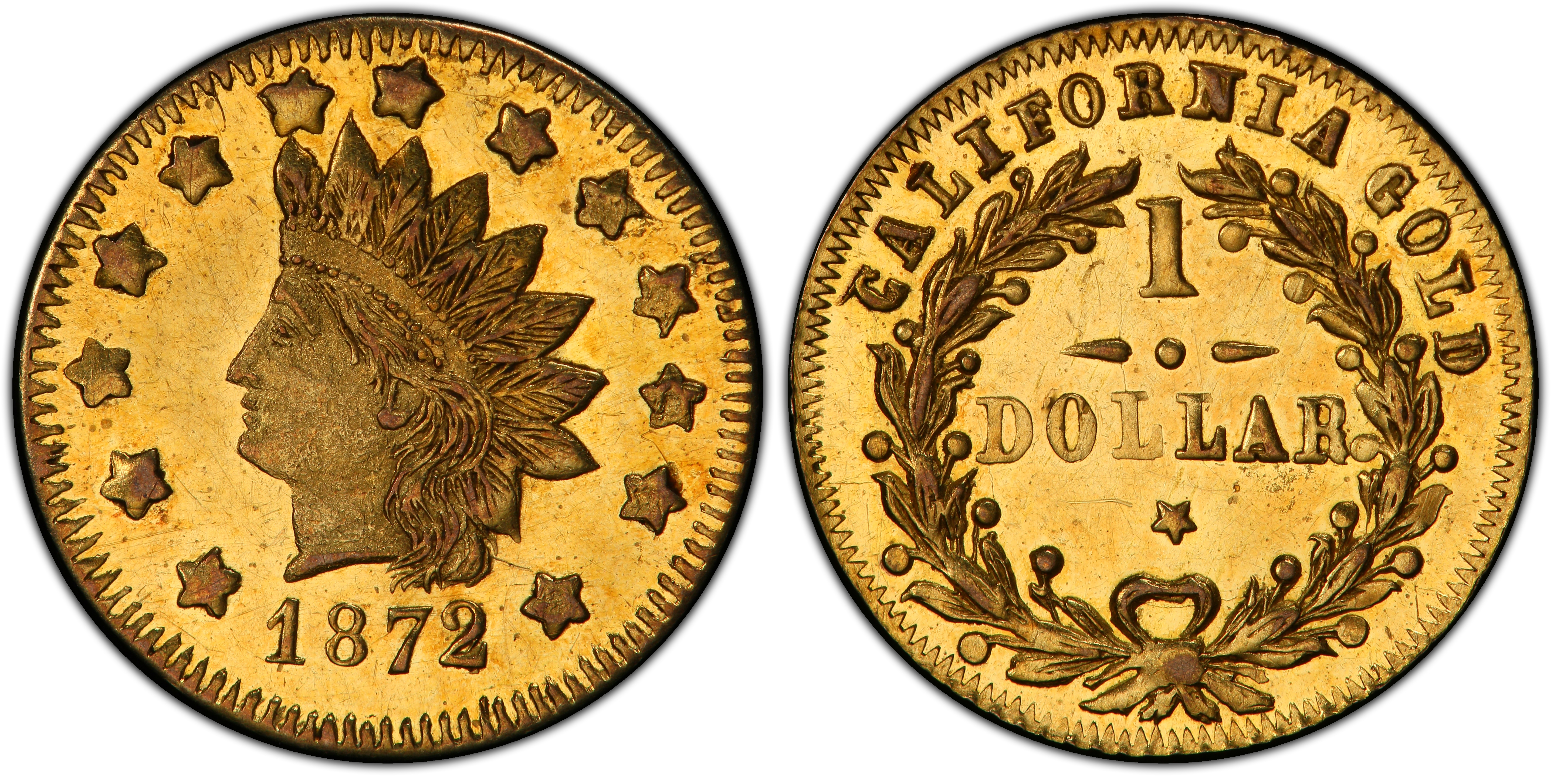
Obverse & Reverse
The 1872 G$1 BG-1206 is a fascinating product of the second major phase of California Fractional Gold production (1859-1882), often dubbed the 'Jeweler's Issue' period. Unlike the earlier 'Period One' pieces struck from 1852-1857 to alleviate a genuine shortage of small change during the Gold Rush, these later issues served a different purpose. By the 1870s, the United States Mint in San Francisco was in full operation, and the acute need for circulating private coinage had subsided. Instead, these miniature gold coins were primarily manufactured by jewelers and artisans in San Francisco as souvenirs, keepsakes, and novelty items for tourists and locals enchanted by the mystique of the Gold Rush. This era was defined by a cat-and-mouse game with federal authorities. The Private Coinage Act of 1864 expressly forbade the issuance of private money, but enforcement was inconsistent and focused elsewhere for years. This legal gray area allowed dozens of small-scale producers to continue striking these pieces, often with lower gold content and cruder workmanship than their Period One predecessors. The designs became more varied, with Indian Head motifs joining the traditional Liberty heads, likely to mimic the popular federal coinage of the day and increase their appeal. However, by the late 1870s and early 1880s, the U.S. Secret Service, under Chief James J. Brooks, began a determined crackdown, viewing the continued production as a form of counterfeiting and a risk for fraud. This pressure led to the cessation of nearly all fractional gold minting by 1883. The BG-1206 is one of the rarest and most enigmatic issues from this twilight period. Its 'Indian Head' design is crisply executed for the type, but its extreme rarity suggests a very limited, perhaps experimental, production. Referred to by numismatists as the 'King of the Indian Head Round dollars,' its existence as a full Rarity-7 coin points to a mintage that was likely minuscule, perhaps only a few dozen pieces at most. The specific circumstances of its creation and the identity of its maker are lost to history, but it stands as a testament to the persistent and entrepreneurial spirit of California's artisans, who continued to create these iconic symbols of the Golden State long after their practical necessity had vanished.
Associated EventCalifornia Gold Rush (Later Souvenir Period)
Reason For MintingPrimarily created as a souvenir or novelty item for the tourist trade, not for general circulation, during a period of legal ambiguity for private coinage.
Minter HistoryThe specific minter for BG-1206 is unknown, which is common for many 'Period Two' California Fractional Gold pieces. They were typically produced by anonymous jewelers and craftsmen in San Francisco who often did not sign their work, partly to avoid legal repercussions from the U.S. government, which had outlawed private coinage in 1864. These artisans used native California gold, though often of a lower fineness than the earlier, circulating issues.
Historical SignificanceThe BG-1206 represents the final, clandestine phase of private gold coinage in California. Its high rarity and status as a 'jeweler's issue' highlight the transition of these pieces from functional currency to popular souvenirs, while also embodying the legal conflicts between private minters and the federal government that ultimately ended the tradition.
K-N/A
Denomination$1
Minting Period1872
Assayer/MinterUnknown Private Minter
Geographic OriginSan Francisco, California
Obverse DescriptionA stylized head of a Native American princess faces left, wearing a feathered headdress. The portrait is surrounded by 13 six-pointed stars arranged in an arc along the periphery. The date '1872' is positioned below the bust.
Obverse Inscription1872
Reverse DescriptionThe central device is a simple wreath composed of two branches tied with a bow at the bottom. Within the wreath, the denomination '1 / DOLLAR' is inscribed on two lines. The legend 'CALIFORNIA GOLD' encircles the wreath along the upper rim.
Reverse InscriptionCALIFORNIA GOLD / 1 / DOLLAR
CompositionGold
Stated Fineness Actual FinenessVariable, typically lower than federal coinage, often ranging from .500 to .800 fine for this period.
Weight0.45 grams
Diameter11.00 mm
EdgePlain
Extremely low; likely fewer than 25 pieces.
Survival EstimateFewer than 10 known.
Rarity ScaleR-7 (4 to 12 known)
This coin is a paramount rarity in the California Fractional Gold series, known as the 'King of the Indian Head Round dollars.' Its appeal lies in its extreme scarcity, attractive design, and historical context as a late-period jeweler's issue. It is a trophy coin for advanced specialists.
Key VarietiesThe primary diagnostic for the BG-1206 is its significant die rotation; auction records consistently describe the dies as being rotated approximately 90 degrees. A Prooflike (PL) variety is also recognized by PCGS, representing examples with exceptionally reflective surfaces, but these are exceedingly rare. No known patterns or official restrikes exist for this issue.
Authentication TipsThe most critical diagnostic is the ~90-degree die rotation. Genuine examples exhibit a specific strike character, often with slightly soft details but sharp die characteristics. Counterfeits of fractional gold are rampant; many are brass or low-karat gold tokens. Fakes often have incorrect design details, a 'soapy' or cast appearance, incorrect weight, and lack the precise die markers of originals. Pay close attention to the style of the numerals in the date and the lettering. Given the coin's high value and rarity, third-party authentication by PCGS or NGC is essential.
Shopping ConsiderationsFor a coin of this rarity, any example is a major acquisition. A 'premium quality' example would be one that is well-struck for the issue, with minimal surface impairments and some remaining luster. Look for crispness on the details of the headdress and the lettering in the reverse wreath. Many Period Two fractionals were used as jewelry, so check carefully for evidence of mounting, tooling, or harsh cleaning, which would significantly impact the value. The surfaces on authentic pieces can sometimes be described as 'watery' or prooflike. Eye appeal is paramount; an example with pleasing, original color and minimal distracting marks will command a significant premium.
A coin's grade is its condition, rated on a 1-70 scale. For rare coins, this is the most critical factor in determining value, as a tiny difference in preservation can mean a huge difference in price.
Relevant Grade TypesOriginal issues were business strikes, although not intended for widespread circulation. They are found in Circulated grades (AU-55 to AU-58 are most common for survivors) and, very rarely, in Mint State (MS, 60-70). The term 'Prooflike' (PL) is a designation applied to business strikes with mirrored surfaces and is noted on the major grading service holders. True Proof (PR/PF) strikings from the original period of issue are not known to exist for this variety.
Mint State CharacteristicsAn uncirculated BG-1206 would be defined by full, uninterrupted luster, often with a slightly reflective, prooflike quality. The strike can be inconsistent; a top-tier example would show sharp details on the feathers of the headdress and the leaves of the wreath. Due to the small size and private minting process, planchet quality can be imperfect, and minor striking flaws may be present even on high-grade specimens. Contact marks, though minimal, would be the primary determinant between MS grades.
Circulated Wear PatternsWear first appears on the highest points of the design. On the obverse, this includes the cheek of the Indian princess and the feathers in the headdress. On the reverse, the highest points of the wreath's leaves and the bow would show the first signs of friction. In lower circulated grades (though few exist), the stars and peripheral lettering would begin to lose their sharpness.
Key Factors For ValueRarity is the dominant value factor, as all known examples are treasures. Beyond that, value is determined by surface preservation and eye appeal. An example free of jewelry mounting, harsh cleaning, or significant marks is vastly superior. The degree of prooflike reflectivity adds a premium. A sharp strike that brings out the design details is highly desirable. Finally, certification by PCGS or NGC is non-negotiable, and a CAC sticker on a high-grade example would signify premium quality and add a substantial premium.
PCGS Price Guide
| Grade | Price | Population |
|---|---|---|
| 63 | $12,000.00 | 1 |