1881 G50C BG-1070, PL (Regular Strike)
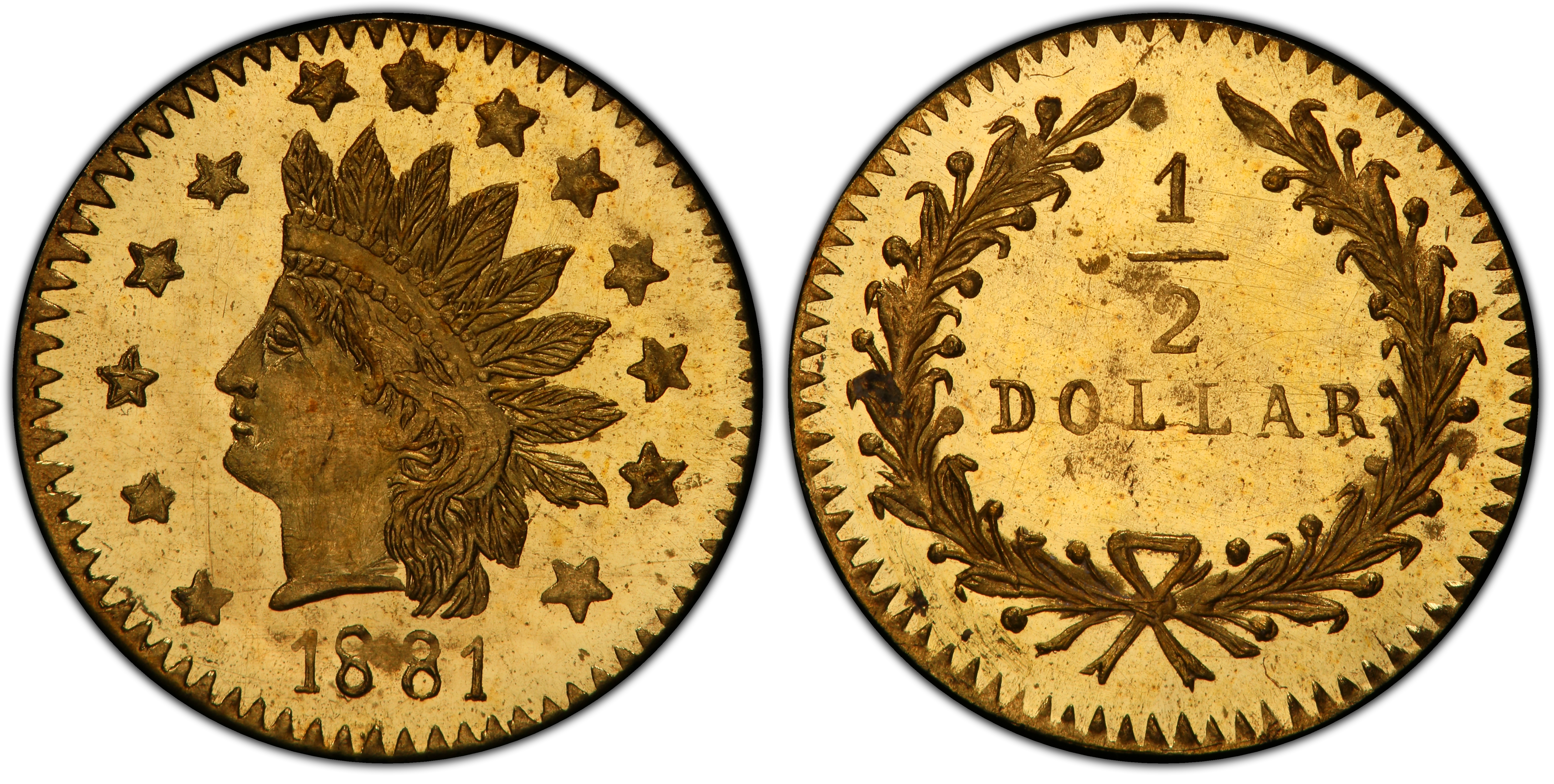
Obverse & Reverse
The 1881 BG-1070 50-cent piece represents the final evolution of California's fascinating fractional gold series, a numismatic story born from necessity that ended in novelty. The initial 'Period One' (1852-1857) issues were a direct response to a severe shortage of small-denomination coinage during the frenetic early years of the Gold Rush, providing a crucial medium for minor transactions. By the time this 'Period Two' (1859-1882) piece was struck, the economic landscape of California had matured significantly. The establishment and output of the San Francisco Mint had largely resolved the coinage crisis, rendering the original purpose of fractional gold obsolete. Consequently, the motivation for their production shifted dramatically. Rather than serving as essential currency, these later issues were primarily manufactured by jewelers and metalsmiths in San Francisco as souvenirs and keepsakes. They catered to a burgeoning tourist trade and a local population fond of trinkets that recalled the state's golden beginnings. These 'jeweler's issues' were often lighter and of less consistent fineness than their Period One predecessors, as their value was derived more from their novelty than their intrinsic worth. The year 1881 stands at the precipice of the end for this industry; the U.S. government, which had passed an 1864 law against private coinage, began to enforce it more strictly, with the Secret Service actively cracking down on producers whose creations too closely resembled federal money. This heightened scrutiny would effectively terminate the production of denominated fractional gold by 1883, making the BG-1070 one of the last of its kind. Its existence as a beautifully struck, often prooflike specimen underscores its intended market: not the dusty pouches of miners, but the velvet-lined jewelry boxes of sentimentalists and travelers.
Associated EventCalifornia Gold Rush (Later Tourist/Souvenir Period)
Reason For MintingPrimarily created as a souvenir or charm for the tourist trade, not to alleviate a circulating coin shortage which had largely ended.
Minter HistoryThe specific minter of the BG-1070 variety is unknown, a common trait for many 'Period Two' issues. Production during this era was dominated by a community of San Francisco jewelers, many of French origin, who struck these pieces for private sale. Unlike the earlier assayers who often marked their work, these later producers were less concerned with branding their pieces as monetary instruments and more with selling them as novelties. Records from this period are scarce, and attribution is often based on die characteristics and diagnostics rather than explicit markings. These jewelers operated in a legally gray area, and anonymity likely provided a degree of protection from increasing federal scrutiny.
Historical SignificanceThe BG-1070 is significant not as a circulating coin, but as a tangible artifact of California's transition from a raw frontier to a place of myth and tourism. It represents the commercialization of the Gold Rush legacy itself, a shift from producing functional money to creating commemorative souvenirs. As one of the final denominated issues before government suppression, it marks the end of a uniquely American chapter of private enterprise in coinage.
Not Applicable
Denomination50 Cents
Minting Period1881
Assayer/MinterUnknown Private Minter (Jeweler)
Geographic OriginSan Francisco, California
Obverse DescriptionA stylized head of a Native American, often referred to as an 'Indian Head,' facing left. The portrait is adorned with a feathered headdress. The features are typically sharply defined on high-grade examples, surrounded by thirteen stars representing the original colonies.
Obverse InscriptionNo inscription.
Reverse DescriptionA simple wreath composed of two branches tied together by a ribbon at the bottom. Inside the wreath, the denomination is expressed as '1/2'. The date '1881' is positioned above the wreath.
Reverse Inscription1881 1/2
CompositionGold
Stated Fineness Actual FinenessVariable, typically between .500 and .750 fine for Period Two issues.
Weight0.25 grams
Diameter10.00 mm
EdgePlain
Unknown
Survival EstimateFewer than 75
Rarity ScaleR-5 (31-75 Known)
This variety is highly sought after for its attractive 'Indian Head' design and its status as a late-date issue. The frequent availability of specimens with prooflike (PL) or deep prooflike (DPL) surfaces adds significant appeal, as these coins exhibit a flashy, mirrored finish that stands out in the series. It represents an accessible entry point into the scarcer R-5 rating category of California fractionals.
Key VarietiesThe primary variety is the regular business strike. However, within this variety, special collector designations are paramount: * **Prooflike (PL):** Specimens struck from fresh, polished dies that exhibit mirrored fields. This is not a separate issue but a manufacturing characteristic of certain coins from the run. * **Deep Prooflike (DPL) / Deep Mirror Prooflike (DMPL):** A more pronounced and desirable version of the PL finish, with deeply reflective, mirror-like surfaces. These are the most coveted examples of the BG-1070. No official patterns or later restrikes are known to exist for this specific Breen-Gillio number.
Authentication TipsGenuine BG-1070 pieces have a sharp, precise strike, especially on the headdress feathers and the reverse wreath. The numerals of the date and fraction are crisp. Counterfeits are often weakly struck with mushy details and may have a soapy or unnatural luster. A key diagnostic is the weight and specific gravity; fakes are often made of gold-plated brass and will be incorrect in weight and density. The surfaces of genuine prooflike specimens should show reflectivity in the fields but retain frosty texture on the devices; fakes often have a uniform, unnatural sheen across the entire coin. All questionable pieces should be authenticated by a major third-party grading service.
Shopping ConsiderationsWhen acquiring a BG-1070, prioritize surface quality and strike. A premium quality example for its grade will possess deeply mirrored fields if designated PL or DPL, with minimal distracting contact marks. Look for a sharp strike on the high points: the feathers on the obverse and the details of the bow on the reverse. Avoid examples that have been harshly cleaned, which will show parallel hairlines and impaired luster. Tooling or smoothing in the fields to mimic a prooflike surface is a major issue to watch for. An original, unmolested 'skin' with a touch of reddish-gold toning is highly desirable and commands a significant premium.
A coin's grade is its condition, rated on a 1-70 scale. For rare coins, this is the most critical factor in determining value, as a tiny difference in preservation can mean a huge difference in price.
Relevant Grade TypesOriginal 1881 issues were business strikes, though some were produced with special care for the souvenir market, resulting in prooflike surfaces. They are found in Circulated grades (About Uncirculated-50 to AU-58 are most common for circulated examples) and Mint State (MS, 60-70) grades. No true Proofs were struck in 1881. The 'PL' and 'DPL' designations are not a different type of coin, but rather a desirable characteristic of a business strike coin's finish, indicating it was among the first struck with polished dies.
Mint State CharacteristicsIn Mint State, the quality of BG-1070 is defined by its luster, strike, and surface preservation. Luster can range from satiny to deeply prooflike. The strike is typically sharp, but weakness can sometimes be seen on the centermost feathers of the headdress. Due to the small size and handling as novelties, even uncirculated examples are prone to tiny contact marks or light friction on the highest points of the design.
Circulated Wear PatternsWear first appears on the high points of the Indian's cheek and the feathers in the headdress. On the reverse, the bow of the ribbon and the highest leaves of the wreath will show the first signs of friction. On lower-grade circulated examples (VF and below), the finer details of the feathers will merge and the stars on the obverse may become faint.
Key Factors For ValueThe single most important factor for this variety is the surface designation; a DPL/DMPL coin is worth many times more than a standard MS example. Beyond that, a sharp, full strike is critical. Eye appeal is paramount; coins with clean, vibrant, mirrored fields and frosty devices are highly prized. The presence of a CAC sticker, verifying premium quality for the grade, adds a significant premium, especially on high-grade prooflike specimens.
PCGS Price Guide
| Grade | Price | Population |
|---|---|---|
| 62 | N/A | N/A |
| 63 | N/A | 1 |
| 64 | $975.00 | 2 |
| 64+ | $1,150.00 | N/A |
| 65 | $1,450.00 | N/A |
| 65+ | $1,600.00 | N/A |
| 66 | $1,850.00 | N/A |
| 66+ | $2,250.00 | 1 |