1875 G50C BG-1056, DMPL (Regular Strike)
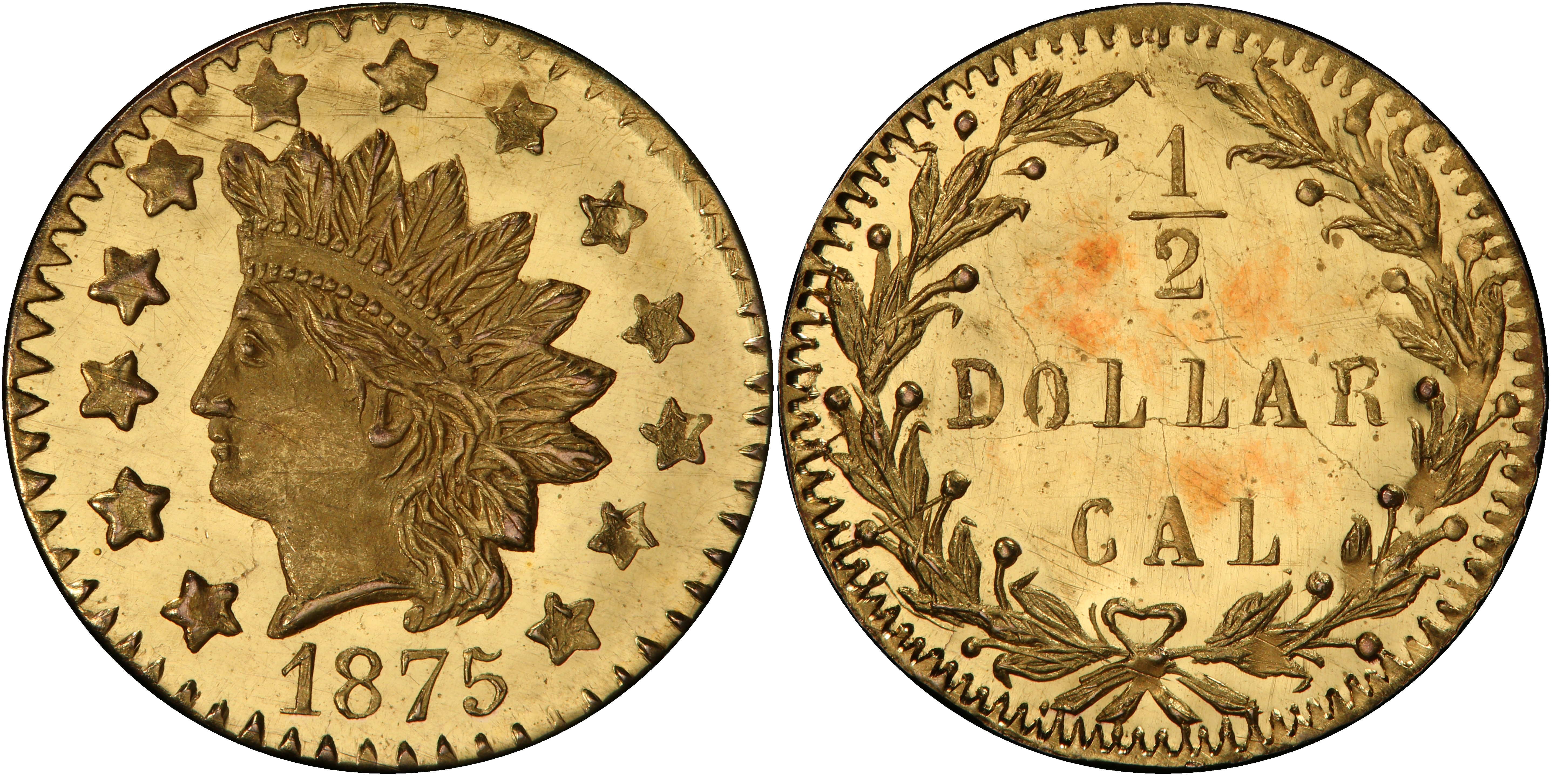
Obverse & Reverse
The 1875 50 Cents, BG-1056, is a quintessential example of a 'Period Two' California Fractional Gold piece. By the mid-1870s, the initial, desperate need for small denomination coinage that characterized the California Gold Rush of the early 1850s had long since passed. The San Francisco Mint, opened in 1854, was producing ample federal coinage for commerce. The continued production of these minuscule gold pieces was driven by a different, but equally potent, economic force: tourism and the robust market for souvenirs and keepsakes. These 'jeweler's issues,' as they are known, were no longer intended to be the lifeblood of daily transactions but were instead tangible, affordable mementos of the romanticized Gold Rush era. They were marketed to locals, tourists, and businessmen who might send them back East as a novel curiosity. This specific variety, BG-1056, is attributed to the jeweler Herman J. Brand, a known San Francisco producer of such tokens during this period. These pieces were often struck with less precision and lower gold content than their Period One predecessors, as their value was primarily sentimental rather than monetary. The Coinage Act of 1864 had made the private issuance of currency illegal, but enforcement by the Secret Service was inconsistent and did not fully clamp down on these denominated 'souvenir' operations until the early 1880s. Producers like Brand operated in this legally gray area, creating a fascinating and complex chapter in American numismatic history. The DMPL (Deep Mirror Proof-Like) designation on this particular coin is especially noteworthy; it indicates the planchet was struck by freshly polished dies, creating a beautiful, mirror-like finish in the fields with frosted devices. This premium quality finish was not accidental; it was an intentional marketing feature to enhance the coin's eye appeal and desirability as a souvenir item, setting it apart from more utilitarian circulating coins.
Associated EventCalifornia Gold Rush
Reason For MintingPrimarily struck as a souvenir or keepsake of the California Gold Rush era for the tourist and jewelry trade rather than for monetary circulation.
Minter HistoryHerman J. Brand was a San Francisco-based jeweler and a known producer of California Fractional Gold pieces during the 'Period Two' era. Like many of his contemporaries, Brand's business catered to the significant market for Gold Rush souvenirs. He produced a variety of denominated gold tokens, often featuring Indian Head designs. His operations continued until the early 1880s when increased pressure from the U.S. Secret Service forced jewelers to cease producing items that could be misconstrued as circulating coinage. In response, Brand and others transitioned to making non-denominated tokens or 'charms' to avoid prosecution.
Historical SignificanceThis coin is a significant artifact of the post-Gold Rush economy in California, illustrating the transition of private gold coinage from a commercial necessity to a nostalgic souvenir. It represents the work of jewelers like Herman Brand who capitalized on the romantic image of the Gold Rush, and the DMPL quality highlights the emphasis on appearance and marketability over intrinsic value. As an R-6 variety, its high rarity underscores the small-scale, artisanal nature of its production.
N/A
Denomination50 Cents
Minting Period1875
Assayer/MinterHerman J. Brand
Geographic OriginSan Francisco, California
Obverse DescriptionA small Indian Head portrait facing left, with a feathered headdress. The portrait is surrounded by 13 stars, arranged in an arc around the periphery. The date '1875' is below the bust truncation.
Obverse Inscription1875
Reverse DescriptionThe denomination '1/2' is in the center, enclosed by a wreath of two olive branches. The wreath is open at the top and tied with a bow at the bottom. The legend 'CALIFORNIA GOLD' is inscribed in an arc around the top periphery, outside the wreath.
Reverse Inscription1/2 CALIFORNIA GOLD
CompositionGold
Stated Fineness Actual FinenessVariable, typically between .500 and .900 (12k-22k) for Period Two issues.
Weight0.25 grams
Diameter10.00 mm
EdgePlain
Unknown, but very low.
Survival EstimateFewer than 75 known
Rarity ScaleR-6 (31-75 known)
The BG-1056 is highly coveted for its extreme rarity (R-6), its connection to the romantic lore of the California Gold Rush, and its status as a 'jeweler's issue.' The DMPL designation adds a powerful layer of appeal, as the deeply mirrored surfaces provide exceptional beauty and are far scarcer than regular strikes. It appeals to specialists in California gold, collectors of territorial coinage, and those who prize aesthetic quality.
Key VarietiesThe primary variety is the regular business strike. No original proof strikings are known for California Fractional Gold. The key special collector issue for this variety is the 'DMPL' or Deep Mirror Proof-Like designation, which is not a separate striking but a feature of early strikes from highly polished dies. Some examples are known with significant die rotations, one noted with the reverse rotated approximately 150 degrees, which constitutes a minor but collectible variety.
Authentication TipsGenuine Period Two pieces like BG-1056 must be denominated (e.g., '1/2'). Non-denominated pieces or those saying 'CAL GOLD CHARM' are later tokens. The strike is often crude compared to federal issues; look for characteristic softness in some areas. The gold color can vary due to fineness. For DMPL examples, the mirror-like fields should be deeply reflective and consistent with die polish lines, not a modern applied polish. Counterfeits are common and often have incorrect design details, weight, or a soapy, cast-like appearance.
Shopping ConsiderationsFor a DMPL example, the quality of the mirrors and the degree of cameo contrast between the fields and devices are paramount and define a 'premium quality' piece. Look for sharp strikes on the high points of the Indian's cheek and the feathers, and on the bow of the reverse wreath. Given their history as souvenirs, many examples were mounted as jewelry; carefully check the edges and surfaces for signs of mounting, removal, or tooling. Original, uncleaned surfaces with deep, flashy mirrors command a significant premium. Avoid examples that have been harshly cleaned, which would destroy the delicate DMPL surfaces and drastically reduce the coin's value and appeal.
A coin's grade is its condition, rated on a 1-70 scale. For rare coins, this is the most critical factor in determining value, as a tiny difference in preservation can mean a huge difference in price.
Relevant Grade TypesOriginal period issues were business strikes intended for sale as souvenirs, not circulation. They are found in both Circulated (1-58, often from handling or use in jewelry) and Mint State (MS, 60-70) grades. The 'DMPL' (Deep Mirror Proof-Like) is a surface designator applied to high-quality business strikes, it is not a separate type of striking. No true Proof (PR/PF) examples were struck during the original period of issue.
Mint State CharacteristicsA high-quality MS example of BG-1056 will show sharp details, though some inherent weakness from the original hammer-striking process is common, particularly on the highest points of the design. Luster on a non-DMPL coin is typically satiny. For a DMPL specimen, the key is the depth and clarity of reflection in the fields; a true DMPL should have mirror-like surfaces that are clearly distinct from the frosted texture of the design elements. Due to the softness of the gold, even high-grade examples can show tiny planchet flaws or contact marks.
Circulated Wear PatternsWear first appears on the high points of the design: the Indian's cheekbone, the eyebrow, and the feathers in the headdress. On the reverse, the highest points of the wreath's leaves and the knot of the bow will show initial friction. In lower grades (VF and below), the stars on the obverse will begin to lose their sharpness and the finer details of the wreath will merge.
Key Factors For ValueFor this specific coin, the presence and quality of the DMPL designation is the single most important value driver. A coin with deep, watery mirrors and strong cameo contrast is worth multiples of a standard MS example. Beyond that, the sharpness of the strike is critical, followed by the preservation of the surfaces—coins free of distracting marks, scratches, or evidence of cleaning are highly prized. Eye appeal, including attractive original gold toning, can also add a significant premium. A CAC sticker on a DMPL example would be a powerful endorsement of the surface quality and originality, adding another substantial premium.
PCGS Price Guide
| Grade | Price | Population |
|---|---|---|
| 63 | $750.00 | N/A |
| 63+ | $850.00 | N/A |
| 64 | $1,000.00 | N/A |
| 64+ | $1,200.00 | N/A |
| 65 | $2,250.00 | 1 |
| 66 | N/A | N/A |