1873 G$1 BG-1123, PL (Regular Strike)
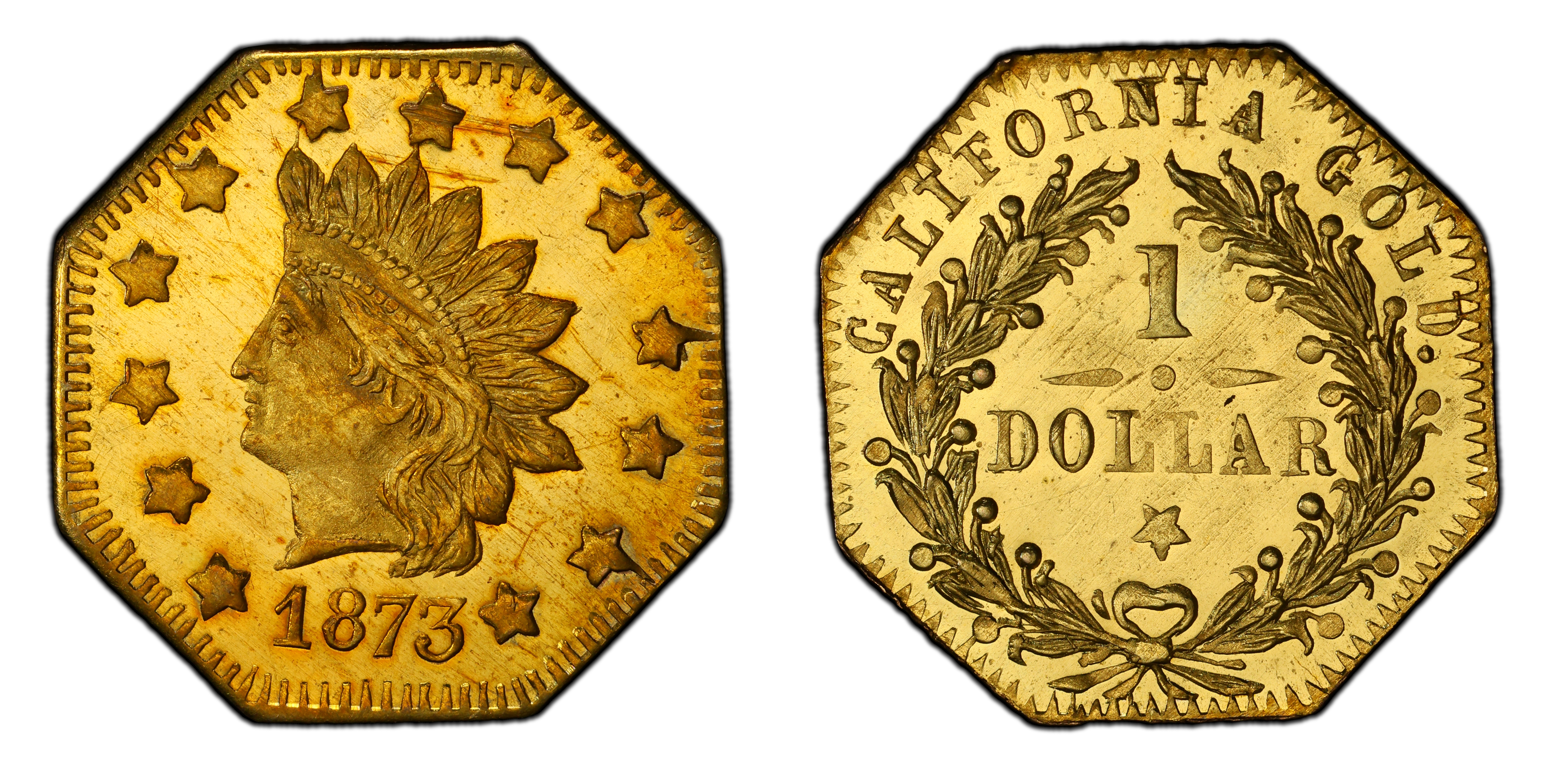
Obverse & Reverse
The 1873 Octagonal Indian Head Gold Dollar, cataloged as Breen-Gillio 1123, is a quintessential example of a 'Period Two' California Fractional Gold piece. These fascinating and diminutive coins emerged not from a government mint, but from the crucibles of private jewelers and metallurgists in San Francisco, long after the initial chaos of the Gold Rush had subsided. By 1873, the urgent need for small-denomination coinage that characterized the early 1850s had been largely met by the official output of the San Francisco Mint, which had been operational since 1854. The continued production of fractional gold pieces had therefore shifted from a necessity of commerce to a product catering to a different market: tourists, merchants needing novelty items, and citizens who retained a sentimental or practical affinity for gold in its most portable forms. These 'jeweler's issues' were often lighter and contained less gold than their stated face value, functioning more as tokens or souvenirs than as true circulating currency intended to be redeemed at par. The socio-economic climate of 1870s San Francisco was one of immense growth and transformation; the city was a bustling metropolis and a gateway to the West, attracting visitors from across the country and the world. These tiny gold coins served as perfect mementos of a visit to the Golden State. The BG-1123, with its popular Indian Head motif—a design romanticizing the American frontier—would have been particularly appealing. Struck with hand-cut dies and often by rudimentary screw or hammer presses, the quality of these pieces could vary, yet many, like the BG-1123, were produced with considerable care. The existence of Prooflike (PL) specimens indicates that some were struck using highly polished dies and planchets, intended from the start for collectors or for use in jewelry, where their flashiness would be a key attribute. The Coinage Act of 1864 had made private coinage illegal, but the law was not strictly enforced against these small tokens until the Secret Service cracked down in 1883, effectively ending their production. Today, the BG-1123 is a scarce and highly sought-after artifact from this unique chapter in American numismatic history, representing the transition of fractional gold from utilitarian currency to cherished keepsake.
Associated EventPost-Gold Rush California Commerce and Tourism
Reason For MintingPrimarily struck as souvenirs and novelty 'pocket pieces' for the tourist and jewelry trade rather than for general circulation.
Minter HistoryThe specific maker of BG-1123 is not definitively known, a common trait for many Period Two issues. These coins were produced by a number of San Francisco-based jewelers and artisans who capitalized on the public's fascination with gold. Unlike the 'Period One' minters who sometimes hallmarked their work, many later producers operated anonymously, creating a wide array of designs with Liberty, Washington, and Indian Head motifs to satisfy popular taste. These minters were skilled craftsmen but were not operating under any government charter, leading to significant variability in weight and fineness across different issues.
Historical SignificanceThe BG-1123 represents the final phase of privately issued gold coinage in the United States. Its existence demonstrates a lingering demand for gold in daily life and the entrepreneurial spirit of California's artisans, even after federal coinage became plentiful. It is a tangible link to the robust souvenir and jewelry trade of 19th-century San Francisco and the romanticism of the Gold Rush era.
BG-1123
DenominationG$1
Minting Period1873
Assayer/MinterUnknown San Francisco Jeweler
Geographic OriginSan Francisco, California
Obverse DescriptionAn Indian Head portrait facing left, wearing a feathered headdress. The portrait is surrounded by thirteen six-pointed stars. The date '1873' is positioned below the truncation of the neck.
Obverse Inscription1873
Reverse DescriptionThe denomination '1 DOLLAR' is inscribed within a wreath composed of two branches tied together at the bottom with a bow. The wreath is open at the top.
Reverse Inscription1 DOLLAR
CompositionGold
Stated Fineness Actual FinenessVariable, but typically lower than the .900 fineness of federal gold coins.
Weight0.50 grams
Diameter11.50 mm
EdgePlain
Unknown
Survival EstimateFewer than 75 known
Rarity ScaleR-6 (Very Rare)
This coin is highly prized for its octagonal shape, classic Indian Head design, and significant rarity. As a one-dollar denomination, it is larger and more substantial than the quarter and half-dollar fractionals, adding to its appeal. Examples with a Prooflike (PL) designation are particularly sought after for their exceptional eye appeal.
Key VarietiesThe primary variety is the regular strike as described. No major varieties from the original minting period are known or cataloged. Unlike some earlier territorial issues, there are no known patterns, trial pieces, or official later-date restrikes associated with BG-1123.
Authentication TipsGenuine BG-1123 specimens must have the denomination 'DOLLAR' on the reverse; pieces without a denomination or with phrases like 'CAL GOLD CHARM' are later tokens. The style of the engraving should be consistent with known genuine examples; fakes often have crude, poorly defined details or incorrect letter/number fonts. The surfaces of authentic pieces, particularly high-grade examples, may show fine die polishing lines or a slightly uneven strike, characteristic of the private manufacturing process. Modern counterfeits are often cast or have a soapy, unnatural luster. Any piece with a bear on the reverse is a modern token and not a genuine fractional gold coin.
Shopping ConsiderationsFor a premium quality example, seek a coin with a sharp strike, particularly on the details of the headdress feathers and the lettering on the reverse. Prooflike (PL) or Deep Mirror Prooflike (DMPL) examples command significant premiums and are defined by clear reflectivity in the fields. Given their rarity, even circulated examples are desirable, but buyers should look for problem-free surfaces without distracting marks, evidence of cleaning, or damage from being mounted in jewelry. Original, uncleaned surfaces with a hint of coppery-gold toning are highly desirable. Due to the prevalence of counterfeits, purchasing examples certified by major grading services like PCGS or NGC is strongly recommended.
A coin's grade is its condition, rated on a 1-70 scale. For rare coins, this is the most critical factor in determining value, as a tiny difference in preservation can mean a huge difference in price.
Relevant Grade TypesOriginal period issues of BG-1123 were business strikes, often produced with special care to enhance their appeal as souvenirs. They are found in Circulated grades (1-58) and, more commonly for this rare issue, in Mint State (MS, 60-70). The Proof (PR/PF) category is not applicable, as no true Proofs were struck during the original period. However, many examples were struck on polished planchets with polished dies, resulting in a mirrored finish. These are designated as Prooflike (PL) or Deep Mirror Prooflike (DMPL) by grading services, which are business strikes with special characteristics, not a separate type of minting.
Mint State CharacteristicsUncirculated examples are defined by their luster. A typical Mint State BG-1123 will exhibit either a soft, satiny luster or, if designated PL/DMPL, highly reflective, mirror-like fields. The strike can be inconsistent; some examples are sharply detailed, while others may show weakness on the high points of the Indian's cheek or the center of the wreath. Due to the softness of the gold and the manufacturing process, it is common to see minor planchet irregularities or handling marks, even on high-grade specimens.
Circulated Wear PatternsWear first appears on the highest points of the design. On the obverse, look for friction on the cheekbone and the feathers of the headdress. On the reverse, the highest points of the leaves and the bow in the wreath will show the first signs of abrasion. On lower-grade circulated examples, the stars and legends will begin to lose their sharpness and may appear to merge with the fields.
Key Factors For ValueThe primary value driver is the coin's grade and surface quality. An uncirculated, problem-free coin is worth many times more than a circulated one. A Prooflike (PL) or DMPL designation will add a significant premium. Eye appeal is critical; examples with clean, original surfaces and a sharp strike are highly coveted. Coins that have been harshly cleaned, polished, or removed from jewelry will trade at a substantial discount. A CAC sticker, indicating premium quality for the grade, is a significant value multiplier for this and other rare territorial issues.
PCGS Price Guide
| Grade | Price | Population |
|---|---|---|
| 63 | $3,000.00 | 1 |
| 63+ | $3,350.00 | N/A |
| 64 | $4,250.00 | 2 |
| 64+ | $4,750.00 | N/A |
| 65 | $5,500.00 | 1 |