1872 G50C BG-1048, PL (Regular Strike)
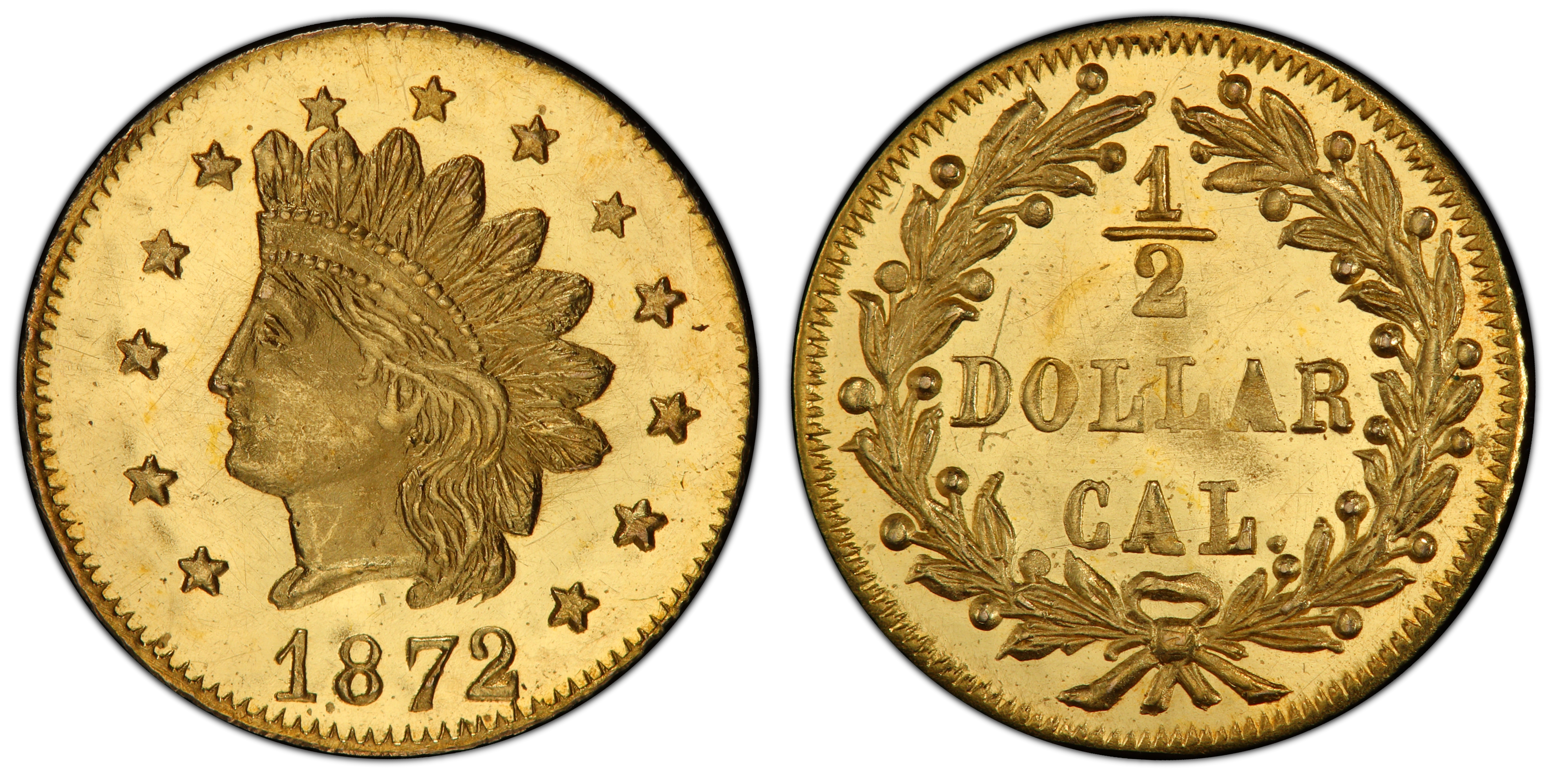
Obverse & Reverse
The BG-1048 is a quintessential example of a 'Period Two' California Fractional Gold piece, a fascinating and complex series born from the monetary chaos of the American West. Following the initial California Gold Rush, the United States Mint in San Francisco, established in 1854, began to address the severe shortage of circulating small change. The earliest fractional gold coins, struck from 1852 to 1856 ('Period One'), were often crudely made but contained gold value close to their stated denominations and genuinely served a vital commercial purpose. However, the pieces struck after the Civil War, from roughly 1859 to 1882, represent a different phenomenon. By the 1870s, the acute need for small denomination coinage had been met by federal issues. The motivation for producing pieces like the 1872 BG-1048 had shifted. These were no longer primarily instruments of commerce but were instead produced by jewelers and private minters largely as souvenirs, keepsakes, and curiosities for tourists and collectors. Their gold content was substantially less than their face value, making them profitable tokens. Herman J. Brand, a San Francisco jeweler and die sinker to whom this variety is attributed, was a prolific producer during this era. He, like others, navigated a legal gray area; the private minting of coins was made illegal by the Coinage Act of April 22, 1864, but the law was not strictly enforced against these small, token-like pieces until 1883. To circumvent the law, many Period Two producers backdated their coins to the 1850s, but the 1872 date on this piece is contemporary to its manufacture. These 'jeweler's issues' are characterized by more refined designs and production quality than their Period One predecessors, yet they are numismatically significant as tangible links to the enduring legacy of the Gold Rush and the unique economic environment of 19th-century California.
Associated EventPost-Gold Rush Economic Development & Tourism
Reason For MintingPrimarily created as a souvenir and collectible item for the tourist trade, rather than to fill a circulating coinage need.
Minter HistoryHerman J. Brand was a prominent San Francisco die sinker and jeweler active in the latter half of the 19th century. He is credited with producing a significant number of different California Fractional Gold varieties during the second period of issue (1859-1882). Unlike the earlier assayers who were focused on converting raw gold dust into usable currency, Brand and his contemporaries were entrepreneurs catering to a market for novelties and mementos of the Gold Rush era. His work is generally of a higher artistic and technical quality than the more primitive Period One issues, reflecting his skill as a jeweler and the souvenir-focused purpose of the coins.
Historical SignificanceThe BG-1048 represents the evolution of California Fractional Gold from a necessary form of local currency to a popular collectible and souvenir. It is a physical artifact of the commercialization of the Gold Rush legacy in late 19th-century San Francisco, demonstrating how private minters adapted to changing economic conditions and legal pressures. Its existence highlights a numismatic gray market that thrived for decades after the federal government asserted its sole authority to coin money.
N/A
DenominationG50C (Gold 50 Cents)
Minting Period1872
Assayer/MinterHerman J. Brand (Attributed)
Geographic OriginSan Francisco, California
Obverse DescriptionA large bust of a Native American (Indian Head) faces left. The portrait is adorned with a feathered headdress. The field is encircled by thirteen six-pointed stars, representing the original colonies.
Obverse Inscription(No lettering)
Reverse DescriptionThe denomination '1/2' is centered within a wreath composed of two olive branches tied together with a bow at the bottom. The date '1872' is located below the bow.
Reverse Inscription1/2 1872
CompositionGold
Stated Fineness Actual FinenessVaries, but typically lower than official U.S. coinage of the era.
Weight0.24 grams
Diameter10.10 mm
EdgePlain
Unknown
Survival Estimate75-125
Rarity ScaleR-4 (Per Breen-Gillio)
This variety appeals to collectors for its classic Indian Head design, specific Breen-Gillio attribution, and its status as a representative of the popular 'jeweler's issue' souvenir coinage from Period Two. The 'PL' (Prooflike) designation adds significant appeal, highlighting its sharp strike and reflective surfaces, which are uncommon for the series.
Key VarietiesThe BG-1048 is itself a specific die marriage. While there are no major varieties of BG-1048, the broader 1872 50C series includes numerous other BG numbers with different design elements, such as smaller heads or different wreath styles. No special collector issues like restrikes are known for this specific variety; its primary distinction lies in its original business strike quality, with some examples exhibiting Prooflike surfaces from freshly polished dies.
Authentication TipsGenuine BG-1048 examples have specific die characteristics. Look for a strong, well-defined strike, especially on the feathers and the details of the wreath. Counterfeits and modern replicas often have a mushy or cast appearance, incorrect weight, and a brassy color. A key diagnostic for some BG-1048s is that the sixth star (counting clockwise from the bottom left) is very close to or touches the second feather of the headdress. Familiarity with the photos in the Breen-Gillio reference guide is essential for authentication. Any piece with a bear on the reverse is a modern token, not an authentic fractional.
Shopping ConsiderationsFor a premium quality example, seek a coin with a sharp, full strike, particularly on the highest points of the Indian's cheek and the bow on the reverse. Original, undisturbed luster is paramount; many of these small gold pieces have been cleaned or used in jewelry. A specimen with warm, reddish-gold or greenish-gold toning is highly desirable. The 'PL' or 'DMPL' designations from grading services like PCGS or NGC command a significant premium. Avoid examples with scratches, rim bumps, or evidence of having been mounted in jewelry, as these issues dramatically reduce value.
A coin's grade is its condition, rated on a 1-70 scale. For rare coins, this is the most critical factor in determining value, as a tiny difference in preservation can mean a huge difference in price.
Relevant Grade TypesOriginal period issues of BG-1048 were all business strikes intended for sale as souvenirs, not for widespread circulation. They are found in Circulated (1-58) grades, though this is less common, and more frequently in Mint State (MS, 60-70) grades. No true Proofs were struck during the original period of issue. However, due to the use of polished dies, some business strikes exhibit mirrored surfaces and are designated as Prooflike (PL) by grading services, a highly desirable and distinct characteristic.
Mint State CharacteristicsAn uncirculated BG-1048 will exhibit frosty, satiny luster. High-quality examples (MS-63 and above) are well-struck with sharp details on the headdress feathers and wreath leaves. Due to the small size and minting process, perfect centering can be an issue; well-centered examples command a premium. Small planchet flaws or die polish lines are common and not necessarily detrimental unless they are distracting. The most coveted examples have deeply reflective, PL surfaces, which result from being among the first coins struck from freshly prepared dies.
Circulated Wear PatternsAlthough not heavily circulated, wear first appears on the high points of the design. On the obverse, friction will dull the luster on the cheekbone and the feathers of the headdress. On the reverse, the highest points of the bow and the numbers of the fraction '1/2' will show the first signs of flattening. In lower grades (VF and below), the stars and wreath details will begin to merge with the fields.
Key Factors For ValueThe primary value drivers for this coin are grade and surface quality. A high Mint State grade (e.g., MS-64 vs. MS-62) causes a substantial price jump. The presence of a Prooflike (PL) designation adds a significant premium. Eye appeal is crucial; a coin with original, attractive coloration and clean surfaces will always be more valuable than a similarly graded but dull or spotted example. Finally, certification by a top-tier service (PCGS or NGC) is standard, and a CAC sticker, verifying premium quality for the grade, will further enhance its market value.
PCGS Price Guide
| Grade | Price | Population |
|---|---|---|
| 64 | $1,050.00 | 1 |
| 65 | N/A | N/A |
| 67 | N/A | N/A |