1852 G25C BG-799DD, PL (Regular Strike)
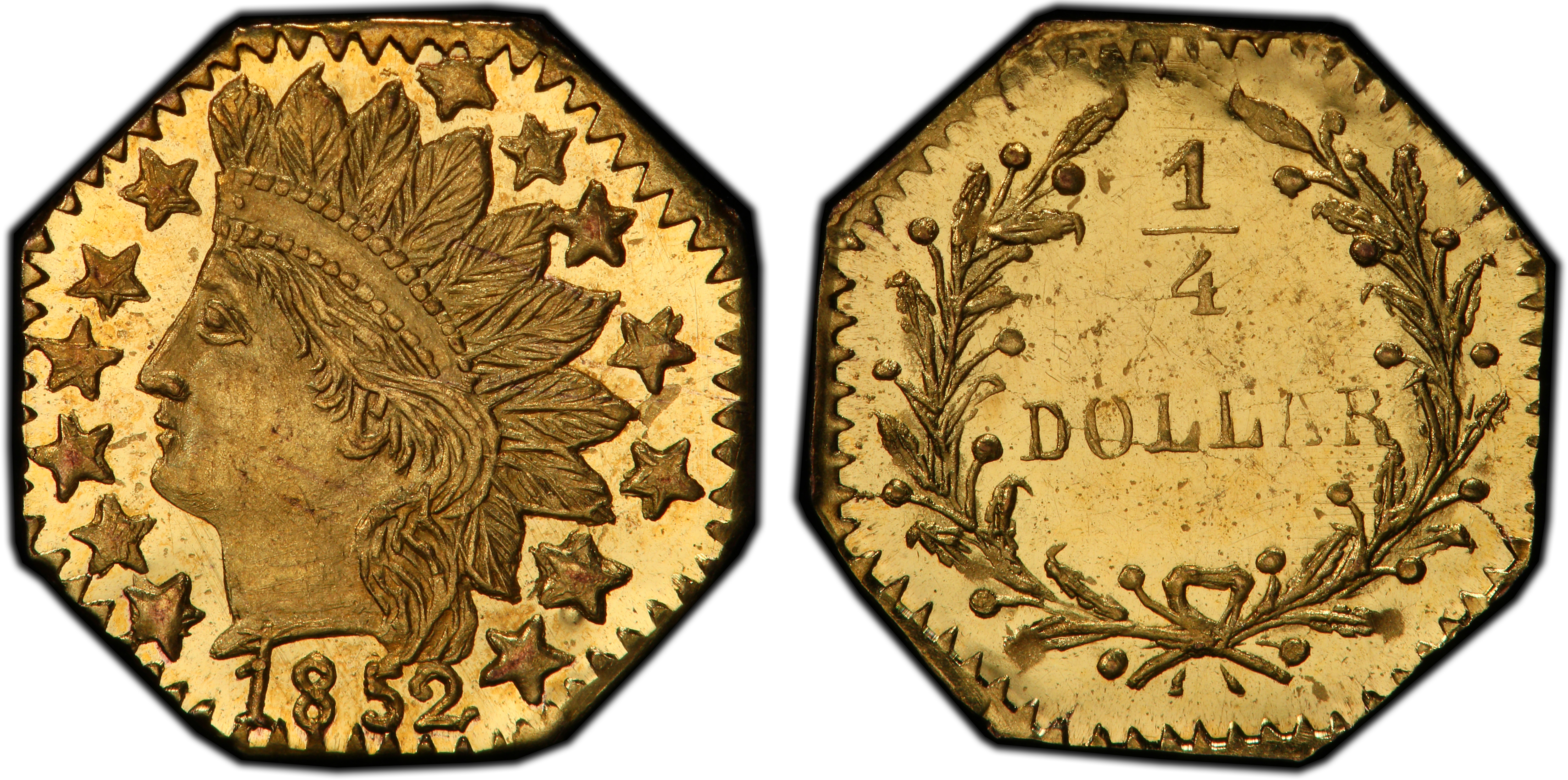
Obverse & Reverse
The 1852 'G' 25 Cents, cataloged as BG-799DD, represents a fascinating and somewhat enigmatic entry in the extensive series of California Fractional Gold. These small-denomination gold pieces were born of necessity from the chaos and economic boom of the California Gold Rush. Following the discovery of gold in 1848, a massive influx of prospectors and merchants created a vibrant economy, but one severely hampered by a chronic shortage of circulating small change. Gold dust, weighed imprecisely and subject to dispute, was an inefficient medium for daily transactions. To fill this void, private jewelers and metallurgists in San Francisco began striking their own coins in 25-cent, 50-cent, and one-dollar denominations starting in 1852. These pieces, tiny by any standard, facilitated commerce for several years. The BG-799DD presents a numismatic puzzle. The date '1852' places it in what collectors define as 'Period One' (1852-1857), a time when these fractionals were believed to have been genuinely intended for circulation and were often made to a higher intrinsic value than later issues. However, the 'G' mintmark is almost universally attributed to Robert B. Gray & Co., a San Francisco jeweler who reportedly purchased the business of another fractional minter, Antoine Nouizillet, around 1859-1860. Gray's own marked issues are characteristic of 'Period Two' (1859-1882), when production shifted towards creating souvenirs and jewelry charms for the burgeoning tourist trade, often with lower gold content and more fanciful designs. The existence of an 1852-dated coin with Gray's later mark is anomalous. It may represent a later 'backdated' mule striking, where a Period Two obverse die was paired with a leftover or newly created dated reverse die to circumvent the Coinage Act of 1864 which prohibited private coinage. This was a common practice among later jewelers. Alternatively, it could suggest a much earlier, unrecorded involvement of Gray in the fractional gold trade. Regardless, the BG-799DD is a product of the unique economic conditions of Gold Rush California, where private enterprise stepped in to fulfill a basic function the federal government had not yet managed to address on the remote West Coast.
Associated EventCalifornia Gold Rush
Reason For MintingTo alleviate a severe shortage of small-denomination coinage for everyday commerce in Gold Rush-era California.
Minter HistoryRobert B. Gray & Co. was a prominent San Francisco jewelry firm active in the mid-19th century. Numismatic scholarship indicates Gray entered the fractional gold business around 1859 by acquiring the equipment and dies of Antoine Nouizillet, one of the prolific Period One minters. Gray continued to use some of Nouizillet's dies before creating his own, which were typically marked with a 'G'. His issues are primarily associated with the 'Period Two' or 'Jewelers' Issues' era (1859-1882), when the coins were made more as souvenirs than for circulation. His pieces are noted for a wide variety of designs, including the distinctive 'Necklace Bust' of Liberty.
Historical SignificanceThis coin is significant as a tangible artifact of the private minting efforts that sustained California's economy during its formative Gold Rush years. The BG-799DD variety, specifically, highlights the complex and sometimes poorly documented transition between the circulation-focused 'Period One' and the souvenir-driven 'Period Two' of fractional gold production, embodying a key numismatic mystery regarding its date and minter attribution.
BG-799DD
Denomination25 Cents
Minting Period1852 (Dated)
Assayer/MinterRobert B. Gray & Co. (presumed)
Geographic OriginSan Francisco, California
Obverse DescriptionAn Indian Head, facing left, with a feathered headdress. The portrait is somewhat crudely engraved, typical of many jewelers' issues. Thirteen stars encircle the portrait along the octagonal border. The date '1852' is below the bust.
Obverse Inscription1852
Reverse DescriptionA simple wreath of two olive branches, tied at the bottom with a bow. Within the wreath is the denomination '25 CENTS'. The legend 'CALIFORNIA GOLD' is inscribed outside the wreath, following the upper octagonal border.
Reverse InscriptionCALIFORNIA GOLD 25 CENTS
CompositionGold
Stated Fineness Actual FinenessVaries, typically 14 to 22 karats for the period, often lower than face value.
EdgePlain
Unknown
Survival EstimateFewer than 15 known
Rarity ScaleR-7 (High)
The BG-799DD is highly sought after due to its extreme rarity and the intriguing historical anomaly of its 1852 date combined with a presumed Period Two minter's design. Its octagonal shape and Indian Head motif are classic elements of the series, and the Prooflike designation adds significant visual appeal and desirability.
Key VarietiesThe primary variety is the BG-799DD die marriage itself. Other BG-799 varieties exist with different letters (e.g., 799R, 799U, 799V) and different dates, each representing a distinct die pairing. No special collector restrikes are known for this specific variety; the originals were business strikes, though many were preserved in high grade as they were sold as souvenirs.
Authentication TipsAuthentic pieces must have a denomination (e.g., '25 CENTS'). Replicas often have a bear on the reverse and lack a denomination. Genuine fractional gold coins are typically very thin. The strike may be uneven or weak in spots due to the crude 'hammer' method of minting, a characteristic often missing on modern fakes. The engraving style should be consistent with known Breen-Gillio exemplars. Referencing high-quality images from major auction archives is essential for die characteristic comparison.
Shopping ConsiderationsA premium quality example of BG-799DD would be one with a sharp strike, particularly on the fine details of the headdress and the wreath. For a PL (Prooflike) designated coin, look for deeply mirrored, reflective fields that contrast with frosted devices. The surfaces should be clean and free of significant, distracting contact marks, which is rare for these small, easily damaged coins. Avoid examples that have been cleaned, tooled, or mounted in jewelry, as this drastically reduces value. Original, undisturbed surfaces with a pleasing reddish-gold luster are paramount.
A coin's grade is its condition, rated on a 1-70 scale. For rare coins, this is the most critical factor in determining value, as a tiny difference in preservation can mean a huge difference in price.
Relevant Grade TypesOriginal issues were business strikes, intended for commerce or sale as souvenirs, and are found in Circulated (1-58) and Mint State (MS, 60-70) grades. Due to their status as collectibles from the time of issue, many survive in high grades. No true Proofs were struck during the original period. However, some dies were highly polished, resulting in coins with mirror-like surfaces. When these characteristics are exceptional, grading services designate them as Prooflike (PL) or Deep Mirror Prooflike (DMPL), which are business strikes with special surface qualities, not a different method of manufacture.
Mint State CharacteristicsUncirculated examples of BG-799DD are characterized by their luster and strike. The luster can range from satiny to deeply prooflike. Due to the primitive minting process, the strike is often uneven, with some areas being fully struck while others show softness. Weakness is common on the high points of the Indian's cheek and the bow on the reverse wreath. Contact marks, even small ones, are common and significantly impact the grade. A truly premium MS coin will have minimal marks and strong underlying luster.
Circulated Wear PatternsWear first appears on the highest points: the cheek and feathers of the Indian Head, and the leaves and bow of the reverse wreath. On lower-grade examples, the fine details of the feathers will merge, and the legend and date will show significant flattening. Because they were so small, they were easily lost and did not typically circulate extensively, so heavily worn examples are less common than uncirculated ones.
Key Factors For ValueFor the BG-799DD, rarity is the primary value driver. Beyond that, the grade and surface characteristics are critical. A Prooflike (PL) designation commands a significant premium over a standard Mint State example. Eye appeal is paramount; a coin with clean, original surfaces and a sharp strike will be worth multiples of a weakly struck or heavily marked coin of the same numerical grade. Given the questions about its origin, any specimen with a clear provenance or pedigree would also command a premium.
PCGS Price Guide
| Grade | Price | Population |
|---|---|---|
| 66 | $4,500.00 | 1 |