1874/3 G50C BG-945, PL (Regular Strike)
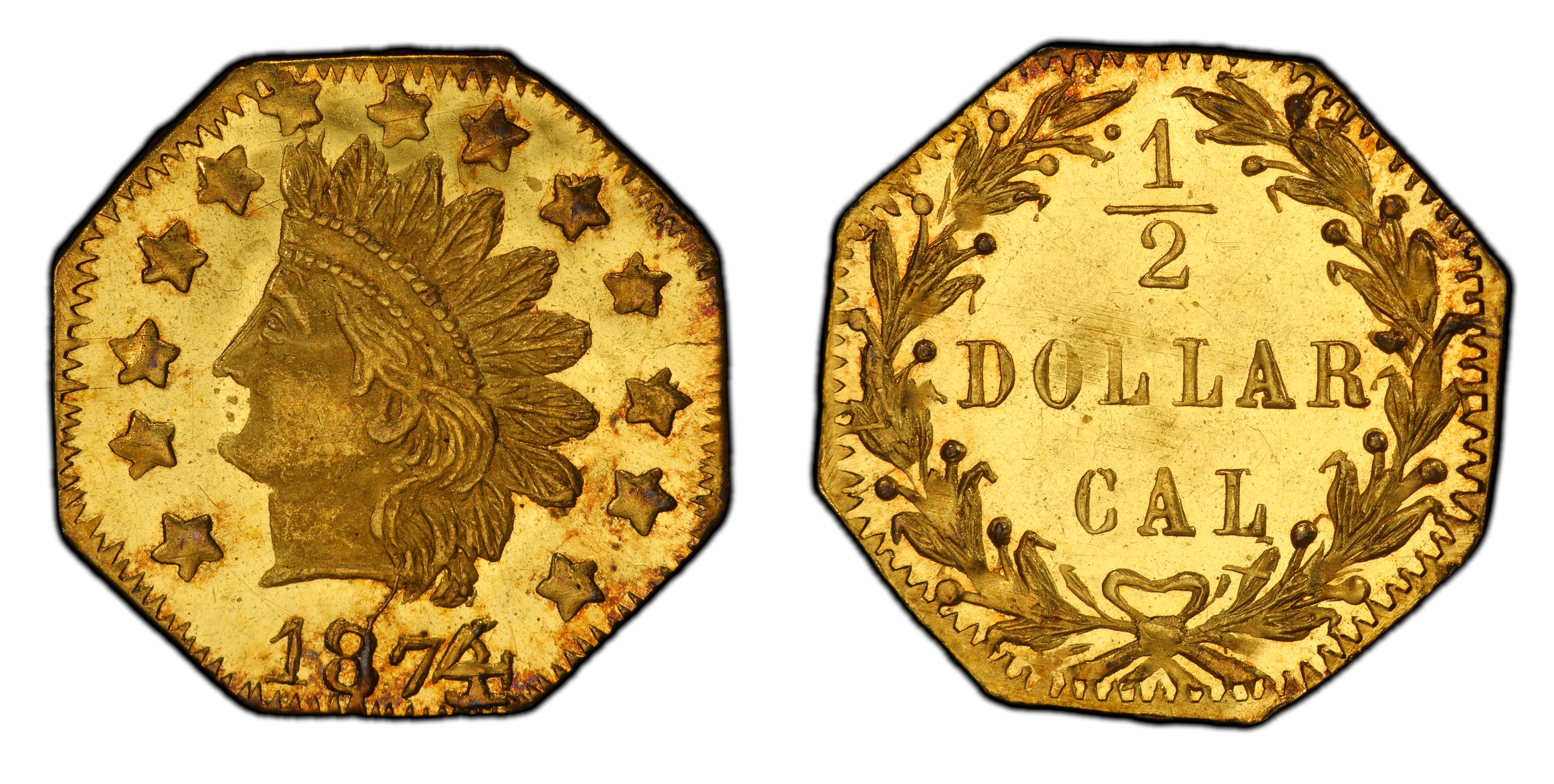
Obverse & Reverse
The 1874/3 BG-945 50 Cents is a fascinating artifact from the second period of California's private gold coining era. Unlike the 'Period One' issues (1852-1857), which were struck out of genuine necessity to alleviate a severe shortage of small change during the initial Gold Rush boom, the 'Period Two' pieces (1858-1882) were created in a different economic climate. By the 1870s, the United States Mint in San Francisco was in full operation, and federally issued coins had largely satisfied the region's transactional needs. The impetus for producing these later fractional pieces, including the BG-945, had shifted from utility to novelty. San Francisco jewelers and private minters, whose identities are often lost to history, manufactured these miniature gold coins primarily as souvenirs and keepsakes. They capitalized on the romantic allure of the Gold Rush, selling these tiny octagonal and round pieces to tourists, locals, and merchants who desired a tangible memento of California's golden identity. The Coinage Act of 1864 had explicitly outlawed private coinage, but enforcement by the Secret Service was lax until the early 1880s. This legal gray area allowed for a thriving cottage industry. The BG-945, with its clear 1874/3 overdate, demonstrates the ad-hoc nature of this production; dies were re-purposed and used until they failed, a common cost-saving measure for these small-scale operations. These pieces were not intended for widespread circulation but undoubtedly saw some limited local use, treated more as valuable tokens than official currency. Their low intrinsic value and tiny size made them impractical for daily commerce but perfect as an affordable piece of real gold. Today, the BG-945 is a prized collectible, representing the final chapter of America's private gold coinage and serving as a direct link to the enduring legacy of the California Gold Rush.
Associated EventPost-Gold Rush California Commerce
Reason For MintingPrimarily struck as a souvenir or keepsake of the California Gold Rush era for sale to tourists and collectors, rather than for circulatory purposes.
Minter HistoryThe specific minter or jeweler who produced the BG-945 die pair is unknown, a common trait for many Period Two California fractional gold issues. These operations were typically small, often run by jewelers in the San Francisco area who engraved their own dies and struck coins on an as-needed basis. Their work was clandestine due to the 1864 law prohibiting private coinage, leading them to avoid placing identifying initials or names on their products. Research by numismatists like Robert D. Leonard Jr. has shed light on some makers of this period, but many, including the producer of this variety, remain anonymous.
Historical SignificanceThe BG-945 is significant as a representative of 'Period Two' fractional gold, illustrating the transition of these pieces from essential currency substitutes to commercial souvenirs. It highlights a prolonged period of lax federal oversight on private minting and the enduring romanticism of the Gold Rush that created a market for such items long after their practical need had vanished. The overdate and die cracks offer physical evidence of the pragmatic and often crude manufacturing techniques of these private jewelers.
Not Applicable, Breen-Gillio is the standard.
Denomination50 Cents
Minting Period1874
Assayer/MinterUnknown private minter
Geographic OriginSan Francisco, California
Obverse DescriptionAn Indian Head motif facing left, wearing a feathered headdress. The portrait is encircled by thirteen six-pointed stars. The date, 1874, is positioned below the bust, with the 4 clearly struck over a 3.
Obverse Inscription1874/3
Reverse DescriptionThe denomination '1/2' appears in the center, surrounded by a wreath of two olive branches tied with a ribbon at the bottom. The legend 'CALIFORNIA GOLD' is inscribed in an arc above the wreath.
Reverse InscriptionCALIFORNIA GOLD 1/2
CompositionGold
Stated Fineness Actual FinenessTypically varied between .500 and .900 for Period Two issues, but the specific fineness for BG-945 is not documented.
EdgePlain
Unknown
Survival Estimate76-200 (based on R-4+ rating)
Rarity ScaleR-4+
This variety is highly sought after due to its status as a clear 1874/3 overdate, its distinctive octagonal shape, and its high R-4+ rarity. It appeals to specialists in California gold, overdate collectors, and those fascinated by the souvenir coinage of the Old West. The presence of known die cracks allows for precise attribution and die state analysis.
Key VarietiesThe primary variety is the 1874/3 overdate itself. A significant diagnostic marker for this variety is a die crack that runs from the rim, through the 8 in the date, and up to the bust of the Indian Head. A heavy radial die break has also been noted on at least one high-grade specimen from the Sunrise Collection. No later-date restrikes or special collector issues are known to exist for the BG-945 variety.
Authentication TipsGenuine BG-945 examples must exhibit the correct 1874/3 overdate style and precise die markers, particularly the die crack through the '8'. Weight and size should be consistent with other Period Two 50C pieces. The strike is often somewhat soft, especially on the reverse wreath, a characteristic of genuine pieces. Counterfeits are common in the series; they often have a soapy, cast-like appearance, incorrect weight, or may feature a bear on the reverse, which is a definitive sign of a replica. Authentication by a major grading service is highly recommended.
Shopping ConsiderationsA premium quality BG-945 will show a bold, clear overdate and strong definition in the headdress feathers and central wreath details, although some softness is typical for the issue. Seek examples with clean, original surfaces exhibiting prooflike (PL) or deep mirror prooflike (DMPL) fields, which are sometimes encountered and command a significant premium. Luster should be vibrant and unbroken in the protected areas. Avoid examples with harsh cleanings, scratches, or evidence of having been mounted in jewelry. The presence of the known die crack through the date is a required diagnostic, not a flaw, but its severity may affect eye appeal for some collectors.
A coin's grade is its condition, rated on a 1-70 scale. For rare coins, this is the most critical factor in determining value, as a tiny difference in preservation can mean a huge difference in price.
Relevant Grade TypesOriginal BG-945 specimens were business strikes, but as they were intended as souvenirs, many were preserved in high grades. They are found in both Circulated (1-58) and, more commonly, Mint State (MS, 60-70) grades. No true Proofs were struck during the original period of issue. However, many Period Two fractionals were struck on polished planchets to enhance their appeal as novelties, resulting in coins with Prooflike (PL) or Deep Mirror Prooflike (DMPL) surfaces, which are designated by grading services and are highly desirable.
Mint State CharacteristicsUncirculated examples often exhibit a soft, satiny luster, sometimes with deep reflectivity in the fields. The strike is characteristically weak in the center of the reverse wreath. Contact marks are common due to the softness of the gold and the production methods, but a premium MS coin will have minimal and well-hidden marks. The 1874/3 overdate should be sharp and distinct. The die crack through the date is a consistent feature, not a post-minting flaw.
Circulated Wear PatternsWear first appears on the high points of the design. On the obverse, check the cheekbone of the Indian Head and the tips of the headdress feathers. On the reverse, the highest points of the wreath's leaves and the numerals of the '1/2' fraction will show the first signs of friction and flattening. In lower grades (VF and below), the stars on the obverse will begin to lose their points and the finer details of the wreath will merge.
Key Factors For ValueFor the BG-945, value is driven by several key factors. The grade is paramount, with a sharp jump in price for each point in Mint State. The surface designation is critical; a PL or DMPL coin will command a substantial premium over a standard MS example of the same grade. Surface quality is vital: coins with original, undisturbed luster and minimal distracting marks are prized. Eye appeal, including attractive original gold toning and a sharp strike on the portrait, significantly enhances value. The clarity of the 1874/3 overdate is also a factor, with bolder examples being more desirable. A CAC sticker will add a further premium, confirming the quality for the assigned grade.
PCGS Price Guide
| Grade | Price | Population |
|---|---|---|
| 62 | N/A | N/A |
| 64 | N/A | N/A |
| 65 | $2,250.00 | 1 |