1871 G50C BG-1045 (Regular Strike)
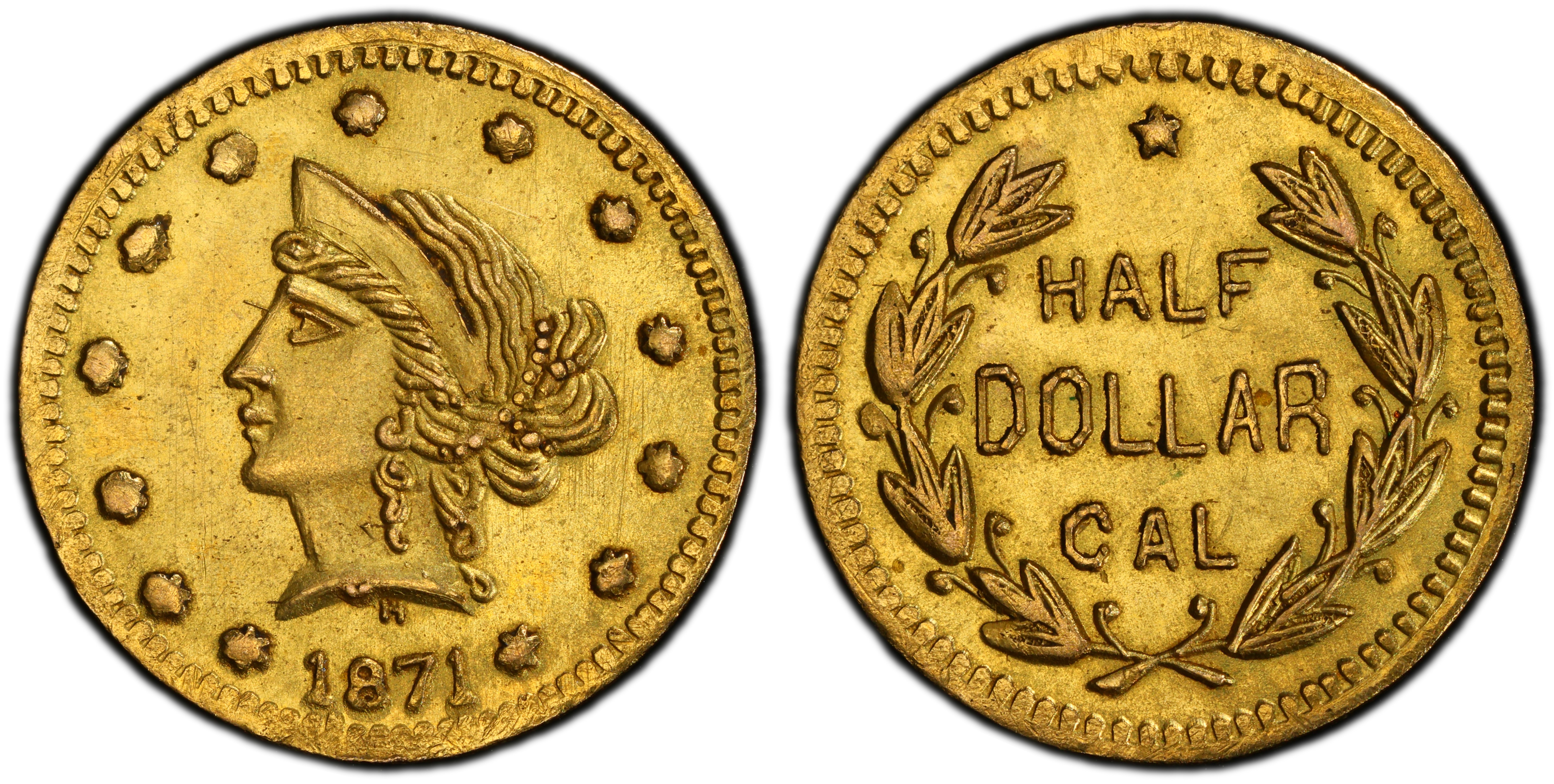
Obverse & Reverse
The 1871 BG-1045 half dollar is a fascinating and anomalous issue within the broader series of California Fractional Gold. While born of the tradition that began during the California Gold Rush, this piece hails not from the gold fields or San Francisco, but from the bustling frontier town of Leavenworth, Kansas. Its story is that of its makers, Reuben N. Hershfield and Noah Mitchell, whose thriving jewelry business tapped into the national romance with the Gold Rush. These pieces belong to 'Period Two' (1858-1882) of fractional gold, a time when the acute need for circulating small change in California had largely subsided with the establishment of the San Francisco Mint. The motivation for producing these later issues shifted from necessity to novelty. They were primarily manufactured as souvenirs, keepsakes, and items for jewelry, often sold to travelers or distributed by salesmen across the West. The fact that a firm in Kansas was minting 'California' gold speaks to the widespread cultural significance of the Gold Rush; the 'California Gold' inscription was a powerful marketing tool, evoking images of adventure and wealth. Unlike the earlier, functional 'Period One' issues, these pieces were intentionally underweight, containing far less than fifty cents worth of gold. This practice drew the attention of the U.S. Secret Service, which investigated private minters for violating the Coinage Act of 1864. Hershfield & Mitchell's operation was significant enough to warrant such scrutiny, and government actions against them and other jewelers in 1871 likely curtailed production, contributing to the rarity of surviving specimens. The BG-1045 is thus not a relic of the forty-niners' commercial struggles but a sophisticated product of a later, more settled frontier, reflecting a commercial pivot from utilitarian coinage to nostalgic memorabilia.
Associated EventPost-Civil War Western Expansion
Reason For MintingPrimarily created as a commercial souvenir and jewelry item capitalizing on the fame of the California Gold Rush.
Minter HistoryReuben N. Hershfield and Noah Mitchell operated a highly successful and large-scale jewelry manufacturing and sales business at 54 Delaware Street in Leavenworth, Kansas, from approximately 1862 to 1875. Hershfield, a Russian immigrant, was a prominent civic figure, involved in founding the local synagogue and serving on the first Board of Regents for the University of Kansas. Their firm grew to employ 30-40 artisans and several traveling salesmen covering a wide territory including Kansas, Missouri, Colorado, and beyond. Their production of 'California Fractional Gold' was a sideline to their main jewelry business, intended as popular and affordable gold novelties. The small 'H' initial found under the bust on BG-1045 is the mark of their firm. Their activities ceased after government intervention against private coiners in the early 1870s.
Historical SignificanceThe BG-1045 is significant for demonstrating the commercialization of the Gold Rush legend far beyond California's borders. It represents the transition of fractional gold from quasi-currency to pure souvenir and serves as a tangible link to the broader economic development of the American West, where a Kansas jewelry firm could successfully market a product intrinsically tied to California's identity.
BG-1045
Denomination50 Cents
Minting Period1871
Assayer/MinterHershfield & Mitchell
Geographic OriginLeavenworth, Kansas
Obverse DescriptionA classic Liberty Head motif facing left, reminiscent of contemporary federal gold coinage. The hair is tied in a bun at the back. Thirteen six-pointed stars encircle the portrait. The date '1871' is below the bust. A very small initial 'H' for Hershfield is visible just below the truncation of the neck.
Obverse Inscription1871
Reverse DescriptionA wreath composed of two branches tied with a bow at the bottom. The denomination '50 CENTS' is inscribed within the wreath. The legend 'CALIFORNIA GOLD' appears between the wreath and the upper border, separated by a single star at the top.
Reverse InscriptionCALIFORNIA GOLD / 50 CENTS
CompositionGold
Stated Fineness Actual FinenessVariable, but known to be significantly less than federal coinage of the era.
Weight0.50 grams
Diameter11.80 mm
EdgePlain
Unknown
Survival Estimate31-75 (R-5). As of late 2023, PCGS and NGC combined have certified approximately 50 examples in all grades.
Rarity ScaleR-5
This variety is highly sought after for its specific and unusual origin in Leavenworth, Kansas, making it a key piece for specialists. Its connection to the well-documented Hershfield & Mitchell firm, confirmed rarity (R-5), and typically sharp, attractive appearance make it a prized item for advanced collectors of fractional gold.
Key VarietiesThe regular business strike is the only variety known for BG-1045. No proof strikings or later restrikes from the original dies have been recorded.
Authentication TipsAuthentic examples are identified by the tiny 'H' below the bust, a key diagnostic. The strike quality is generally sharp. Counterfeits of the broader Cal Gold series are rampant; many fakes are gold-plated brass and may have incorrect details, a soapy feel, or a different design style. A key giveaway on many fake fractionals is the image of a bear on the reverse, a design never used on genuine 19th-century issues. All genuine Period Two issues must be denominated (e.g., 'CENTS' or 'DOLLAR').
Shopping ConsiderationsA premium quality example for its grade will exhibit a sharp, well-defined strike, particularly on the stars, Liberty's hair details, and the wreath leaves. Many surviving examples are in high grades (MS62-MS64) and often display attractive prooflike or semi-prooflike surfaces. Look for original, uncleaned surfaces with a pleasing reddish or 'chestnut-gold' toning. Avoid examples that have been harshly cleaned, show scratches, or have been used in jewelry, evidenced by solder marks or excessive rim damage. Given the high population of Mint State survivors, a circulated example would be unusual and should be priced significantly lower.
A coin's grade is its condition, rated on a 1-70 scale. For rare coins, this is the most critical factor in determining value, as a tiny difference in preservation can mean a huge difference in price.
Relevant Grade TypesOriginal period issues of BG-1045 were business strikes. As they were sold primarily as souvenirs rather than for circulation, they are most commonly found in Mint State (MS, 60-70) grades, though some circulated examples (AU, 50-58) exist. No proofs were struck during the original period of issue, and no later-date restrikes are known to exist.
Mint State CharacteristicsUncirculated examples are characterized by their luster, which is often semi-prooflike to prooflike, giving the fields a mirrored appearance. The strike is typically sharp and well-executed for the series, superior to many cruder California-made pieces. Due to the small size and handling over time, even high-grade specimens may show tiny contact marks or faint hairlines, but these should not be distracting. The overall eye appeal is defined by the combination of sharp strike, clean surfaces, and original color.
Circulated Wear PatternsWear first appears on the highest points of the design. On the obverse, this includes Liberty's cheekbone, the hair above her eye, and the highest points of the coronet. On the reverse, the leaves at the top of the wreath and the ribbon bow will show initial flatness and loss of detail. On lower-grade examples, the legends will begin to soften and merge with the fields.
Key Factors For ValueFor the BG-1045, value is driven by grade and surface quality. A sharp strike is expected, so a weakly struck piece would be less desirable. The degree of proof-likeness (PL) significantly enhances eye appeal and value. Original, uncleaned surfaces with attractive toning command strong premiums. Coins certified by PCGS or NGC are the market standard. A CAC sticker, indicating premium quality for the grade, adds a further significant premium, as it confirms superior eye appeal and originality.
PCGS Price Guide
| Grade | Price | Population |
|---|---|---|
| 45 | N/A | 1 |
| 50 | $240.00 | 2 |
| 50+ | $250.00 | N/A |
| 53 | $275.00 | N/A |
| 53+ | $285.00 | N/A |
| 55 | $300.00 | 3 |
| 55+ | $315.00 | N/A |
| 58 | $325.00 | 7 |
| 58+ | $335.00 | N/A |
| 60 | $385.00 | N/A |
| 61 | $450.00 | 7 |
| 62 | $525.00 | 13 |
| 62+ | $600.00 | N/A |
| 63 | $900.00 | 14 |
| 63+ | $975.00 | N/A |
| 64 | $1,100.00 | 2 |
| 64+ | $1,250.00 | N/A |
| 65 | $1,500.00 | 2 |
| 65+ | $1,750.00 | N/A |
| 66 | $2,250.00 | 1 |