1870 G50C BG-920 (Regular Strike)
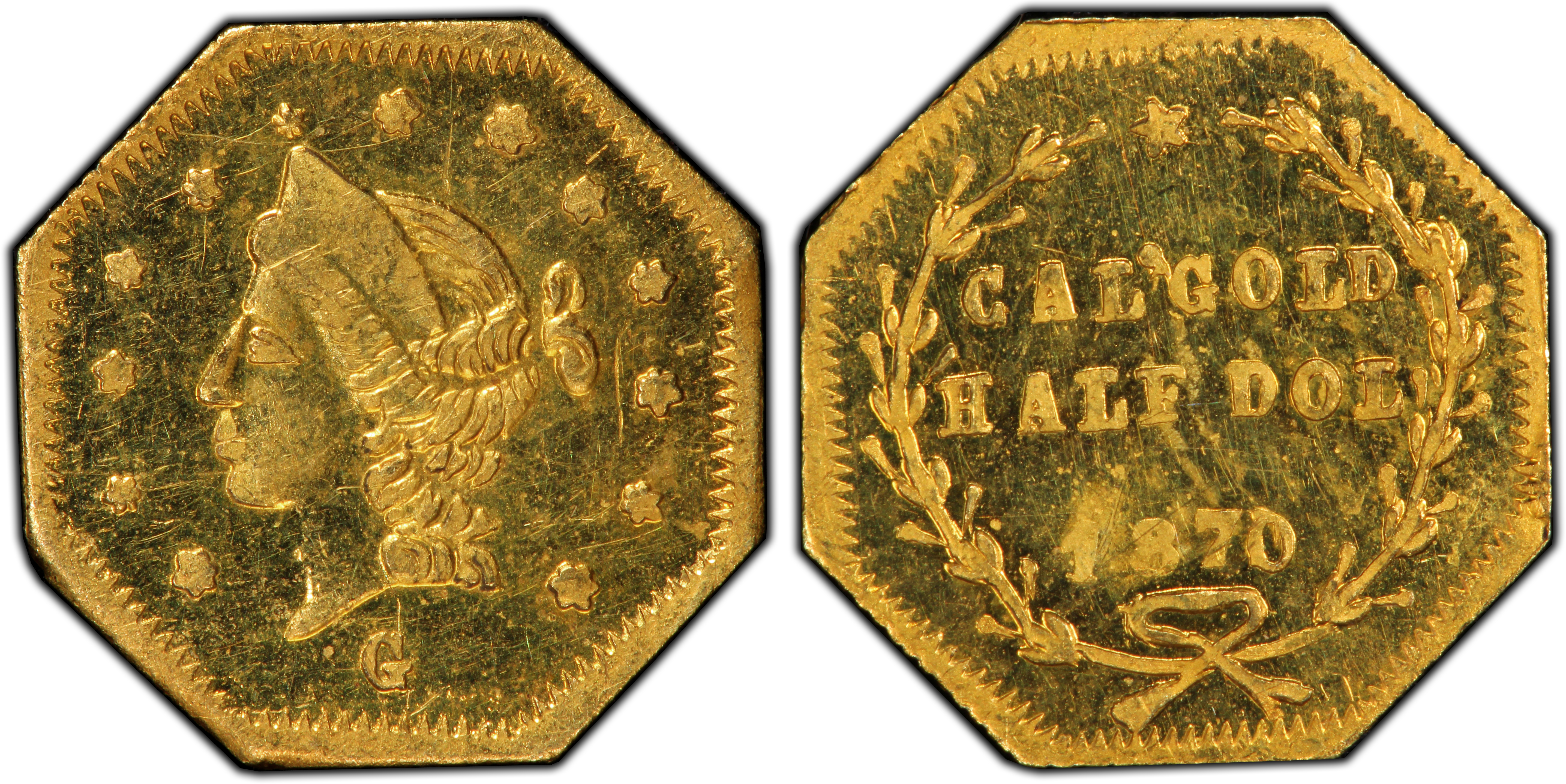
Obverse & Reverse
The 1870 octagonal 50-cent piece, cataloged as Breen-Gillio 920, represents a fascinating chapter in the story of post-Gold Rush commerce and numismatics. It belongs to what scholars define as 'Period Two' (1858-1882) of California Fractional Gold production. Unlike the 'Period One' issues (1852-1857), which were struck out of a genuine and acute necessity for small change in the gold fields, Period Two pieces were created in a different economic climate. By 1870, the San Francisco Mint was in full operation, and federally issued coins were more readily available. The primary impetus for producing these tiny gold pieces had shifted from circulation to souvenir sales. San Francisco was a bustling international port and a destination for tourists and businessmen who desired mementos of the famous Gold Rush. Jewelers like Robert B. Gray astutely filled this demand. These pieces were not intended to circulate widely, though some undoubtedly did. Their intrinsic value was often less than their face value, a fact that would have hindered widespread acceptance but was irrelevant for a keepsake. The Coinage Act of 1864 had technically made all private coinage illegal, but enforcement was lax, particularly for these small-denomination items that posed no real threat to the monetary system. The Secret Service did not seriously crack down on their manufacture until 1883, allowing a vibrant and varied production run for over two decades. The BG-920, with its distinctive octagonal shape evoking the massive $50 'slugs' of the Assay Office, was a potent symbol of California's gold heritage, perfectly packaged for a visitor to mail back East. Its existence is a testament to the continued romantic allure of the Gold Rush and the entrepreneurial spirit of San Francisco's jewelers.
Associated EventPost-Gold Rush California Commerce
Reason For MintingPrimarily produced to be sold as souvenirs and keepsakes of the California Gold Rush, rather than to alleviate a shortage of circulating coinage.
Minter HistoryRobert B. Gray was a prominent manufacturing jeweler in San Francisco. He entered the fractional gold business around 1859 or 1860 by purchasing the dies, hubs, and equipment of another established minter, Antoine Louis Nouzillet. For a time, Gray even used Nouzillet's old dies before creating his own, which are distinguished by his hallmark 'G' on the obverse. Gray's workshop was located at 616 Merchant Street in San Francisco. Numismatic analysis reveals that Gray's issues are generally of higher weight and quality compared to many other Period Two producers. His enterprise flourished during the 1860s, but in 1871, he sold his interests to the California Jewelry Company, which was operated by the Levison Brothers. This sale marked the end of the 'G' hallmark fractional gold pieces.
Historical SignificanceThe BG-920 is a prime example of a 'souvenir' or 'jeweler's' issue of California Fractional Gold. It signifies the transition of these private mintages from utilitarian objects of commerce to romanticized mementos. Its creation long after the acute coinage shortages had passed highlights the enduring national fascination with the Gold Rush and provides a tangible link to the tourist and luxury goods trade of 1870s San Francisco.
N/A
Denomination50 Cents
Minting Period1870
Assayer/MinterRobert B. Gray & Co.
Geographic OriginSan Francisco, California
Obverse DescriptionA Liberty Head, facing left, with hair tied in a bun. The portrait is somewhat crude, typical of the jeweler's issues of the period. Thirteen stars encircle the head. The date '1870' is below the bust, and the minter's hallmark, a small letter 'G', is positioned in the field between the lowest curls of hair and the date.
Obverse InscriptionG 1870
Reverse DescriptionThe denomination '50 CENTS' is enclosed within a wreath. The wreath is composed of two branches tied together at the bottom with a simple bow. The wreath is typically characterized by numerous berries. The design is central on the octagonal planchet.
Reverse Inscription50 CENTS
CompositionGold
Stated Fineness Actual FinenessVariable, typically 14 to 22 karats.
Weight0.25 grams
Diameter10.00 mm
EdgePlain
Unknown
Survival Estimate76-200 (Per R-4+ rating)
Rarity ScaleR-4+
This variety appeals to collectors due to its distinct octagonal shape, the clear minter's hallmark 'G' for the well-regarded Robert B. Gray, and its status as a representative of the souvenir-driven Period Two issues. It is a tangible piece of San Francisco's post-Gold Rush history.
Key VarietiesNo major varieties are cataloged for the BG-920 die marriage. Unlike federal coinage, California Fractional Gold was not subject to the same rigorous production standards, leading to minor variations in strike and planchet quality, but these are not considered distinct varieties. No special collector issues, patterns, or restrikes are known for BG-920.
Authentication TipsGenuine pieces exhibit a specific die crudeness; the stars and lettering are often not perfectly formed. The 'G' hallmark should match known exemplars from Robert B. Gray's work. The gold will have the correct color and density, unlike modern brass replicas. Many fakes exist, often with incorrect design details (such as a bear on the reverse) or a soapy, cast-like appearance. Weight can be a key indicator; counterfeits are often underweight or made of a different metal entirely. Referencing the detailed photographs in the Breen-Gillio reference, 'California Pioneer Fractional Gold', is the best authentication method.
Shopping ConsiderationsA premium quality example for its grade will show a sharp strike, especially on the Liberty Head's hair details and the numerals of the date. Luster is a key factor; many surviving examples are cleaned or have been used as jewelry. Look for pieces with original, undisturbed surfaces, often displaying a warm, reddish-gold or honey-gold patina. Weakness on the peripheral stars or wreath is common and should be expected, but the central devices should be bold. Avoid examples that show signs of tooling, harsh cleaning (hairlines), or evidence of having been mounted in jewelry, such as solder marks or rim damage.
A coin's grade is its condition, rated on a 1-70 scale. For rare coins, this is the most critical factor in determining value, as a tiny difference in preservation can mean a huge difference in price.
Relevant Grade TypesOriginal period issues of BG-920 were all business strikes. As they were sold primarily as souvenirs, many entered collections immediately and survive in high grades, from Circulated (1-58) to Mint State (MS, 60-70). The majority of certified examples are in the AU to low Mint State range. There were no Proofs struck during the original period of issue, and there are no known later-date collector restrikes.
Mint State CharacteristicsUncirculated examples are defined by the quality of their luster, which is typically somewhat subdued and satiny rather than deeply frosty. The strike is often uneven; it is common to see some weakness in the stars on one side and stronger definition on the other. High-grade pieces will have minimal contact marks, which appear readily on the soft gold surfaces, particularly on the cheek of Liberty and the flat fields of the reverse. Deeply prooflike (DPL) examples are known but are exceptionally rare and command significant premiums.
Circulated Wear PatternsWear first becomes evident on the highest points of the design. On the obverse, this includes Liberty's cheek, the hair above the ear, and the eyebrow ridge. On the reverse, the leaves and berries at the top of the wreath and the ribbon bow will show the first signs of friction. In lower grades (VF and below), the date and the word 'CENTS' will begin to lose their sharpness.
Key Factors For ValueValue is primarily driven by grade and surface preservation. An example with original, uncleaned surfaces and attractive eye appeal will always be worth more than a harshly cleaned piece of the same grade. Strike quality is secondary but important; a sharply struck coin is more desirable than a weakly struck one. Luster is critical in Mint State grades. Finally, a CAC sticker, indicating premium quality for the grade, adds a significant premium for this and other California Fractional Gold issues, as it gives buyers confidence in the originality of the surfaces.
PCGS Price Guide
| Grade | Price | Population |
|---|---|---|
| 45 | $190.00 | 4 |
| 45+ | $190.00 | N/A |
| 50 | $200.00 | 7 |
| 50+ | $210.00 | N/A |
| 53 | $225.00 | N/A |
| 53+ | $235.00 | N/A |
| 55 | $240.00 | 7 |
| 55+ | $265.00 | N/A |
| 58 | $300.00 | 11 |
| 58+ | $335.00 | N/A |
| 60 | $375.00 | 2 |
| 61 | $425.00 | 6 |
| 62 | $475.00 | 24 |
| 62+ | $550.00 | N/A |
| 63 | $750.00 | 11 |
| 63+ | $875.00 | N/A |
| 64 | $1,350.00 | 1 |